
"I'm pretty sure I'm burnt out."
Those are often the first words I hear from successful women who book a career clarity call with me.
They expect our conversation to focus on stress, workload, boundaries, or recovery.
Instead, I usually ask a different question.
"What is your burnout revealing about the career you've built, and what may need to change next?"
That question often catches them off guard.
Not because burnout isn't real. It absolutely is.
But because burnout describes how you feel. It doesn't always explain why you feel that way.
Over the years, I've noticed a pattern. Many of the women I work with don't just need a vacation or better boundaries. They've reached a point where the career that once fit them no longer does.
Until they understand what no longer fits, every career decision feels like guesswork.

Career Burnout Describes the Feeling. It Doesn't Always Explain the Cause.
When you're exhausted, it's natural to assume the problem is simply working too much.
You might tell yourself:
"I'm just overloaded."
"Maybe I'm getting older."
"I've lost my passion."
"Maybe this is just what every executive role feels like."
Sometimes those explanations are true.
Sometimes the workload really is unsustainable.
But I've also seen women leave one demanding company for another, only to find themselves burned out again within a year.
The job changed.
The exhaustion didn't.
That's because the workload wasn't the only issue.
The deeper issue was career fit.
One client said something during one of our coaching sessions that perfectly captured the distinction.
"I became exhausted from working out of alignment versus working too hard."
That sentence completely changed the direction of our work.
Instead of trying to help her recover so she could continue doing the same type of work, we started investigating something much more important.
What, exactly, had stopped fitting?
That question opened the door to a completely different future.
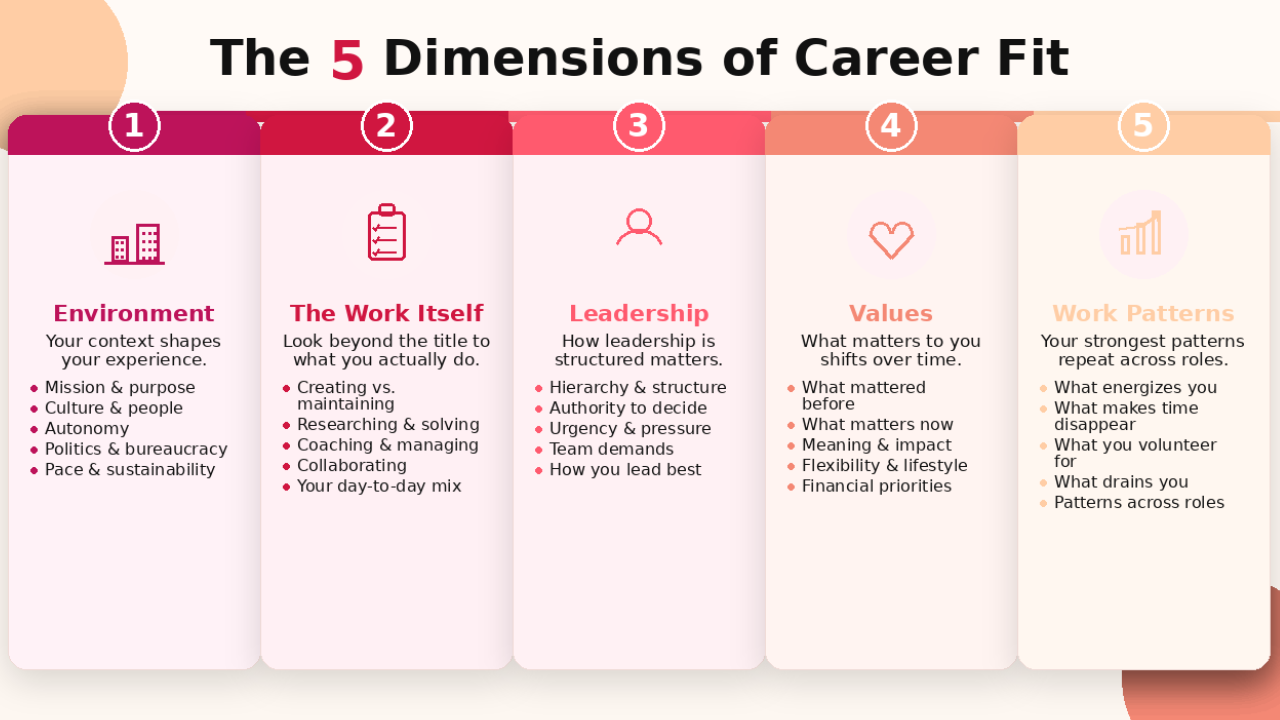
The Five Dimensions of Career Fit I Investigate When Burnout Signals Misalignment
When burnout might be connected to career misalignment, I'm not only asking:
"How can we reduce the stress?"
I'm asking:
"What has changed?"
Because careers aren't static.
The role that fit you ten years ago may not fit the person you've become today.
To understand that, I look across five dimensions.
1. Work Environment
Sometimes women think they need a completely different career when what they actually need is a different environment.
Does the company's mission still matter to you?
Does the culture energize you or drain you?
How much autonomy do you have?
How political is the organization?
Is the pace sustainable?
Are you spending your days navigating bureaucracy instead of creating value?
Two people can have the exact same job title and have completely different experiences because the environment is different.
2. The Work Itself
Then we look beyond the title.
What are you actually doing all day?
Creating?
Maintaining?
Researching?
Coaching?
Presenting?
Managing?
Problem solving?
Collaborating?
Many successful women realize they don't dislike their profession.
They dislike the ratio of work they're doing.
They've gradually drifted away from the work that gives them energy and into work that's simply expected because they're senior enough to do it.
3. Leadership Fit
This is one of the biggest misconceptions I see.
Women often tell me:
"I don't think I want leadership anymore."
Sometimes that's true.
But often it isn't.
What they actually dislike is a particular version of leadership.
Leading inside a rigid hierarchy.
Leading without enough authority to make meaningful changes.
Leading through constant urgency.
Leading teams while carrying impossible workloads.
Leadership isn't one thing.
There are countless ways to lead.
Until we separate leadership from the environment it's happening in, it's impossible to know whether leadership is actually the problem.
4. Career Values
What mattered to you fifteen years ago may not matter most today.
Maybe early in your career you valued prestige.
Now you value flexibility.
Maybe you once wanted to climb as quickly as possible.
Now you want meaningful impact.
Maybe financial security drove every decision.
Now you're asking yourself whether this is really how you want to spend the next decade.
Values evolve.
Your career needs to evolve with them.
5. Work patterns
This is where I often uncover the biggest breakthroughs.
Instead of focusing only on your current role, I look across your entire career.
What work has consistently energized you?
What kinds of projects have made time disappear?
What work have you repeatedly volunteered for?
When have you felt most alive?
And just as importantly—
What patterns have consistently drained you?
Because while industries, companies, and job titles change, your energizing work patterns are often remarkably consistent.
That's where career clarity begins.
What Career Misalignment Actually Looked Like for This Client
One client came to me convinced she wanted to leave leadership behind.
"I don't think I want leadership anymore," she told me.
But as we looked at her career, not just her current job, a different pattern emerged.
She still lit up when she talked about:
- Mentoring people.
- Coaching emerging leaders.
- Building a compelling vision.
- Bringing diverse stakeholders together.
- Researching complex problems.
- Learning something new.
- Creating strategy from the ground up.
Then we looked at what was draining her.
Not leadership.
Bureaucracy.
Rigid hierarchy.
Maintenance work.
Constant urgency.
Endless governance.
Carrying everyone else's problems without the time, resources, or authority to actually lead well.
She loved creating.
She loved building.
She loved collaborating.
What she no longer wanted was spending every day maintaining systems someone else had built while constantly reacting to the next urgent issue.
That distinction changed everything.
She didn't hate leadership.
She hated one specific configuration of leadership.
That's a far more useful conclusion because it gives you something concrete to build toward instead of simply running away from what you don't want.
How Career Clarity Became a Roadmap for Her Next Move
Once we understood what was actually draining her, the career search became dramatically easier.
Not because there was only one answer.
But because she finally had criteria.
Instead of scrolling through job boards hoping something would feel right, we translated her patterns into career-fit criteria.
Her next role needed:
- A collaborative culture rather than a rigid hierarchy.
- Strategy and creation instead of constant maintenance.
- Opportunities to mentor and develop people.
- Enough autonomy to shape the work.
- Space to research, learn, and solve meaningful problems.
- Less performative visibility.
- Less unnecessary urgency.
Then we built from there.
We identified the work she wanted to keep doing.
The work she no longer wanted her career built around.
Realistic role families.
Specific job titles.
Industries that aligned with her strengths.
Work environments where she was far more likely to thrive.
A transition strategy that leveraged decades of experience instead of throwing it away.
This is where many career assessments stop.
They tell you your strengths.
They tell you your personality.
They tell you what motivates you.
Those insights are helpful.
But they don't answer the question every successful woman eventually asks:
"What does this actually look like in the real world?"
That's where my work begins.
I decode the patterns across your career.
Together, we define your career-fit criteria.
Then I translate those patterns into realistic career directions that build on your experience rather than asking you to start over.
Finally, we create a strategic next move.
Instead of asking, "What should I do?"
You're evaluating several strong career directions against clear, evidence-based criteria.
That is career clarity.
Not certainty that one perfect job exists.
Confidence that you're making your next decision based on what genuinely fits you now.
Career Burnout Isn't Always Asking You to Rest
Sometimes it's asking you to rethink.
One of the biggest mistakes I see successful women make is trying to recover from burnout before understanding what's causing it.
If the root problem is career misalignment, more rest alone won't solve it.
You'll recover enough to go back into the same environment.
Then the cycle starts again.
That doesn't mean you automatically need to leave corporate.
It doesn't mean you have to become an entrepreneur.
It doesn't mean leadership is over.
And it certainly doesn't mean you've lost your ambition.
It may simply mean you've outgrown the version of your career you've been living.
The work that once energized you may have quietly shifted.
Your values may have changed.
Your strengths may no longer be fully utilized.
The environment may no longer support the way you do your best work.
Burnout can absolutely tell you that something needs to change.
But burnout doesn't tell you what.
Career clarity does.
If you've been asking yourself whether you're burned out, in the wrong role, or simply afraid to make another career mistake, you don't have to keep trying to figure it out alone.
That's exactly why I created my free 3-Part Live Masterclass: Burned Out... Now What?
In this live series, I'll show you why burnout makes career decisions so much harder than they need to be, how to tell whether you're experiencing burnout, career misalignment, or decision fatigue, and introduce my Career Capacity Framework, a practical approach to restoring your mental bandwidth before making your next career move. You'll also complete your own personalized Career Capacity Assessment, so you'll leave with a much clearer understanding of what's actually keeping you stuck.
If you've built a successful career that no longer feels right, wake up already exhausted, keep second-guessing your next move, or can't imagine doing this for another five years, this masterclass was designed for you.
Reserve your free seat today and take the first step toward understanding what your burnout is really trying to tell you, so you can make your next career move with clarity and confidence, not exhaustion.

About Career Coach & Author
Theresa White, Career Clarity Expert, 5x Certified Career Coach, and the Founder of Career Bloom, is known for her expertise in guiding people to get unstuck and find the direction they need to move forward in their careers—fast. In a time when so many people are re-evaluating their work, Theresa offers actionable insights that empower clients to identify their true strengths and pursue work that genuinely aligns with their goals.
Theresa’s clients often call her sessions “epiphanies” and “transformational.” She brings immediate clarity to career goals, helping people unlock a deep understanding of what makes work fulfilling for them. Past participants consistently describe her approach as “spot on” and an “answer to questions they’d been asking for weeks.”
Theresa’s approach is empathetic yet practical, and she’s known for empowering clients with a clear direction in as little as 30 days, guaranteeing results.
Connect with Theresa on LinkedIn, listen to the Career Clarity Unlocked Podcast, or schedule your free 30-minute career clarity consultation.

Career Burnout and Career Misalignment: Frequently Asked Questions
How do I know if I’m burned out or in the wrong career?
Burnout can come from an unsustainable workload, but sometimes the deeper problem is that the work, environment, or direction no longer fits you. Look at what is actually draining you: the volume of work, or the work itself, the culture, your level of autonomy, and how you spend most of your day. The goal is to understand what needs to change before assuming you need an entirely new career.
Should I change careers because of burnout?
Not necessarily. Burnout may mean you need a different workload or workplace, but it can also reveal that you’ve outgrown the type of work you’ve been doing. Before making a career change, get clear on whether you need a new company, role, industry, leadership path, or a different kind of work altogether.
Will changing jobs fix career burnout?
A new job can help if the primary problem is your current company, manager, culture, or workload, but it won’t automatically fix a career-fit problem. If you move without understanding what drained you in the first place, you can end up recreating the same experience in a different organization. Career clarity gives you specific criteria for evaluating your next move instead of simply choosing what looks better than the job you want to leave.
What Other Job Seekers Are Reading
Subscribe now to never miss the latest blog!
Every Thursday, we cover an important topic, actionable advice, and inspiring content to help you find work that makes you feel like *pinch me* I'm getting paid to do this???
We hate SPAM. We will never sell your information, for any reason.