
Remember when we were kids and everyone handed us the exact same golden rulebook for life?
It was beautifully simple: study hard, get the degree, land a stable job, work hard, keep your head down... and one day, you'd finally "make it."
So, we did.
We checked every single box. We took the entry-level grinds, survived on questionable amounts of caffeine, and put in the hours.
Somewhere along the way, I honestly believed there would be this magical milestone where everything would finally click. I told myself the next promotion would be the one. Or the next salary bump. I spent years chasing titles and bigger paychecks because I genuinely believed that once I "made it," the fulfillment would finally come.
Except it never really happened.
The fulfillment never came. The achievements did, but they always faded faster than I expected, leaving me with that same nagging feeling that something was still missing.
If you're a woman in your 30s or 40s sitting at your desk right now feeling completely stuck, exhausted, and wondering why the success you've built feels so empty, you aren't alone.
You're living through something that's becoming known as The Great Millennial Career Crisis.
Let's talk about how we got here, why doing everything "right" didn't deliver what we thought it would, and what to do if you're realizing the life you've worked so hard to build no longer feels like it fits.
Prefer to listen? Tune into the full episode here on Spotify.
What Is the Great Millennial Career Crisis?
Over the past year or so, I've noticed the phrase "The Great Millennial Career Crisis" popping up more and more. At first, I thought it was just another catchy headline. But the more I sat with it, the more I realized it perfectly describes what I've been hearing from clients for years.
This isn't simply about disliking your job.
It's about an entire generation arriving at a point in life where we're asking ourselves a question we never had time to ask in our twenties:
"Is this actually the life I wanted... or just the life I kept working toward because I thought I was supposed to?"
That question hits harder than most people expect because there isn't an obvious villain.
Your boss might actually be wonderful. Your team might be supportive. You might earn more money than you ever imagined you would when you were twenty-five. Your LinkedIn profile might look impressive.
And yet...
Every Sunday evening, that familiar feeling starts creeping in.
You catch yourself scrolling job boards without knowing what you're even looking for. You fantasize about quitting, then immediately panic because you have absolutely no idea what you'd do instead. You feel guilty for wanting more because, objectively, your life looks pretty good.
I've had hundreds of conversations with women who describe this feeling in completely different ways.
Some tell me they're burned out. Others say they're bored. Some feel trapped by the salary they've worked so hard to earn. Others have completely lost confidence in themselves.
But underneath every one of those conversations is the same question:
"Why doesn't success feel the way I thought it would?"
I honestly think that's the real millennial career crisis.
It's realizing that the version of success we spent decades chasing isn't the version of success that actually fulfills us.
We've reached the destination we spent years working toward, only to discover it doesn't feel the way we imagined it would.
And once that realization hits, it's incredibly difficult to ignore.

Why Millennials Feel Stuck After Doing Everything "Right"
I think one of the biggest misconceptions about millennials is that we rejected the traditional path.
Most of us didn't.
We embraced it wholeheartedly.
We went to university because everyone told us education was the safest investment we could make. We took on student loans because it was supposed to pay for itself. We accepted unpaid internships because we were told they would open doors. We worked late, answered emails on weekends, stayed loyal to employers, and kept telling ourselves that all the sacrifices would eventually be worth it.
The promise wasn't just that we'd build successful careers.
The promise was that we'd build successful lives.
For a while, that equation seemed to make sense.
Work hard. Get promoted. Earn more. Buy the house. Build wealth. Feel secure.
Simple.
Except somewhere along the way, the equation stopped working.
Many of us graduated into the aftermath of the Great Recession. Just as our careers started gaining momentum, housing prices climbed beyond what many first-time buyers could realistically afford. Student debt followed us well into adulthood. The cost of living continued rising faster than salaries in many parts of the world. Stable companies started announcing mass layoffs like clockwork. Now artificial intelligence is reshaping industries so quickly that even experienced professionals are wondering what their careers will look like ten years from now.
Meanwhile, life didn't slow down.
If anything, it became more expensive and more complicated.
Many millennials are now raising children while simultaneously helping aging parents. We're expected to be high performers at work, emotionally present at home, financially responsible, physically healthy, constantly learning new skills, and somehow still find time for self-care.
Honestly...
I'm exhausted just typing that sentence.
When people ask why millennials seem so burned out, I don't think the answer is that we're less resilient than previous generations.
If anything, I think we're one of the most adaptable generations. We've navigated recessions, rising housing costs, student debt, mass layoffs, and now AI reshaping the workplace. Every time the world changed, we changed with it.
I think the problem is that we've spent years adapting to a world that kept changing while still measuring ourselves against a definition of success that was created for a completely different one.
That's an impossible standard to live up to.
And it's one of the biggest reasons so many accomplished women find themselves wondering:
"What if this isn't actually the life I want anymore?"
The irony is that by the time many of us finally ask that question, we've already built entire careers around an answer we gave when we were twenty-two.
And that's where things get really interesting.
Because the biggest reason so many women feel stuck today isn't simply burnout.
It's that somewhere along the way, we became incredibly good at jobs we never intentionally chose for the long haul.
We Became Really Good at Jobs We Never Meant to Keep
I see this all the time.
Someone graduates into a shaky job market, takes the first decent opportunity they can find, and tells themselves, "I'll do this for a year or two while I figure out what I actually want."
Then life happens.
You get good at the job.
Really good.
Your manager notices, so you get promoted. Your salary goes up. People start relying on you. Before you know it, you've built an entire professional identity around something you never consciously chose in the first place.
Ten years later, you're introducing yourself as someone who works in compliance, project management, finance, operations, HR, or marketing, even though if someone had asked twenty-three-year-old you, "Is this what you want to spend your life doing?" the answer probably would've been, "I have no idea."
The strange part is that success makes this trap even harder to recognize.
When you're good at something, people keep giving you more of it. More responsibility. More visibility. More promotions. More reasons to stay exactly where you are.
Eventually you stop asking whether you actually enjoy the work because everyone keeps reinforcing that you're excellent at it.
One of the biggest lessons I've learned, both personally and from coaching hundreds of women, is that competence and fulfillment are two completely different things.
Just because you're capable of doing something doesn't mean it's where you're meant to spend the next twenty years of your life.

Success Became a Pair of Golden Handcuffs
If changing careers were as simple as deciding to do something different, far more people would do it.
But by the time most women come to me, they're not twenty-five anymore.
They have mortgages. Or rent that somehow costs more than their first annual salary. Student loans that still haven't disappeared. Children who depend on them. Parents who are starting to need more support. Retirement accounts they've spent years building. Health insurance they can't afford to lose.
When someone casually says, "Why don't you just quit?" I honestly laugh.
Quit and do what?
This is where so much career advice completely misses the mark.
The internet loves telling people to "follow their passion," as though everyone has the financial flexibility to walk away from a six-figure income and start over from scratch.
Life isn't that simple.
By this stage, career decisions aren't just about finding work you enjoy. They're connected to your family, your finances, your future, and the people who depend on you. Walking away isn't impossible, but it isn't a decision most people can make on impulse either.
That's why I don't believe in blowing your life up in search of fulfillment.
I believe in making strategic, intentional career moves that respect both your ambitions and your reality.
Signs of Career Burnout: Why It Is Not Always About Long Hours
One statistic kept confirming everything I'd already been hearing from clients while I was researching this article.
Around 70% of millennials report experiencing burnout.
That's an astonishing number.
But burnout doesn't always look the way we think it does.
Sometimes it's exactly what it sounds like. You're working too many hours, carrying too much responsibility, and your nervous system is waving a giant white flag.
But sometimes burnout comes from something much harder to recognize.
It's spending eight hours a day solving problems you no longer care about. It's constantly shrinking yourself to fit into a role you've quietly outgrown. It's waking up every Monday knowing you can absolutely do your job... you just don't want to anymore.
That kind of burnout isn't caused by working harder.
It's caused by working out of alignment for too long.
I've had clients tell me they took a two-week vacation and felt just as drained the day they came back as the day they left.
That isn't because the vacation wasn't long enough.
It's because you can't recover from a career that no longer fits by taking a temporary break from it.
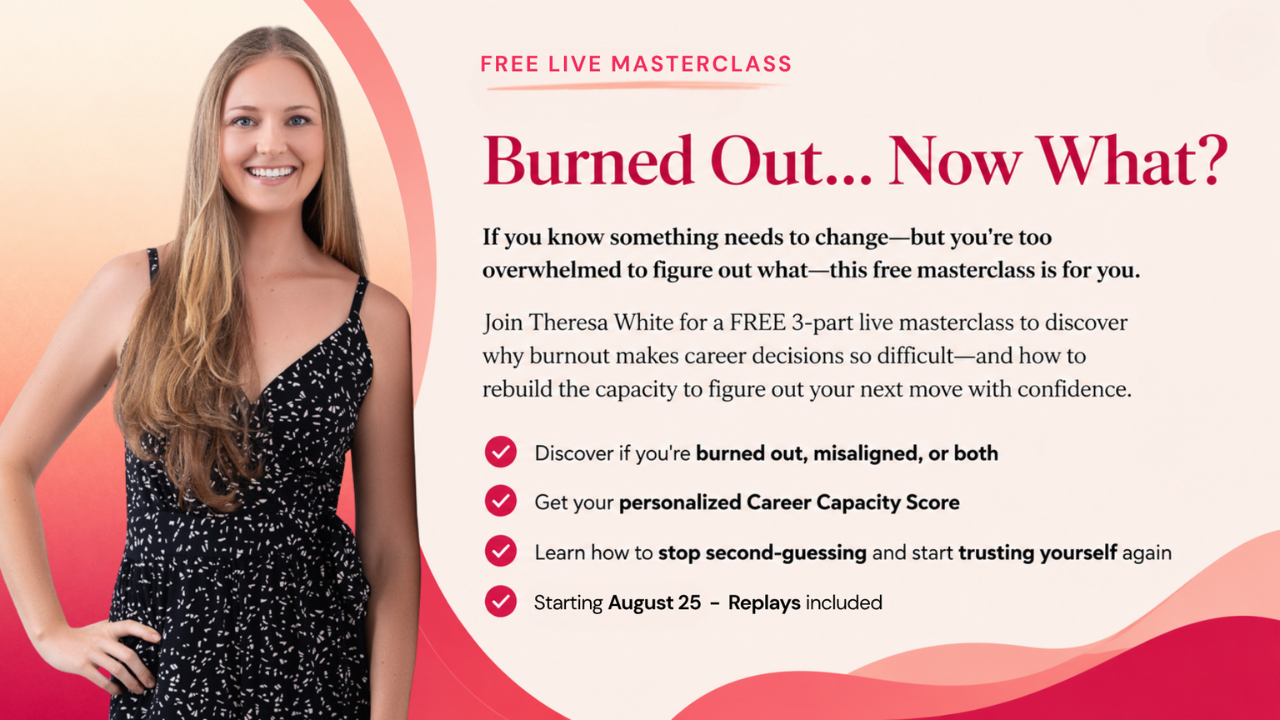
Feeling burned out and unsure what comes next? Click here to join my free Burnout, Now What? Masterclass and learn how to move forward with clarity.
We've Been Delaying Our Lives While Waiting to Feel Like We've "Made It"
This is probably the part that hits me the hardest.
So many millennials have spent years postponing life because we genuinely believed we were building toward something.
I'll travel once I get promoted.
I'll buy the house once I earn a little more.
I'll start the family once work settles down.
I'll slow down after this next project.
I'll be happier once...
There's always another milestone. Another goal. Another finish line.
And before you know it, you're forty years old wondering when exactly you were supposed to start enjoying the life you've been working so hard to build.
I don't say that to be depressing. I say it because I lived some version of it myself.
I spent years believing fulfillment was waiting for me somewhere in the future. If I could just accomplish one more thing, I'd finally arrive.
But fulfillment doesn't magically appear because your LinkedIn headline changed. It doesn't arrive with a bigger office, a better title, or another line on your résumé.
If anything, I've found the opposite.
The women who seem happiest aren't necessarily the ones making the most money or climbing the fastest.
They're the ones whose careers actually fit the life they're trying to build.
The Great Millennial Career Crisis Is Actually an Identity Shift
The more I've thought about it, the less I think this is just a career crisis.
I think it's an identity shift.
The version of you who chose your career at twenty-two isn't the same woman reading this article today.
You've lived.
You've lost people.
You've built relationships.
You've discovered what matters and what doesn't.
Your values have changed.
Maybe you used to care about prestige. Now you care about flexibility.
Maybe you used to chase promotions. Now you crave peace.
Maybe you used to measure success by your salary. Now you're measuring it by whether you have enough energy left to enjoy your family at the end of the day.
That doesn't make you less ambitious.
It makes you more self-aware.
And I think that's the real turning point.
Because once you stop asking, "How do I keep climbing?" and start asking, "What kind of life am I actually trying to build?" everything starts to change.
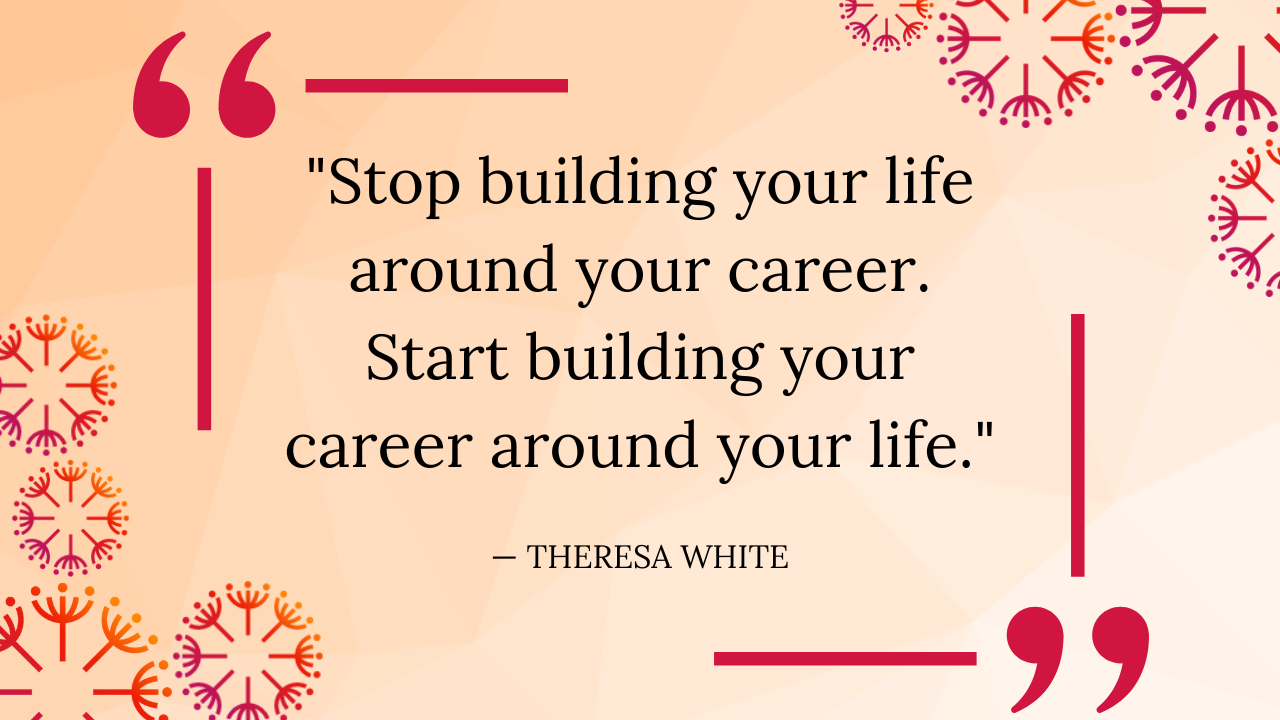
You stop building your life around your career.
You start building your career around your life.
So... Where Do You Go From Here?
If you've made it this far, you might be thinking,
"Okay... this is me. Now what?"
The first thing I want to say is this:
Please don't read this article and immediately hand in your resignation tomorrow morning.
Seriously.
There are absolutely situations where leaving quickly is the right decision, especially if your health, safety, or well-being are on the line.
But for the vast majority of women I work with, that's not where we start.
We start with clarity.
I know that might sound strange coming from someone who helps women navigate career changes, but I've never believed that making a huge life decision from a place of frustration is the right move.
When you have clarity, you stop making impulsive decisions and start making intentional ones. You stop running away from something and start moving toward something that actually fits the life you're trying to build.
Because without clarity, it's incredibly easy to leave one job... and unknowingly recreate the same burnout in a different company, a different role, or even a completely different industry.
The goal isn't simply to change jobs. It's to find the right job.
One that's aligned with who you are today, not who you were ten or fifteen years ago.
How to Navigate the Millennial Career Crisis and Reclaim Your Power
1. Stop Designing Your Career. Start Designing Your Life.
This is where almost everyone starts in the wrong place.
They open LinkedIn.
Search job titles.
Scroll.
Apply.
Repeat.
Instead, grab a blank piece of paper and forget about work for a moment.
Ask yourself:
→ What time do I want to wake up?
→ How much flexibility do I want?
→ Do I want to lead people or simply do meaningful work?
→ Do I want to travel? Work remotely? Finish at 5:00?
→ How much money do I actually need, not just want, to feel secure?
Only after you've designed the life...
...should you design the career that supports it.
Because careers are meant to serve your life.
Not the other way around.
2. Separate What You're Good At From What Gives You Energy
This is the exercise I give almost every client.
Draw a line down the middle of a page.
Skills That Drain Me
- Leading meetings
- Managing projects
- Solving crises
- Training new hires
Skills That Give Me Energy
- Coaching people
- Writing
- Problem solving
- Building new ideas
Now compare the lists.
You'll probably notice something surprising.
Some of the things you're best at might also be the things that leave you feeling the most drained.
The goal isn't finding a job you're good at.
The goal is finding the overlap.
Skills + Energy = Sustainable Success.
Just because you can do something for forty hours a week doesn't mean you should.
3. Audit Your Burnout Before You Change Your Career
Not all burnout comes from the same place.
Ask yourself:
□ Am I burned out because I'm working too much?
□ Because I'm doing work that no longer fits me?
□ Because of my manager?
□ Because of the culture?
□ Because I've simply outgrown this chapter?
Those answers lead to completely different solutions.
Changing companies won't fix misalignment.
Taking a vacation won't fix a toxic boss.
And quitting your job won't fix burnout caused by never setting boundaries.
Diagnose the problem before you prescribe the solution.
4. Get Curious Before You Get Courageous
You don't need courage first.
You need information.
Before making a career change, try to have:
→ 5 conversations with people doing work that interests you.
→ Listen to 3 podcasts about that industry.
→ Read 2 books.
→ Take 1 class.
Notice what happens.
Every conversation replaces fear with information.
Every step makes the next one feel smaller.
Confidence isn't something you wait for.
It's something you build.
5. Write Your Own Definition of Success
I think this might be the most important step of all.
For years, my definition of success came from somewhere else.
It came from school.
From society.
From people who genuinely wanted the best for me but couldn't possibly know what would make me feel fulfilled.
Eventually, I realized I wasn't chasing my definition of success.
I was chasing someone else's.
So I'd love for you to ask yourself one simple question:
"What does success actually look like for me?"
Not for your parents.
Not for your coworkers.
Not for LinkedIn.
For you.
Maybe success means:
- Leading a global team.
- Working four days a week.
- Being home for dinner with your family every night.
- Working remotely so you have more freedom.
- Earning enough money to finally stop worrying about money.
- Leaving a toxic workplace without taking a pay cut.
- Building your own business.
Or maybe your answer looks completely different.
That's the point.
Success isn't one thing.
For one woman, it's leading a global team.
For another, it's having the flexibility to be there when her kids get home from school.
For someone else, it's finally having peace of mind after years of financial stress.
None of those definitions are wrong.
The mistake is assuming success should look the same for everyone.
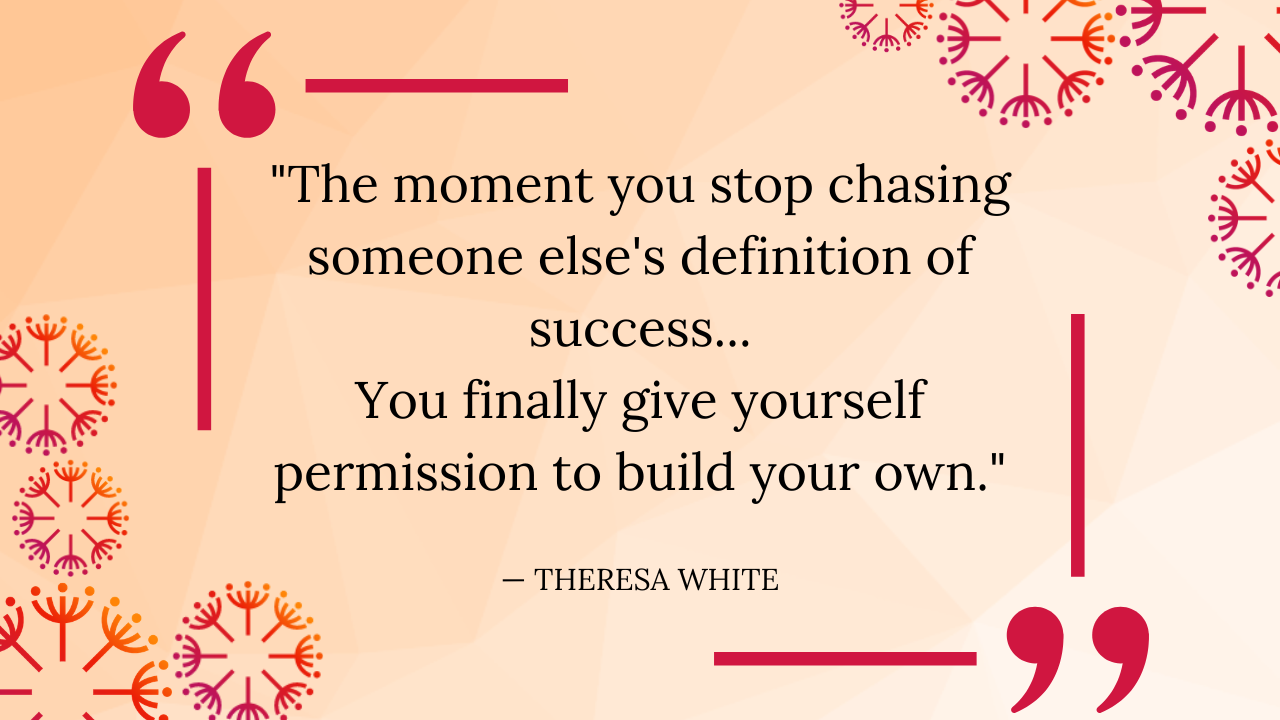
Because the moment you stop chasing someone else's definition of success...
You finally give yourself permission to build your own.
Ready to Figure Out What Comes Next?
If you've made it this far, there's a good chance at least one part of this article felt uncomfortably familiar.
Maybe you've realized you're burned out.
Maybe you've outgrown the career you once worked so hard to build.
Or maybe, for the first time in a long time, you've started asking yourself different questions.
Whatever brought you here, I want you to know this:
You don't have to figure it out alone.
One of the biggest misconceptions about career change is that you need to have the entire plan before you take the first step.
You don't.
You just need enough clarity to know where to step next.
That's exactly why I created my Burnout, Now What? Masterclass.
Inside, I'll help you understand what's really behind your burnout, get clear on what needs to change, and start figuring out what your next chapter could realistically look like.
The goal isn't simply to escape burnout. It's to build a career and life that actually fit who you are now.
One that's aligned with your strengths, your goals, and your definition of success.
If you're feeling burned out, stuck, and wondering what comes next, I'd love to help.
Join me for the free Burnout, Now What? Masterclass, and let's start figuring out your next step together.

About the Author: Theresa White, Career Clarity Expert and Coach
Theresa White, Career Clarity Expert, 5x Certified Career Coach, and the Founder of Career Bloom, is known for her expertise in guiding people to get unstuck and find the direction they need to move forward in their careers, fast. In a time when so many people are re-evaluating their work, Theresa offers actionable insights that empower clients to identify their true strengths and pursue work that genuinely aligns with their goals.
Theresa’s clients often call her sessions “epiphanies” and “transformational.” She brings immediate clarity to career goals, helping people unlock a deep understanding of what makes work fulfilling for them. Past participants consistently describe her approach as “spot on” and an “answer to questions they’d been asking for weeks.”
Theresa’s approach is empathetic yet practical, and she’s known for empowering clients with a clear direction in as little as 30 days, guaranteeing results.
Connect with Theresa on LinkedIn, listen to the Career Clarity Unlocked Podcast, or schedule your free 30-minute career clarity consultation.

Frequently Asked Questions About the Millennial Career Crisis
What is the millennial career crisis?
The millennial career crisis describes the growing number of professionals who have achieved traditional career success but still feel unfulfilled, burned out, or unsure of what's next. Many millennials followed the "work hard and you'll make it" blueprint, only to discover that promotions, titles, and salary alone don't guarantee fulfillment.
Why do so many successful millennials feel unfulfilled at work?
Feeling unfulfilled doesn't necessarily mean you're in the wrong career or that you've failed. For many millennials, priorities have shifted over time. What felt like success at twenty-two may no longer align with the person you've become, making it natural to question what's next.
Is it too late to change careers in your 30s or 40s?
Absolutely not. In fact, many people make their most successful career changes after they've built years of experience. The key isn't starting over, it's leveraging the skills, strengths, and insights you've already developed to move into work that better aligns with your goals and definition of success.
What Other Job Seekers Are Reading
- What to do when you're feeling stuck in career
- How to Find Your Perfect Career
- 8 progressive companies to work for
- 7 Message Templates to Reach Out to Recruiters
- Free Job Search Tracker
Get Career Clarity In Just 30 Days! Take this 60 second quiz to see if a free career clarity call with my team is your next best step.
Subscribe now to never miss the latest blog!
Every Thursday, we cover an important topic, actionable advice, and inspiring content to help you find work that makes you feel like *pinch me* I'm getting paid to do this???
We hate SPAM. We will never sell your information, for any reason.