If you’re feeling overwhelmed at work right now, stressed, exhausted, or like you’re somehow letting down your family and your job at the same time… I want you to hear me clearly:
You are not failing.
You’re human, it’s December, and this season stretches us in every possible direction.
Every year around this time, my clients ask the same questions:
- “How do I deal with all this work pressure before the holidays?”
- “How do I stop feeling guilty for saying no?”
- “How do I know if I’m burnt out or just tired?”
- “How do I stop feeling like I’m letting down everyone, at home and at work?”
And every year, the emotional weight seems a little heavier. This year especially, I’m hearing more people talk about something we’re calling quiet cracking, that moment where it’s not full burnout yet, but something inside you is starting to fracture.
If that’s you, don’t ignore it.
In this blog, I’ll walk you through exactly how to navigate holiday work stress, prevent burnout, and reclaim some joy (and sanity) during a time that’s supposed to feel magical, not miserable.
1. Holiday Work Stress or Burnout? How to Recognize the Warning Signs in Your Body
There’s a difference between normal end-of-year stress and actual burnout, and your body is usually the first to tell you which one you’re dealing with.
Normal stress looks like this:
- A stressful day
- Something goes wrong
- You come home
- You have dinner
- You sleep
- You wake up refreshed
That’s normal. That’s life.
Burnout looks very different:
- You can’t be present with your family
- You lie awake at night replaying the day
- Your stomach hurts for no reason
- Your shoulders are so tight your back aches
- You wake up exhausted
- And this becomes a pattern
If your body is saying, “No. Enough. Stop,” it means you crossed the threshold between “a stressful season” and “something is breaking inside of me.”

Quiet cracking is real. And it’s your warning sign.
Before burnout happens, your body whispers. If you ignore it, it starts shouting.
Brené Brown, a leading researcher on burnout and resilience, puts it beautifully: “The antidote to overwhelm appears to be nothingness or ‘non-doing’ time.”
When she feels overwhelmed, she tells herself, “I need 10–15 minutes of non-doing.”
Sometimes we don’t need to push harder. We need 15 minutes of walking around the parking lot.
It sounds simple, almost too simple, but this small habit can stop quiet cracking before it becomes a complete burnout event.
2. You Are Human, Not Superhuman: Why You Can’t Do Everything in a 24-Hour Day

Let me tell you something you already know but probably haven’t internalized:
You are not superhuman.
Your day has 24 hours.
Your body requires sleep… ideally eight of them.
That leaves you with about 16 hours of awake time. And within those 16 hours, you are trying to squeeze:
- full-time work
- childcare
- partner responsibilities
- housework
- holiday shopping
- social events
- cooking
- cleaning
- emotional labor
- self-care
- the invisible load
- and maybe, if you’re lucky… rest
There is no version of this that adds up.
There is no reality where you meet every expectation without something breaking, usually your energy, your patience, or your health.
We cannot stretch time.
We cannot be everything to everyone.
And we cannot say “yes” to every request without saying “no” to ourselves.
Every yes you give out of guilt, fear, or pressure becomes a withdrawal from your own well-being. And that bill always comes due, as exhaustion, quiet cracking, or full burnout.
You’re human.
And during seasons like this, boundaries aren’t optional. Boundaries are survival.
Related Read: Quiet Cracking vs. Quiet Quitting
3. Use the Eisenhower Matrix to Bring Order to the Holiday Chaos
One of my absolute favorite tools, and one of the most practical during December, is the Eisenhower Matrix. It is simple, visual, and especially powerful during a season when everything feels urgent and important all at once.
This framework helps you sort every task into four clear quadrants:
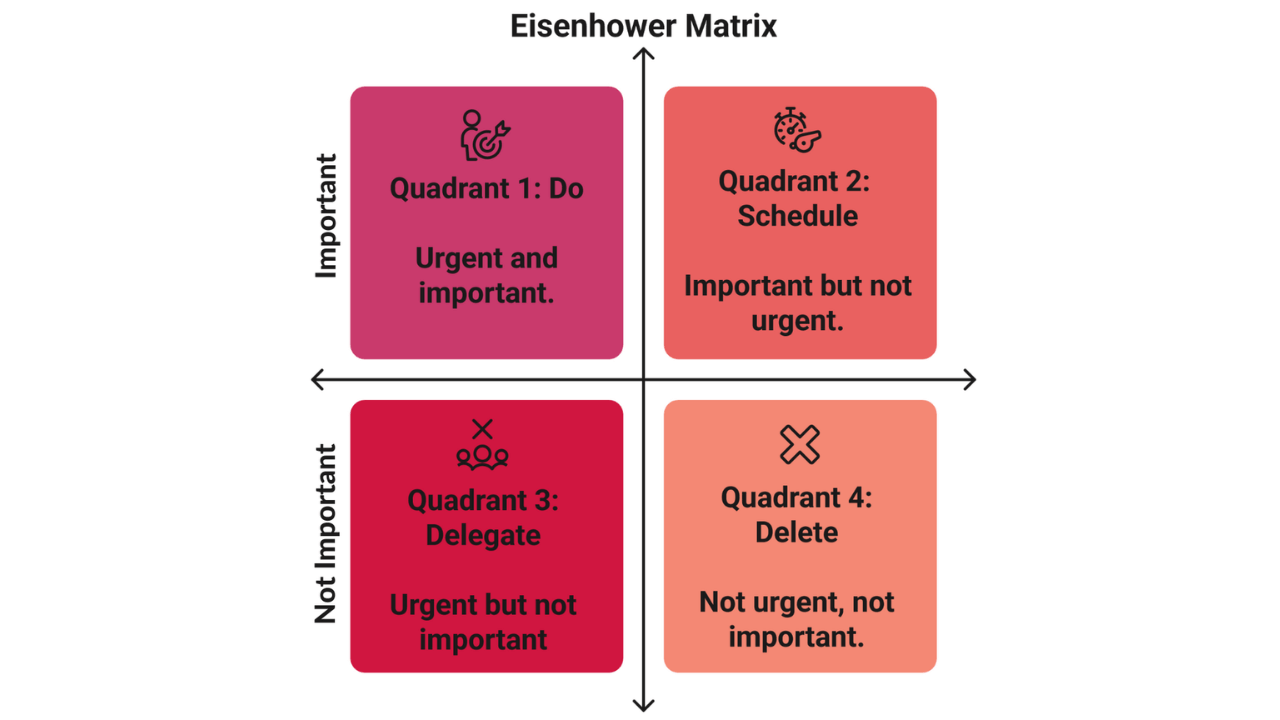
It helps you categorize your tasks into four quadrants:
Quadrant 1: Do
Urgent and important.
These are the things that truly must get done now. The non-negotiables.
Quadrant 2: Schedule
Important but not urgent.
These matter for your long-term goals, but they don’t need to happen today.
Schedule them for after the holidays or into Q1.
Quadrant 3: Delegate
Urgent but not important to you.
These tasks do not require your unique skill set. Someone else can do them.
Quadrant 4: Delete
Not urgent, not important.
These tasks pretend to matter, but they don’t. Release them without guilt.
Just writing everything down, seeing it on paper, and sorting what belongs where can bring instant relief. It gives your brain an organized filing system instead of one overwhelming, tangled list.
And if leadership keeps piling on more and more “urgent” tasks, show them your matrix and ask:
“Here’s everything I’m responsible for. Which of these do you want me to push to next week so I can take on this new priority?”
You’re not being difficult.
You’re not being unhelpful.
You are inviting them into problem-solving instead of quietly drowning.
Most managers do not realize how much you are carrying until you show them clearly.
If all this holiday stress has you questioning what you truly want next in your career, my Career Clarity Advent Calendar can help you figure that out in the simplest way possible. It’s completely free, and for 24 days you’ll receive one quick, 60-second prompt to help you reconnect with what you actually want, not what you think you should want. By the end of the season, you’ll have meaningful clarity you can turn into action just in time for the biggest hiring months of the year. Join the free Career Clarity Advent Calendar

4. Use the Post-It Rule to Reduce Stress and Improve Focus: 3 Tasks Per Day
Another tool I personally swear by (especially during hectic seasons) is the Three Things Rule.
At the start of your workday, take a post-it note and write down the three things that make the day a success.
Not ten.
Not eight.
Not your entire to-do list.
Just three.
If you get these three things done, your day is a win. Everything else can wait until tomorrow.
Here’s why this works:
- When we try to do too much, we end the day feeling like failures.
- When we focus on three things, we end the day feeling accomplished.
- It gives your brain a finish line.
- It stops you from equating productivity with worth.
- It actually increases quality because you’re focused on what matters.
And you can do this at home, too.
Three things:
- Pick up the kids
- Play for 15 minutes
- Do 1 load of laundry
Done. A successful evening.
Three things again:
- Do the dishes
- Pick up the kids
- Read a bedtime story
Done.
Instead of beating yourself up for not doing the dishes, decorating perfectly, answering every email, or finishing the laundry, you celebrate the fact that you did your top three, the things that mattered most.
This is how you stop feeling like you’re letting down everyone.
You stop judging your days by impossible standards.

5. Listen to Your Body Before You Say Yes (Or No)
When someone asks you to do something, attend a party, take on extra work, or volunteer for something, pause and notice your body’s reaction.
Your body knows the answer before your mind rationalizes it.
If your immediate reaction to a holiday party invite is:
- “Oh God, no.”
- “Ugh, these are not my people.”
- “I feel like I should go, but I really don’t want to.”
Your body just told you the truth.
Honor it.
And on the flip side, if something lights you up (for example, “I’d love to take my kids on that trolley ride to see the Christmas lights!”), that is your yes.
Let your body guide your boundaries.
You don’t need to justify it.
You don’t need to explain it.
You don’t need to apologize for it.
You’re human. Your energy matters.
6. You Are Not Letting People Down, You're Expecting Too Much of Yourself
One of the biggest reasons people feel overwhelmed this time of year is because they’re holding themselves to standards no human could meet.
You expect yourself to:
- excel at work
- be emotionally available
- be the holiday magic maker
- prepare gifts
- be patient
- keep the house clean
- be the perfect partner
- attend every event
- and maintain your health
And when you inevitably can’t achieve all of that, you tell yourself you’re “letting people down.”
No… you’re doing too much.
No one can meet those expectations.
When you shift the lens from “everything I didn’t do” to “the three things I did do,” everything changes.
You get to end the day feeling proud, not ashamed.

7. Learn the Early Warning Signs Your Body Uses to Signal Stress
Jonathan Fields, the author and creator of The Good Life Project, teaches the idea of identifying your “circuit breakers,” which are the internal signals that show you have reached your limit.
For some people, it’s insomnia.
For others, headaches.
For others, irritability, anxiety, stomach pain, back tightness, and constant exhaustion.
What are yours?
Your body is having a conversation with you every day.
Your only job is to listen.
When your body says:
- “This is too much.”
- “Slow down.”
- “I can’t do this today.”
Honor it before it turns into quiet cracking.
SLOW DOWN
8. Your Worth Is Not Tied to Your Performance
Let me be blunt:
If your worth disappears the moment you stop being useful to others, that wasn’t love, that was a transaction.
Brené Brown says it beautifully, and it’s something I wish everyone could internalize:
Your worth does not increase when you give more.
Your worth does not decrease when you give less.
Your worth simply is.
And here’s the proof:
Some of the worst, most ineffective managers I’ve ever seen get promoted over and over again, not because of their performance, but because of politics, relationships, or simply being loud.
Meanwhile, the quiet, hardworking woman who does everything right but never talks about her accomplishments? She doesn’t get promoted.
So no, performance is not your worth.
And performance is not what determines visibility inside a company.
Visibility comes from politics.
Worth comes from being human.
And those two things were never meant to be the same.
9. Take Time Off, Even If Work Is Busy
You need to hear this:
Take your time off. Period.
I’ve coached people who worked 10+ years at a company, loyal, dedicated, hardworking, constantly going above and beyond. And when layoffs came? They were let go.
Not because they didn’t work hard.
Not because they didn’t sacrifice.
But because companies care about profits, not loyalty.
Your employment is an exchange:
40 hours/week of your time, skills, and expertise
in exchange for a paycheck.
That’s it.
Don’t care more about the company than the company cares about you.
Take your time off.
Spend time with the people who love you.
Make memories you’ll cherish.
Rest because your body needs it.
A year from now, what will you remember?
Will you say,
“I’m so glad I stayed late every night that week to finish that project!”
Probably not.
But will you remember,
I’m so grateful I took that week off and spent it with my kids doing magical holiday things”?
Absolutely.
Those are the moments that matter.
Make more of those.

10. You Are Not Starting Over, You Are Starting From Experience
If all of this holiday stress has you questioning your job, your career, or your field, let me tell you:
You’re not starting over. You’re starting from experience.
One of my favorite tools for figuring out whether you’re exhausted or truly in the wrong field is the Good Day / Bad Day Jar.
- If you consistently have zero or one “good day” coin per week?
You need a change. - If most weeks show three or four good days?
You might just be in a stressful season.
And right now, December, is actually the perfect time to explore a career shift. Not to job hunt immediately, but to get clear on what you want.
Because January and February are massive hiring months, and by then you want to know exactly what direction you’re moving toward.
If all this stress has you questioning your next step, whether you’re simply overwhelmed or truly ready for a career change, my Career Clarity Advent Calendar can help you find that clarity. It’s completely free, and over 24 days you’ll get one simple, 60-second prompt delivered each day to help you reconnect with what you actually want. By the end of the holiday season, you’ll have meaningful insights you can turn into action — just in time for the biggest hiring months of the year.

You Deserve More Ease Than You’re Allowing Yourself
The holidays are supposed to be a season of connection, joy, reflection, and rest. But for so many people, especially high achievers, caretakers, leaders, people-pleasers, and people with families, December becomes a pressure cooker.
It doesn’t have to be this way.
Take three moments today:
- Look at what your body is telling you.
- Choose the three things that matter most today.
- Give yourself permission to say no, without guilt.
And then ask yourself:
A year from now, what will I be grateful I chose today?
Make decisions from that place.
Because you are worthy.
You are human.
And you deserve a holiday season that feels good in your body, your mind, and your heart, not one that breaks you.
This is your life. Claim the peace you deserve and write your own beautiful story.
FAQs: Quiet Cracking, Holiday Work Stress, and Burnout
Is holiday work stress normal or a sign of burnout?
Holiday work stress can be normal in short bursts. It becomes a problem when the stress does not reset after rest, sleep, or time off. If the stress lingers, affects your health, or makes you feel disconnected from your life, it may be quiet cracking or burnout.
How can I say no to my manager without damaging my career?
You can confidently say no to a manager by using a prioritization-based approach rather than simply giving a refusal. This is often called a "Positive No" or a strategic pushback.
Acknowledge and Validate: Start by showing you value the request: "Thank you for thinking of me for this."
State Your Priority: Clearly present your current workload as a boundary. Use the Eisenhower Matrix to show what you are already working on.
Invite Collaboration: Ask the manager to make the choice: "I have three high-priority items currently. Which of these should I postpone until next week so I can take on this new priority?"
This method shifts the burden of prioritization back to leadership, allowing you to set a boundary while demonstrating you are a problem-solver focused on impact, not just a difficult employee.
About Career Coach & Author
Theresa White, Career Clarity Expert, 5x Certified Career Coach, and the Founder of Career Bloom, is known for her expertise in guiding people to get unstuck and find the direction they need to move forward in their careers—fast. In a time when so many people are re-evaluating their work, Theresa offers actionable insights that empower clients to identify their true strengths and pursue work that genuinely aligns with their goals.
Theresa’s clients often call her sessions “epiphanies” and “transformational.” She brings immediate clarity to career goals, helping people unlock a deep understanding of what makes work fulfilling for them. Past participants consistently describe her approach as “spot on” and an “answer to questions they’d been asking for weeks.”
Theresa’s approach is empathetic yet practical, and she’s known for empowering clients with a clear direction in as little as 30 days, guaranteeing results.
Connect with Theresa on LinkedIn, listen to the Career Clarity Unlocked Podcast, or schedule your free 30-minute career clarity consultation.

What Other Job Seekers Are Reading
- What to do when you're feeling stuck in career
- How to Find Your Perfect Career
- 8 progressive companies to work for
- 7 Message Templates to Reach Out to Recruiters
- Free Job Search Tracker
- Get Career Clarity In Just 30 Days!
Subscribe now to never miss the latest blog!
Every Thursday, we cover an important topic, actionable advice, and inspiring content to help you find work that makes you feel like *pinch me* I'm getting paid to do this???
We hate SPAM. We will never sell your information, for any reason.