You’ve probably felt it lately.
The headlines scream about job losses, wars, oil prices, and “stagflation.” Your LinkedIn feed is full of layoffs and “open to work” banners. And somewhere between refreshing your inbox and bracing for another Monday, you might be thinking:
“Is now the worst possible time to make a change?”
“Am I crazy for wanting more when I should just be grateful I have a job?”
If those thoughts have crossed your mind, this blog is for you.
As a career coach who works with 40‑something professional women every day, I want you to hear this clearly:
You can absolutely use a weak job market to your advantage.
You will not be starting over.
And you do not have to choose between stability and fulfillment.
In fact, this moment may be the best opportunity you’ve had in years to reposition yourself for the next decade of your career.
Let’s talk about how.
Prefer to listen? Tune in on Career Clarity Unlocked.
What’s Actually Happening in the Job Market Right Now
You don’t need another jargon-filled breakdown of the economy, so here’s the plain-language version.
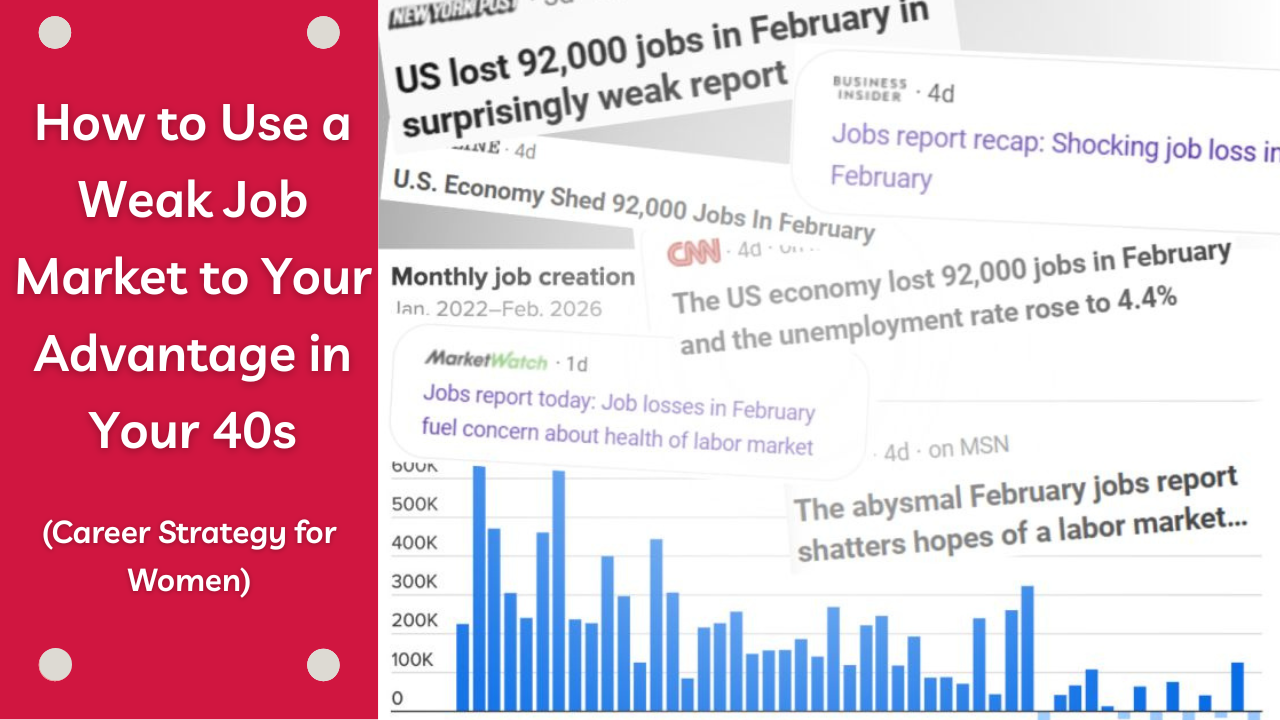
Recently, the U.S. economy lost 92,000 jobs in a single month instead of adding them. Unemployment ticked up. Fewer people are even counted as looking for work. Revisions to previous months show the end of last year was weaker than we thought.
Net‑net: hiring has basically been flat for months.
We’re not in a full‑blown collapse, but we’re definitely in a stall.
Underneath the headlines:
- Some sectors (like manufacturing, parts of tech, parts of government) are shedding jobs.
- Health care and health‑adjacent fields are still long‑term engines of growth, even if they hit temporary bumps.
- Companies are cautious. They’re not hiring wildly. They’re being picky, moving slowly, and obsessing over cost control and productivity.
- AI and automation are reshaping roles, especially mid‑level, process‑heavy work.
So yes, the market is tougher than it was a few years ago.
But here’s the part most people miss:
In every slowdown, there are winners and losers.
And 40-something women with a decade or more of experience?
You are absolutely not destined to be in the losing group.

Who This Advice Is Really For: Mid-Career Women Ready for a Change
Let me paint a picture. See if this feels like you.
You’re a 40‑something professional woman. You’ve got a bachelor’s degree and 10+ years of experience. You’re making around $125,000. On paper, you did everything “right.”
You climbed the ladder. You became the reliable one. The high achiever. The person people depend on.
And yet…
- Your work feels misaligned, boring, or meaningless.
- You’re drained, not energized, at the end of the day.
- You feel underutilized, like you’re using 40% of your potential on a good day.
- Sunday nights feel heavy. You wake up thinking about work and not in a good way.
- You catch yourself thinking, “Eight hours a day can’t just be… this. For the next 20 years.”
You’re ambitious and optimistic. You want to make an impact. You love learning. You know you’re capable of more.
You also:
- Don’t want to start over.
- Don’t want to take a big pay cut.
- Don’t totally know what you want to do next.
- Feel awkward about networking because you want it to be genuine, not transactional.
- Are a little terrified of giving up “secure” misery for the unknown.
That tension between the safety of what you know and the pull toward something more aligned is exactly where my clients are when they find me.
And here’s what I want you to know:
Feeling stuck, confused, and burned out does not mean you’re ungrateful or behind.
It means you’ve outgrown an old chapter.
The question isn’t “Should I want more?” It’s “How do I go after more strategically in this kind of market?”

Why a Weak Job Market Can Actually Work for You
It sounds counterintuitive, but a slower market can actually work in favor of women in their 40s who are ready to pivot.
Here’s why.
1. Companies need adults in the room
When things are uncertain, companies lean heavily on people who bring:
- Judgment
- Pattern recognition
- Emotional intelligence
- The ability to lead others through change
Those qualities typically come from experience, not entry-level talent.
In other words:
You’re not a risk.
You’re often the stabilizing force companies are looking for.
2. The Most Valuable Roles Right Now Fit Your Strengths
In this market, the hottest roles are not always the flashiest. The winners are the roles that reduce risk and increase stability, such as:
- Learning & Development and leadership development
- Manager enablement and coaching
- Organizational effectiveness
- HR Business Partner / People Operations
- Change management
- Internal strategy and transformation
Why?
Because companies need to:
- Do more with less
- Retain top people
- Help managers lead in chaotic times
- Integrate AI and new tools without breaking trust or burning everyone out
These human-centered, strategic, problem-solving roles are exactly where so many of my 40‑something clients thrive when they finally land there.
3. Slower hiring exposes the lazy job searchers (and lets you shine)
When hiring slows down:
- Application numbers go up.
- Time‑to‑hire stretches out.
- Most people respond by panic‑applying to anything that moves with minimal effort.
This is your moment.
Because in a sea of low‑effort, spray‑and‑pray applications, a thoughtful, targeted, strategic candidate shines.
Your maturity and intentionality become a competitive advantage.

My Story: The Moment I Realized “Successful” Wasn’t Enough
Before I became a full‑time career coach, I had my own version of “successful but miserable.”
I remember one particularly brutal Sunday night. I was sitting on my couch, laptop open, supposedly “getting ahead” for the week. My stomach hurt. My brain felt like static. I kept thinking, “I am competent. I am appreciated. I am paid well. So why do I feel like my soul is leaking out of my body?”
That night I had two competing thoughts:
- “I should be grateful. Plenty of people would kill for this job.”
- “If I feel this way now, what will another 5–10 years of this do to me?”
That second question haunted me.
I didn’t quit the next day. I didn’t burn it all down. I started doing exactly what I now teach my clients:
- Getting honest about what energized me vs. what drained me.
- Identifying the real business problems I was best at solving.
- Paying attention to the roles and functions that matched those strengths.
- Talking to people who were already doing work that lit them up.
Eventually, I repositioned everything I had built, my skills, my story, and my experience, toward a lane where I could use both my brain and my heart: career coaching and organizational development.
I didn’t start over. I redeployed my value.
That’s the difference.
You can do that too.
Step 1: Stop Thinking “Please Pick Me” and Start Thinking “I Solve Expensive Problems”
Most high‑achieving women unconsciously approach their job search like this:
“Here’s my history. Here are all the things I’ve done. I hope someone sees something they like and picks me.”
In this market, that approach keeps you invisible.
The people who win show up like this:
“Here are the expensive problems I know how to solve. Here’s proof I’ve done it before. Here’s how I can do it for you.”
Start there.
How to do it:
Grab a notebook and list 5–10 moments from your career where you know you made things better. Look for:
- Retention: Did people stay on your team? Did you help reduce turnover?
- Onboarding: Did you help new hires ramp faster and more smoothly?
- Process efficiency: Did you fix a clunky process, reduce errors, or save time?
- Manager performance: Did you coach a manager, mediate a conflict, or raise the bar for your team?
- Revenue or cost: Did you prevent client churn, save a deal, or help cut costs intelligently?
Now ask:
What do these stories have in common?
What kinds of problems do I love solving?
Where do I naturally add value without even trying?
Those patterns are the backbone of your next chapter.
You are not “just” a manager / marketer / project lead. You are someone who, for example, consistently improves retention, onboarding, or manager effectiveness.
That’s how you start thinking like a problem‑solver, not a position‑holder.
Step 2: Aim for an Adjacent Career Pivot Instead of Starting Over
A weak job market is not the time to throw your entire career in the trash and try to reinvent yourself as something totally unrelated.
It is a great time to make an adjacent pivot.
An adjacent pivot means moving into a new function where your past experience is an asset, not a mismatch. For example:
- From operations → Learning & Development (you understand how the business really runs, so you design practical training).
- From people management → HRBP or People Partner (you’ve been in the managers’ shoes, so you can support them credibly).
- From project management → organizational effectiveness or internal strategy (you know how to align people, timelines, and priorities).
And this is important:
You will not be starting over.
Your current salary is evidence of your level. Treat it as a floor, not a ceiling.
Instead of applying to junior roles in a new field “just to get a foot in the door,” aim for roles in your new lane that match your responsibility and scope—titles like:
- Senior Learning & Development Partner
- Leadership Development Manager
- Senior HR Business Partner
- Organizational Effectiveness Manager
- Internal Strategy Manager
- Transformation Lead
Those roles are realistic for a 40‑something professional at $125k+ when you align your story, experience, and skill stack to what they need.
Step 3: Build Your 2026 Skill Stack (You Don’t Need Another Degree)
I meet so many women who think, “If I just had another certification or a whole new degree, then I could pivot.”
You don’t need to collect letters after your name for the next three years.
You need a visible skill stack that matches where work is going now.
For the kinds of roles we’ve talked about (L&D, leadership development, org effectiveness, HRBP, internal strategy), focus on:
- Change management basics
How people react to change, what resistance looks like, and how to design communication, training, and support around big shifts. - Data storytelling and simple analytics
You don’t have to become a data scientist. But being able to pull simple numbers (turnover, engagement, pipeline, training completion) into a clear story is gold. - AI‑assisted workflow design
Using AI tools to draft, summarize, outline, and analyze so teams can work smarter, not harder, while doing it in a human and ethical way. - Coaching and facilitation
Leading workshops, guiding discussions, asking good questions, helping others think, learn, and grow.

Make it visible:
Don’t just list these skills; show them.
- Create 2–3 small artifacts:
- A leadership workshop outline you’d love to run
- A change plan for rolling out a new tool
- A simple “before/after” process improvement you’d recommend
- Layer in 1–3 targeted micro‑credentials:
- A change management or people‑centered certificate
- A course in people analytics or data storytelling
- A short program on AI for business or HR
You do not need to go back to school for years. You need a handful of sharp, relevant signals that say, “I speak this language and I’m already in motion.”
Step 4: Use a Slow Job Market to Stand Out in Your Job Search
Here’s the secret upside of a slow market: most people give up at exactly the moment you can stand out by going a little deeper.
While others are:
- Firing off generic resumes
- Applying to anything remotely relevant
- Ghosting their own goals when they don’t hear back
You’re going to:
- Focus your search
- Choose 1–2 target lanes (e.g., L&D and org effectiveness).
- Identify 15 target companies that fit your values, preferred work style, and pay level.
- Write down 5 ideal job titles in that lane.
- Upgrade your professional “shop window”
- Rewrite your LinkedIn and resume around outcomes, not duties.
- Each role gets 3–5 bullet points that read like mini case studies.
- Have real conversations
- Schedule 5 short calls with people in your target roles or companies over the next month.
- Keep it light: “I’m exploring a pivot and would love to hear how you use [X skill] in your day‑to‑day.”
- Follow up with value
- After a conversation, send a short “I’ve been thinking about what you said” note, maybe with a 1‑page idea or outline attached.
- You’re not begging for a job. You’re showing how you think.
Step 5: Honor the Emotional Side
I want to name something out loud:
You’re not just changing jobs. You’re changing identity.
You spent a decade being “the reliable one,” “the manager,” “the person who knows how to do X.” Walking away from that, even if it’s crushing your soul a little, is grief.
Add on:
- Fear of leaving a secure paycheck
- Fear of making the wrong move
- Fear of being “too old” to pivot
- Fear of not knowing exactly what you want
Of course you feel stuck.
It doesn’t mean you’re weak. It means you’re human.
And here’s the reframe:
You’re not starting over in your 40s.
You’re starting again, with more wisdom, more self‑awareness, and more leverage than you had at 22.
Your real security now isn’t in any one company. It’s in:
- Your adaptability
- Your skills
- Your relationships
- Your ability to tell your story and ask for what you want
That’s what you’re building when you decide to use this market to your advantage instead of letting it scare you into staying small.
A Simple 30-Day Plan to Start Moving Toward a Better Career
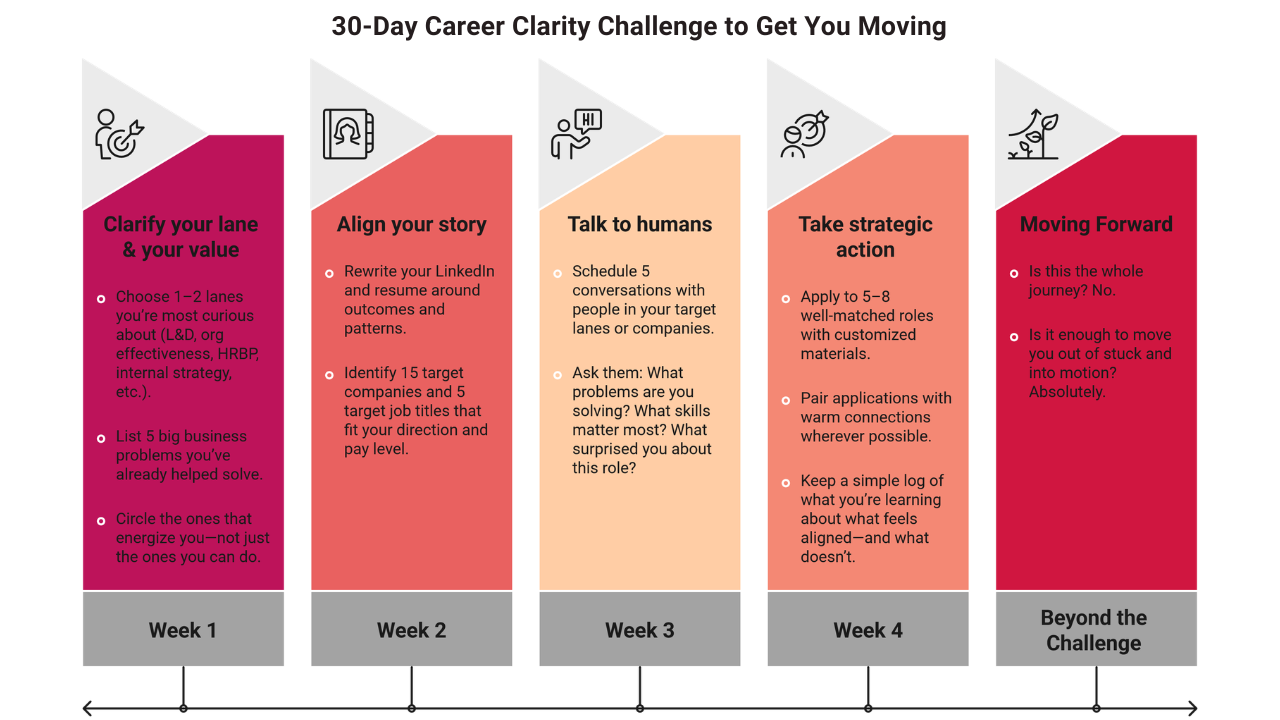
If you’re thinking, “Okay Theresa, I’m in, but where do I even start?” here’s a 30-day challenge you can follow.
Week 1: Clarify your lane & your value
- Choose 1–2 lanes you’re most curious about (L&D, org effectiveness, HRBP, internal strategy, etc.).
- List 5 big business problems you’ve already helped solve.
- Circle the ones that energize you—not just the ones you can do.
Week 2: Align your story
- Rewrite your LinkedIn and resume around outcomes and patterns.
- Identify 15 target companies and 5 target job titles that fit your direction and pay level.
Week 3: Talk to humans
- Schedule 5 conversations with people in your target lanes or companies.
- Ask them: What problems are you solving? What skills matter most? What surprised you about this role?
Week 4: Take strategic action
- Apply to 5–8 well‑matched roles with customized materials.
- Pair applications with warm connections wherever possible.
- Keep a simple log of what you’re learning about what feels aligned, and what doesn’t.
Is this the whole journey? No.
Is it enough to move you out of stuck and into motion? Absolutely.
If You Want Help Getting Career Clarity
If you’ve read this far, chances are you’re nodding along to at least some of this.
You’re realizing:
“I don’t want to stay where I am… but I don’t know exactly where to go next, or how to get there without blowing up everything.”
That’s exactly what I help women figure out.
Inside my work, and especially inside my signature program the Career Clarity Formula, we help you:
- Get clear on the right direction
- Find the work that energizes you versus what drains you
- Confidently articulate your value in a new lane
- Make a strategic pivot without sacrificing your income
When you gain clarity about your direction, the job market becomes much easier to navigate. You stop trying to be everything to everyone and start becoming the obvious choice for roles that truly fit you.
You cannot control the headlines.
But you can control how you show up in this moment.
And in a weak job market, women who know their value, tell their story clearly, and position themselves around real business problems?
They don’t just survive. They win.
You can do that too.
About Career Coach & Author
Theresa White, Career Clarity Expert, 5x Certified Career Coach, and the Founder of Career Bloom, is known for her expertise in guiding people to get unstuck and find the direction they need to move forward in their careers—fast. In a time when so many people are re-evaluating their work, Theresa offers actionable insights that empower clients to identify their true strengths and pursue work that genuinely aligns with their goals.
Theresa’s approach is empathetic yet practical, and she’s known for empowering clients with a clear direction in as little as 30 days, guaranteeing results.
Connect with Theresa on LinkedIn, listen to the Career Clarity Unlocked Podcast, or schedule your free 30-minute career clarity consultation.

Frequently Asked Questions About Changing Careers During a Weak Job Market
Is it a bad time to change careers during a weak job market?
Not necessarily. A weaker job market can actually create opportunities for experienced professionals because companies often prioritize candidates who bring judgment, leadership, and the ability to solve complex problems.
How can professionals in their 40s stay competitive in a slow job market?
Professionals in their 40s can stay competitive by highlighting their ability to solve business problems, building skills that align with emerging workplace trends, and positioning their experience around measurable outcomes rather than job duties.
What is the best strategy for a mid-career pivot in your 40s?
The most effective strategy is usually an adjacent pivot, where you move into a related role that builds on your existing experience, leadership skills, and industry knowledge instead of starting over in a completely new field.
What Other Job Seekers Are Reading
- What to do when you're feeling stuck in career
- How to Find Your Perfect Career
- 8 progressive companies to work for
- 7 Message Templates to Reach Out to Recruiters
- How to Use AI to Find a Job in 2025: Why Soft Skills Still Matter
- Free Job Search Tracker
- Get Career Clarity In Just 30 Days!
- Take this 60 second quiz to see if a free career clarity call with my team is your next best step.
Subscribe now to never miss the latest blog!
Every Thursday, we cover an important topic, actionable advice, and inspiring content to help you find work that makes you feel like *pinch me* I'm getting paid to do this???
We hate SPAM. We will never sell your information, for any reason.