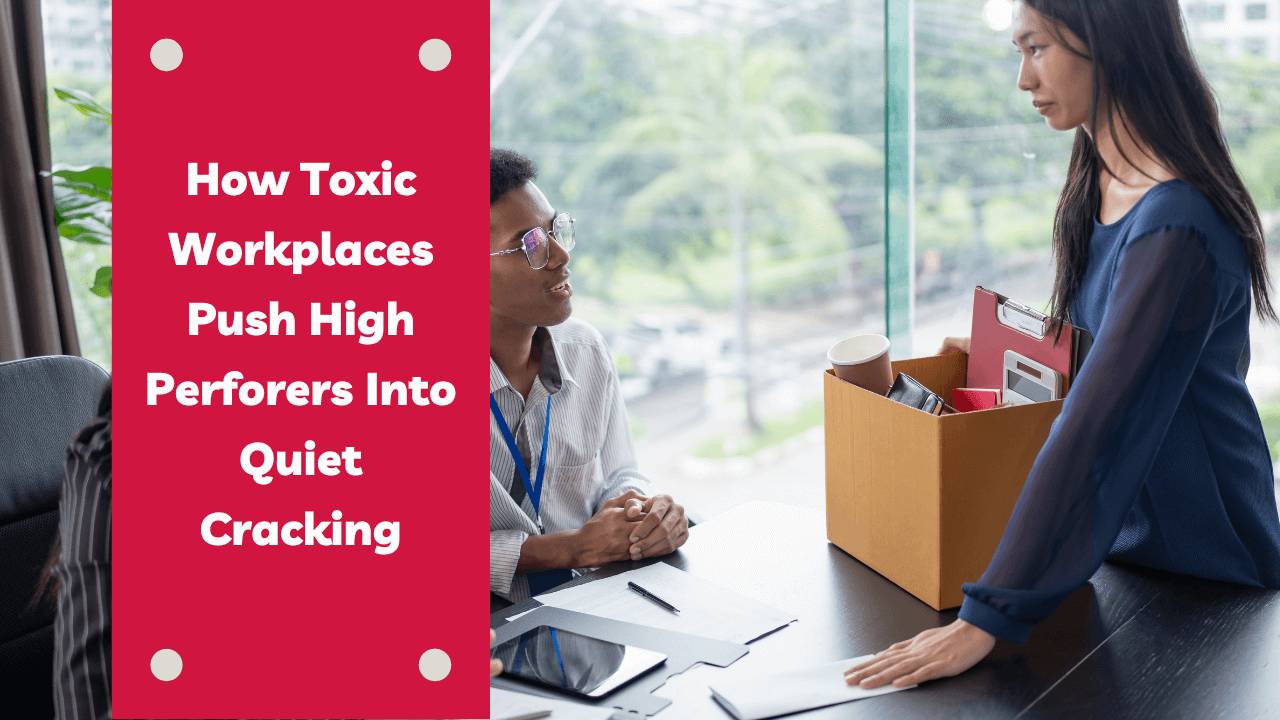
I'll never forget the first time I realised my workplace was actually toxic. I was sitting in a meeting where my manager publicly criticised someone for taking a sick day during a "critical week." Everyone nodded along. I nodded along. We all just accepted that being sick was somehow a personal failing.
That moment stuck with me because it wasn't dramatic. There was no yelling. No obvious cruelty. Just a quiet, pervasive message that your health didn't matter as much as the work. And that's how most toxic workplaces operate. They don't announce themselves. They just slowly normalise the abnormal until you can't tell the difference anymore.
I've spent years working with people who are quietly cracking under the weight of toxic work cultures. And here's what I've learned: the workplace itself is often the problem, not the person. When talented, capable people start showing signs of quiet cracking, it's usually because the environment is breaking them down piece by piece.
The relationship between toxic workplace burnout and quiet cracking is direct. You don't just wake up one day feeling empty and detached for no reason. Something is draining you. And if you're a high performer in a toxic environment, that something is usually the culture you're swimming in every single day.
What Makes a Workplace Toxic Today
Toxic workplaces have evolved. They're not always the obvious nightmare scenarios you see in movies. The boss doesn't have to scream at people or throw things. Modern toxicity is often quieter and more insidious.
A toxic workplace is anywhere that consistently damages your mental health, makes you feel unsafe speaking up, or treats people as disposable resources. It's a place where the culture creates chronic stress at work that never lets up.
I worked in a place once where everything was urgent. Every single thing. There was no such thing as a normal priority. If you pushed back on a deadline, you were labelled as "not a team player." If you asked for help, you were seen as incapable. The message was clear: figure it out, work faster, don't complain.
What made it toxic wasn't one big horrible thing. It was the accumulation of a thousand small cuts. The passive-aggressive emails. The meetings that could have been avoided. The expectation that you'd answer messages at 10 PM. The complete lack of psychological safety at work.
Another thing I see a lot is leaders who say they care about well-being but then reward the people who work weekends and skip vacations. Actions speak louder than words. If your company talks about work-life balance but promotes the person who never logs off, you're in a toxic culture, no matter what the handbook says.
Toxic work culture signs show up in how people talk about the company when leadership isn't around. If everyone is venting, if people are cynical, if the running joke is about how miserable everyone is, that's not normal workplace stress. That's toxicity.
The tricky part is that toxic workplaces often have good people in them. Your coworkers might be great. You might even like your manager as a person. But if the system itself is broken, if the pressure never stops, if the culture punishes humanity, those individual relationships can't protect you from the overall environment.

High Performers Ignore Red Flags Longer
Let me tell you something I've seen play out dozens of times. High performers walk into toxic workplaces and think they'll be different. They think if they just work hard enough, smart enough, prove themselves enough, they'll be the exception to the rule.
They're not. Nobody is.
I did this myself. I saw coworkers burning out and leaving. I watched talented people get chewed up by impossible demands. And I thought, "That won't happen to me. I can handle it." I stayed longer than I should have because I kept thinking the next project, the next promotion, the next quarter would be different.
High performers are especially vulnerable to toxic workplaces because they're used to succeeding through effort. They've always been able to work their way out of problems. So when the workplace is the problem, they just work harder. They stay later. They take on more. And the toxic culture rewards that behaviour, which reinforces the cycle.
You also get invested. You've put in the time. You've built relationships. You've achieved things. Walking away feels like admitting defeat. So you stay, and you tell yourself it's not that bad, and you slowly start experiencing all the early signs of burnout at work without recognising them for what they are.
I had a client who stayed in a hostile work environment for three years longer than she should have because she kept thinking she was about to turn a corner. She'd get a good performance review and think things were improving. Then the next week, the pressure would be back, and nothing would actually change.
"Do More With Less" Expectations
This phrase should be a red flag the size of a billboard. "Do more with less" is corporate speak for "we're not going to give you the resources you need, but we still expect the same results."
I've watched companies lay people off, redistribute their work to whoever is left, and then act confused when everyone is drowning. The workload doesn't magically decrease because you have fewer people. It just gets crammed onto the plates of people who are already full.
One client told me her team went from eight people to four people in six months. The projects didn't change. The deadlines didn't change. The expectations didn't change. They just all had to work twice as hard to keep up. Within a year, two more people quit, and she was left doing the work of eight people with one other person.
This overwork culture is incredibly common right now. Companies are obsessed with efficiency, which often means squeezing every possible drop of productivity out of the smallest number of people. And high performers are the ones who get squeezed the hardest because they're the ones who will actually try to make it work.
The emotional strain at work from constantly trying to do an impossible amount of work is exhausting. You're not failing because you can't keep up. You're being set up to fail by a system that refuses to provide adequate support.
Leaders Who Reward Output, Not Wellbeing
I once had a manager who would praise me for responding to emails at midnight. She'd forward them to other people, saying, "This is the kind of dedication we need." At the time, I felt proud. Looking back, I realise she was celebrating the fact that I had no boundaries and was slowly destroying myself.
When leaders only reward output, they create cultures where people sacrifice everything for work. The person who skips lunch gets praised. The person who works through vacation gets promoted. The person who admits they're overwhelmed gets seen as weak.
This sends a clear message: your value here is only about what you produce, not about who you are as a person. Your well-being is your problem, not ours. Just keep delivering.
I've seen leaders who genuinely believe they care about their teams, but their actions tell a different story. They say to take time off, but they email you while you're gone. They say not to work weekends, but they schedule Monday morning meetings that require weekend prep. The gap between what they say and what they reward creates confusion and mistrust.
High performers internalise this. They start believing their worth is tied to their output. They stop taking care of themselves because rest feels like laziness. They become the leaders' favorite employee right up until they crack, and then they're replaced with the next person willing to grind themselves down.

Fear-Based Cultures That Silence People
Some workplaces run on fear. Not the obvious kind where people are yelling and threatening. The subtle kind where you learn very quickly that speaking up has consequences.
You see someone ask a question in a meeting and get shut down. You watch someone suggest a different approach and get labeled as difficult. You notice that the people who push back don't get promoted. So you learn to stay quiet.
This lack of psychological safety at work is one of the most damaging aspects of toxic cultures. When you can't be honest about problems, when you can't admit you're struggling, when you can't question decisions without risking your reputation, you're trapped.
I worked in a fear-based workplace where my manager would say things like, "I don't want to hear about problems, only solutions." That sounds reasonable on the surface. But what it really meant was, "Don't tell me when things are going wrong. Figure it out yourself or I'll assume you're incompetent."
So people stopped raising issues. They stopped asking for help. They just quietly struggled and hoped things would work out. And when things inevitably went wrong, leadership would be blindsided and would blame the team for not communicating. You can't win in that kind of system.
Fear-based cultures also breed quiet cracking because you can't show any signs of struggle. You have to keep performing, keep smiling, keep pretending everything is fine. The gap between your internal experience and your external presentation gets wider and wider until you're barely holding it together.
Pressure From AI Tracking and Workflow Tools
This is a newer source of toxicity, but it's growing fast. More companies are using software to track productivity. They monitor how long you're active on Slack. They measure keystrokes. They track how many emails you send or how many tasks you complete.
One client told me her company started using software that took random screenshots of her computer throughout the day to prove she was working. Another client said his company tracked mouse movements and flagged anyone who went more than five minutes without activity.
This surveillance creates constant pressure. You can't take a breath without wondering if it's being monitored. You can't step away for a few minutes without anxiety that it'll look like you're slacking off. The message is clear: we don't trust you.
The psychological impact of being constantly watched is real. It creates a hostile work environment stress that's hard to describe if you haven't experienced it. You're always performing, always aware of being monitored, never able to relax even for a moment.
High performers often have complicated relationships with these tools. Part of you thinks, "Well, I'm productive, so what do I have to worry about?" But it still feels dehumanising. You're being reduced to metrics and data points instead of being trusted as a professional who knows how to do their job.
Lack of Recognition or Growth
Nothing makes you crack quietly faster than feeling invisible. When you're working hard, delivering results, and nobody notices or cares, it drains you.
I watched a colleague deliver a massive project that saved the company hundreds of thousands of dollars. She got a generic "good job" email. Another colleague missed a minor deadline and got called into a meeting about performance concerns. The imbalance was stunning.
When negative feedback outweighs positive recognition, when mistakes are highlighted but wins are ignored, people start to feel like nothing they do matters. High performers especially struggle with this because they're used to their work being noticed. When it stops being noticed, they often just work harder, trying to get back to that feeling of being valued.
But in toxic workplaces, no amount of hard work changes the culture. You could be employee of the month every single month and still feel undervalued because the culture doesn't prioritize people.
Growth is the other piece. When there's no clear path forward, when promotions go to the wrong people or don't happen at all, when you're doing the same work year after year with no development, you stagnate. And stagnation breeds quiet cracking.
I had a client who was promised a promotion for two years straight. Every review cycle, her manager said it was coming. It never came. She finally left, and they immediately promoted someone else into a newly created role that was essentially what she'd been promised. That's not an accident. That's a toxic culture that strings people along.
How Toxic Environments Turn Into Quiet Cracking
The path from toxic workplace to quiet cracking is predictable once you know what to look for. It doesn't happen overnight. It's a slow erosion.
First, you notice the problems. You see the red flags. But you tell yourself it's temporary or you can handle it. You're still engaged. You still care about the work.
Then you start adapting. You learn the unspoken rules. You figure out how to survive in the system. You develop coping mechanisms. Maybe you vent to coworkers. Maybe you compartmentalise. Maybe you just push through.
But coping mechanisms only work for so long. The chronic stress at work starts wearing you down. You're tired all the time. You're more cynical. Work that used to excite you now just feels like a grind. You're still performing, but the internal cost is getting higher.
This is where quiet cracking starts. You're functioning on the outside, but something inside you is shutting down. You stop caring as much. You stop trying to fix problems. You do what's required and nothing more. You're still good at your job, but the spark is gone.
The toxic workplace doesn't cause one dramatic breaking point. It causes a thousand small breaks that accumulate over time until you realize you're fundamentally different than you were when you started. You're harder. More guarded. Less optimistic. And you can't remember exactly when that shift happened.
What makes it worse is that toxic workplaces often normalize this. Everyone around you is also quietly cracking, so it feels like this is just how work is supposed to be. You lose perspective on what a healthy workplace even looks like.

Real Examples of Quiet Cracking in Toxic Cultures
Let me share some real stories from people I've worked with. Names and details changed, but the experiences are real.
Sonia worked at a startup where the CEO would schedule 8 PM meetings and get angry if people couldn't attend. The culture was all about hustle and sacrifice. She started having panic attacks on Sunday nights but still showed up every day and hit her targets. She was quietly cracking for eight months before she finally quit. She told me she knew something was wrong, but felt like leaving would mean she wasn't tough enough.
Marcus was in consulting, where the expectation was 70-hour workweeks minimum. He stopped seeing his friends. He gained weight. He wasn't sleeping well. But his performance reviews were excellent, so he thought he was doing fine. It wasn't until his doctor told him his blood pressure was dangerously high that he realized the job was literally killing him.
Jennifer worked in healthcare administration, where they were constantly understaffed. She cared deeply about patients, which the organization used against her. They'd guilt her into covering extra shifts, taking on extra work, and filling gaps that should have been filled by hiring more people. She burned out completely and had to take a three-month leave. She said the worst part was that she loved the mission, but the system made it impossible to do the work sustainably.
These aren't people who were weak or unable to handle pressure. These were high performers in toxic environments that slowly broke them down. The common thread in all their stories was that they stayed quiet about their struggle because the culture made it clear that struggling wasn't acceptable.
When It's Time to Leave vs When You Can Stay
This is the question everyone asks. How do you know if you should stay and try to make it work or if you need to get out?
Here's my honest answer: if the toxicity is coming from the top, you probably need to leave. If leadership is the problem, if the culture is baked into how the company operates, individual employees can't fix that. You can't change a system that doesn't want to change.
But if the toxicity is more localized, if it's your specific team or manager, there might be options. Can you transfer? Can you find a different role in the same company? Can you escalate to HR or skip-level management? These paths don't always work, but they're worth exploring if you otherwise like the company.
Ask yourself these questions: Is my health suffering? Am I a different person than I was a year ago, and not in a good way? Do I dread going to work most days? Have I lost my sense of self? If you're answering yes to multiple of these, it's probably time to start planning your exit.
Also consider: Is there any sign that things might actually improve? Or are you just hoping they will? Hope isn't a strategy. If nothing has changed in six months despite promises or efforts, nothing is going to change.
One thing I tell clients is to stop waiting for the perfect time to leave. There will never be a perfect time. There will always be a project in progress, a busy season, a reason to stay one more month. At some point, you have to prioritize yourself over the company.
But I also want to be realistic. Not everyone can just quit. Financial obligations are real. Job markets are tough. Sometimes you need to stay while you figure out your next move. If that's your situation, focus on protecting your wellbeing as much as possible while you're still there.
How to Start Planning Your Exit
If you've decided you need to leave, here's how to start without panicking or making impulsive decisions.
First, get your finances in order. Figure out how much runway you have. Could you survive a few months without income if needed? Do you need to save more before you make a move? Having financial clarity reduces some of the stress and gives you options.
Update your resume and LinkedIn. Even if you're not actively applying yet, having these current makes you ready to move when opportunities appear. I've seen people miss good opportunities because they weren't prepared to act quickly.
Start networking before you're desperate. Reach out to old colleagues. Let trusted people know you're open to opportunities. Join industry groups. Most jobs come from connections, not cold applications.
Figure out what you actually want next. This is important. Don't just run from a toxic workplace into another one. What kind of culture do you need? What are your non-negotiables? What did this experience teach you about what you don't want?
Set a timeline, even if it's loose. "I'm going to actively look for the next three months" or "I'm going to save for six months and then reassess." Having some structure helps you feel less trapped.
Be strategic about your current job. Don't check out completely if you can help it. You might need references. You don't want to burn bridges. But also, stop going above and beyond for a place that's harming you. Do your job, protect your energy, and invest your best effort into planning your next move.
One client told me she started treating her toxic job like a paycheck and nothing more. She stopped caring about the mission. She stopped taking things personally. She just showed up, did what was required, collected her money, and focused all her emotional energy on her job search. It wasn't ideal, but it helped her protect herself while she was still there.
Related Read: Quiet Cracking vs Quiet Quitting
FAQs About Quiet Cracking in Toxic Workplaces
How do I know if my workplace is toxic?
Your workplace is toxic if it consistently harms your mental or physical health, if you feel unsafe speaking honestly, if people are treated as disposable, or if the culture punishes normal human needs like rest or boundaries. Trust your gut. If work makes you miserable more often than not, something is wrong.
Why do high performers stay in toxic environments?
High performers stay because they're used to succeeding through effort. They think they can outlast the toxicity or prove themselves valuable enough to be treated better. They also get invested in what they've built and struggle to walk away. The sunk cost fallacy is real.
Can a toxic workplace cause burnout?
Absolutely. Toxic workplaces are one of the leading causes of burnout. When you're in constant stress with no support, when you're overworked without recognition, when you can't be honest about struggles, your body and mind eventually give out. The environment creates the burnout.
What are the early signs to watch?
Early signs include dreading work more often than you used to, noticing your mood is worse, feeling tired even after rest, becoming more cynical, caring less about things that used to matter, and feeling like you can't speak up. If you're reading this and wondering if your workplace is toxic, that's probably a sign.
About Career Coach
Theresa White, Career Clarity Expert, 5x Certified Career Coach, and the Founder of Career Bloom, is known for her expertise in guiding people to get unstuck and find the direction they need to move forward in their careers—fast. In a time when so many people are re-evaluating their work, Theresa offers actionable insights that empower clients to identify their true strengths and pursue work that genuinely aligns with their goals.
Theresa’s clients often call her sessions “epiphanies” and “transformational.” She brings immediate clarity to career goals, helping people unlock a deep understanding of what makes work fulfilling for them. Past participants consistently describe her approach as “spot on” and an “answer to questions they’d been asking for weeks.”
Theresa’s approach is empathetic yet practical, and she’s known for empowering clients with a clear direction in as little as 30 days, guaranteeing results.
Connect with Theresa on LinkedIn, listen to the Career Clarity Unlocked Podcast, or schedule your free 30-minute career clarity consultation.

Toxic Workplaces Don't Fix Themselves.
You deserve to work somewhere that doesn't slowly hollow you out. Somewhere that values you as a person, not just a productivity metric. Somewhere you can be honest without fear. Somewhere you can succeed without sacrificing your health.
That place exists. I've seen people find it after leaving toxic cultures. They describe it like coming up for air after being underwater for too long. They realize how abnormal their old workplace was. They remember what it feels like to actually enjoy their work again.
You can't change a toxic workplace from the inside if you're not in a position of power. What you can change is your decision to stay. That's the one thing you control. And sometimes, choosing yourself over a job that's harming you is the bravest thing you can do.
Related Reads + Freebies
Subscribe now to never miss the latest blog!
Every Thursday, we cover an important topic, actionable advice, and inspiring content to help you find work that makes you feel like *pinch me* I'm getting paid to do this???
We hate SPAM. We will never sell your information, for any reason.