
Not everyone wakes up dreaming about their job. Some people just want stability, decent pay, and a life outside work.
If you've been told you need passion to succeed, this article will feel like a relief. You don't need passion. You need alignment, skills, and a strategy that works for real life.
I've worked with so many women who felt broken because they didn't have a burning passion for any particular career. They'd been told their whole lives to "follow their passion" and "do what you love," but nothing sparked that kind of enthusiasm. So they felt guilty, stuck, and like something was wrong with them.
Nothing is wrong with you. The advice is just bad. Let me show you how to build a stable, well-paying career without pretending to care about things you don't actually care about.
Why "Follow Your Passion" Is Bad Career Advice
Let's just say it: the whole "follow your passion" movement has done more harm than good for most people.
Passion Often Comes After Competence, Not Before
Research shows that people usually develop a passion for work after they get good at it, not before. You don't need to love something to start. You need to get good enough at it that it becomes interesting and rewarding.
I didn't wake up passionate about career coaching. I got into it because I was good at helping people, and it paid well. The passion developed later, after I saw the impact and built competence. That's how it works for most people.
Waiting to feel passionate before you commit to a career path means you might wait forever. Competence creates confidence. Confidence creates engagement. Engagement can eventually turn into passion. But it doesn't start there.
Many Fulfilling Lives Are Funded by Neutral, Well-Paying Jobs
Some of the happiest people I know have jobs they feel completely neutral about. They're good at their work. They're paid well. And they use that money and stability to fund the parts of life they actually care about.
Their passion is their family, their hobbies, their travel, and their creative projects. Work is just the thing that makes all of that possible. And that's completely fine.
You don't need to love your job to have a fulfilling life. You need a job that doesn't drain you and pays you enough to enjoy your non-work hours.

Pressure to Feel Passion Causes Unnecessary Career Guilt
When you've been told you should love your work, every day you don't love it feels like failure. You start thinking something is wrong with you. "Why don't I care about this? Why am I not excited? Everyone else seems to love what they do."
Most people don't actually love their jobs. They're just better at faking it or they've accepted that work is work and that's okay.
The pressure to feel passionate creates guilt and anxiety that serves no purpose. You're allowed to see work as a transaction: you give time and skills, you get money and benefits. That's not settling. That's being realistic.
Work Does Not Have to Be Your Identity
American culture especially pushes this idea that your career should define who you are. "What do you do?" is one of the first questions people ask when they meet you.
But your job is just one part of your life. It doesn't have to be the central part. You can be a project coordinator who pays the bills and a passionate gardener who finds meaning in growing things. Both are valid. One doesn't diminish the other.
Separating your identity from your job title is actually healthy. It means job changes, layoffs, or career shifts don't shatter your sense of self.
What Actually Matters If You Don't Feel Passion
If passion isn't the goal, what should you optimize for? Here's what actually makes work sustainable and satisfying without requiring you to love it.
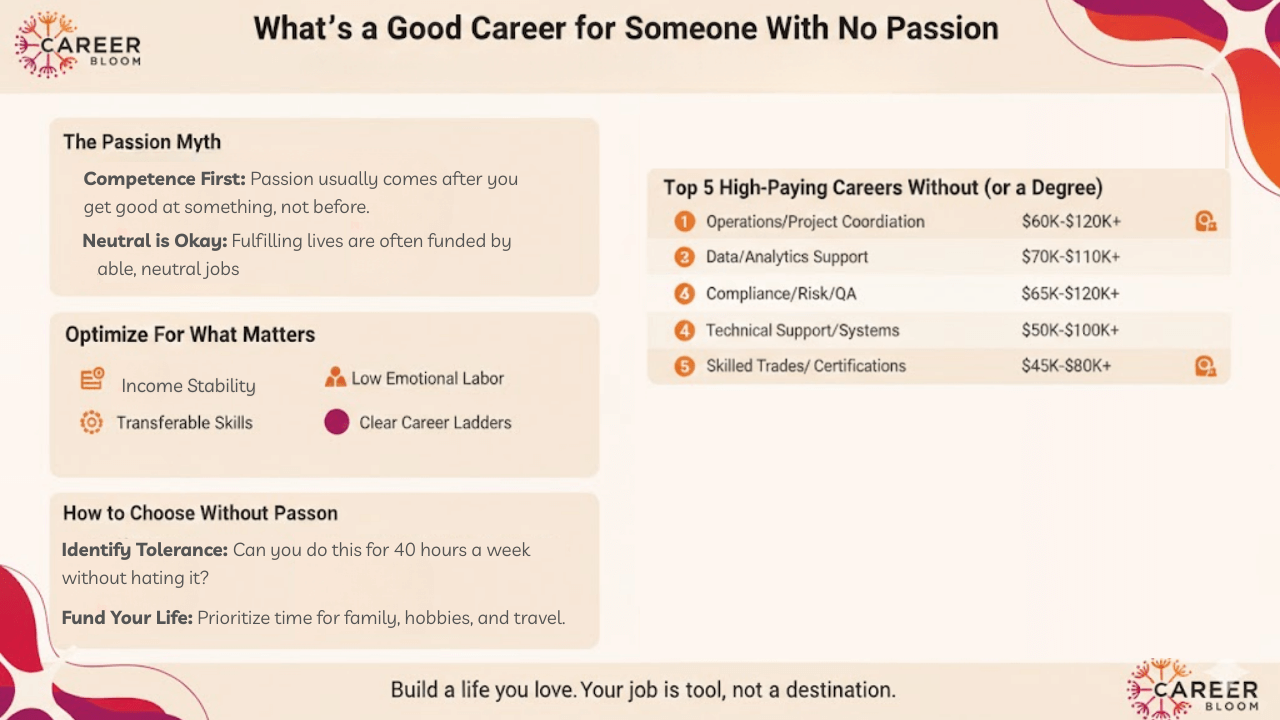
Income Stability
You need to know your paycheck is coming and you can cover your bills without constant stress. Stable income gives you options. It lets you plan. It reduces anxiety.
Jobs with predictable pay, clear salary ranges, and financial stability might not be exciting, but they create the foundation for a secure life. That matters more than passion.
Predictable Schedules
If you want a life outside work, you need a schedule you can count on. Jobs that let you clock in, do the work, and clock out without bleeding into your personal time are valuable.
Passion-driven careers often demand everything from you. Neutral careers with boundaries let you have energy left over for the things you actually care about.
Low Emotional Labor
Some jobs require you to manage other people's emotions constantly. Customer service, therapy, teaching, and social work. These roles can be draining even when you're good at them.
If you don't have passion fueling you, high-emotion labor jobs will burn you out fast. Look for work that's task-focused rather than relationship-focused if that's not your strength or interest.
Transferable Skills
Choose work that builds skills you can take anywhere. If you develop expertise in project management, data analysis, process improvement, or technical systems, you have options. You're not locked into one industry or one company.
Transferable skills give you mobility and leverage. That's security even without passion.
Clear Career Ladders
You don't need to love your job to want to make more money over time. Careers with obvious progression paths let you advance without having to figure out some creative, passion-fueled journey to the top.
You do your job well. You get promoted. You make more money. It's straightforward. That clarity is valuable.
Jobs With No Passion That Still Pay Well
Let me give you specific directions. These are careers where you can make good money without needing to pretend you're passionate about the work.
Operations and Project Coordination Roles
Operations managers, project coordinators, and program managers. These roles are about organizing, tracking, and making sure things run smoothly. If you're good at systems and details, you can do this work well without loving it.
Salaries range from $60K to $120K+, depending on level and industry. The work is stable, skills are transferable, and you're not expected to be emotionally invested in the mission.
Data, Reporting, and Analytics Support
Data analysts, business analysts, and reporting specialists. You work with numbers, create dashboards, and identify trends. It's concrete and measurable. You either did the analysis correctly, or you didn't.
These roles pay well, often $70K to $110K, and they're in demand across every industry. You don't need passion for spreadsheets. You just need to be competent with them.
Compliance, Risk, and Quality Assurance Roles
Compliance officers, risk analysts, QA specialists. These are roles where you make sure rules are being followed, risks are managed, and quality standards are met.
The work is detail-oriented and process-driven. It's not glamorous, but it pays well (often $65K to $120K+), and it's consistently needed. You're protecting the company from problems, which is valuable even if it's not inspiring.
Technical Support and Systems Roles
IT support, systems administrators, and technical account managers. If you're good with technology and can troubleshoot problems, these roles pay well without requiring you to care deeply about the work.
Salaries start around $50K and can go well over $100K as you gain expertise. The demand is high, and you can build a stable career without passion.
Logistics, Procurement, and Supply Chain Jobs
Supply chain analysts, procurement specialists, logistics coordinators. These roles keep businesses running by managing inventory, vendors, and distribution.
The work is practical and necessary. Companies always need it. Pay ranges from $55K to $100K+, and the skills translate across industries. You're solving logistical puzzles, not changing the world. And that's fine.
For more on finding roles that fit your actual priorities instead of what you think you should want, check out How Do I Find Fulfilling Careers That Still Pay Well?
High-Paying Careers Without a Degree
You don't need a four-year degree to make good money. You need skills, certifications, and the ability to prove you can do the work.
Tech Certifications and Support Roles
Google IT Support Certificate, CompTIA A+, Salesforce Administrator. These certifications cost a few hundred dollars and take a few months to complete. They qualify you for support roles that start around $50K and can grow to $80K+ with experience.
You're not coding. You're supporting systems, helping users, and managing platforms. It's practical work that pays well.
Skilled Trades With Predictable Income
Electricians, plumbers, HVAC technicians. These careers require apprenticeships or trade school, not traditional degrees. Pay starts around $45K and can exceed $80K once you're experienced and licensed.
The work is hands-on and practical. You're solving concrete problems. There's clear demand and job security. You don't need passion. You need competence and reliability.
Operations and Process Roles
Many operations and project coordination roles don't require degrees if you have relevant experience or certifications. Project management certifications like CAPM or Google's Project Management Certificate can get you in the door.
Once you're in operations, you can build a career based on results, not credentials. Pay ranges from $55K to $90K+, depending on experience and industry.
Sales Enablement and Account Support
Sales operations, account coordinators, sales support specialists. These roles support sales teams without requiring you to do the selling yourself. You manage data, create reports, and coordinate processes.
Many of these roles prioritize skills and experience over degrees. Pay starts around $50K and grows to $75K+ as you move up.
Administrative Leadership Tracks
Executive assistants, office managers, operations coordinators. These roles can lead to director-level positions in operations or administration without requiring a degree.
If you're organized, detail-oriented, and good with people, you can build a well-paying career in administration. Salaries range from $45K to $90K+, depending on level and company size.
How to Choose a Career When Passion Is Missing
Without passion as your guide, you need different criteria for decision-making. Here's how to choose when you're optimizing for stability and income instead of fulfillment.
Identify Tolerance Instead of Passion
You don't need to love the work. You just need to tolerate it without it draining you completely. Ask yourself: "Can I do this job 40 hours a week without hating my life?"
If the answer is yes, that's enough. You don't need enthusiasm. You need tolerance and competence.
I had a client who realized she could tolerate data work. She didn't love it. It didn't excite her. But it didn't drain her either. She was good at it, it paid well, and it left her with energy for the things she actually cared about. That's a win.
Choose Work That Funds the Life You Want
What do you actually want outside of work? Time with family? Travel? Financial security? Creative hobbies? A comfortable home?
Choose a career that gives you the money and time to have those things. Your job is the vehicle that gets you to the life you want. It doesn't have to be the destination itself.
Focus on Energy Drains vs Energy Neutral Tasks
Some tasks drain you. Others are neutral. Very few actually energize you if you're not passionate about work in general.
Avoid careers heavy in tasks that drain you. Customer complaints drain you? Don't go into customer service. Constant socializing drains you? Don't choose sales. Detailed documentation drains you? Skip compliance roles.
Choose work where most tasks are neutral or at least tolerable. That's sustainable long-term even without passion.
Use Skills You Already Have
Don't force yourself to learn entirely new skills for a career you don't care about. Use what you're already good at in a context that pays better or offers more stability.
If you're naturally organized, look at operations or project management. If you're good with numbers, look at analytics or finance. If you're good with technology, look at IT support or systems work.
Building on existing strengths makes the work easier and the learning curve shorter. You can succeed without needing to be passionate about developing new capabilities.
If you're struggling to identify what you're actually good at or what would be tolerable long-term, The Career Clarity Formula helps you figure that out. It's not about finding your passion. It's about finding what works for you realistically.
What This Looks Like in Real Life
Let me tell you about some clients who built successful careers without passion.
One woman worked in supply chain management. She told me point-blank: "I don't care about logistics. I'm good at it, it pays well, and it doesn't stress me out. That's enough." She made $95K, worked reasonable hours, and used that stability to fund her real passion, which was volunteering with animal rescues.
Another client moved into data analytics. She said, "I don't wake up excited about spreadsheets. But I'm good at finding patterns, the work is straightforward, and I make $85K working remotely. It gives me the flexibility to be present for my kids." She wasn't passionate about data. She was strategic about choosing work that supported her actual priorities.
These women aren't settling. They're being realistic. They're choosing careers that work for their lives instead of trying to force their lives to revolve around careers they're supposed to love.
About Career Coach & Author
Theresa White, Career Clarity Expert, 5x Certified Career Coach, and the Founder of Career Bloom, is known for her expertise in guiding people to get unstuck and find the direction they need to move forward in their careers—fast. In a time when so many people are re-evaluating their work, Theresa offers actionable insights that empower clients to identify their true strengths and pursue work that genuinely aligns with their goals.
Theresa’s clients often call her sessions “epiphanies” and “transformational.” She brings immediate clarity to career goals, helping people unlock a deep understanding of what makes work fulfilling for them. Past participants consistently describe her approach as “spot on” and an “answer to questions they’d been asking for weeks.”
Theresa’s approach is empathetic yet practical, and she’s known for empowering clients with a clear direction in as little as 30 days, guaranteeing results.
Connect with Theresa on LinkedIn, listen to the Career Clarity Unlocked Podcast, or schedule your free 30-minute career clarity consultation.

FAQs About Jobs With No Passion
Will I be unhappy if I choose a career without passion?
Not necessarily. Unhappiness usually comes from work that drains you, underpays you, or doesn't align with your values. If your work is neutral, pays well, and gives you time for things you care about, you can be very happy.
What if I feel guilty for not caring about my job?
That guilt is cultural programming, not reality. You've been told you should love your work. That's not a requirement for a good life. Let go of the guilt. Work is an exchange of value. That's okay.
How do I explain in interviews that I'm not passionate about the field?
You don't say "I don't care about this." You say, "I'm drawn to this role because it aligns with my strengths in [specific skills] and I appreciate the stability and growth potential in this field." Frame it around fit and capability, not emotional investment.
Build a Good Life
A job can be a tool. Money can buy freedom. Neutral work can support meaningful living.
You're not broken for not feeling passionate. You're realistic. You understand that work is one part of life, not the whole thing. And you're choosing to optimize for what actually matters to you: stability, income, and time for the things you care about.
That's smart. That's strategic. And that's completely valid.
Stop waiting to feel passionate before you commit to a career. Choose something you can tolerate that pays well and uses your existing strengths. Build competence. Make money. Create stability. Use that foundation to fund a life you actually care about.
The passion might come later. Or it might not. Either way, you'll be fine. Because you'll have chosen a path that works for real life, not some idealized version of what work is supposed to be.
And honestly? That's more honest and sustainable than most passion-driven career advice will ever be.
What Other Job Seekers Are Reading
- What to do when you're feeling stuck in your career
- How to Find Your Perfect Career
- 8 progressive companies to work for
- 7 Message Templates to Reach Out to Recruiters
- How to Use AI to Find a Job in 2025: Why Soft Skills Still Matter
- Free Job Search Tracker
- Get Career Clarity In Just 30 Days!
- Take this 60 second quiz to see if a free career clarity call with my team is your next best step.
Subscribe now to never miss the latest blog!
Every Thursday, we cover an important topic, actionable advice, and inspiring content to help you find work that makes you feel like *pinch me* I'm getting paid to do this???
We hate SPAM. We will never sell your information, for any reason.