You can turn a loose, conversational interview into a business discussion that makes the hiring manager think, “I can already see you in this role.”
Most candidates don’t do this.
They wait for questions.
They answer them.
And they hope it’s enough.
The candidates who actually get hired do something different, they shift the conversation.
Instead of just answering questions, they show how they think, how they prioritize, and how they create results.
That’s exactly what this approach is designed to help you do.
I’m Theresa White, a career coach working with mid- and senior-level professionals navigating career transitions. In this post, I’ll walk you through a practical, repeatable way to shape interview conversations so you’re not just responding, you’re operating like the person already in the role.
To make this simple and usable, we’ll use two frameworks:
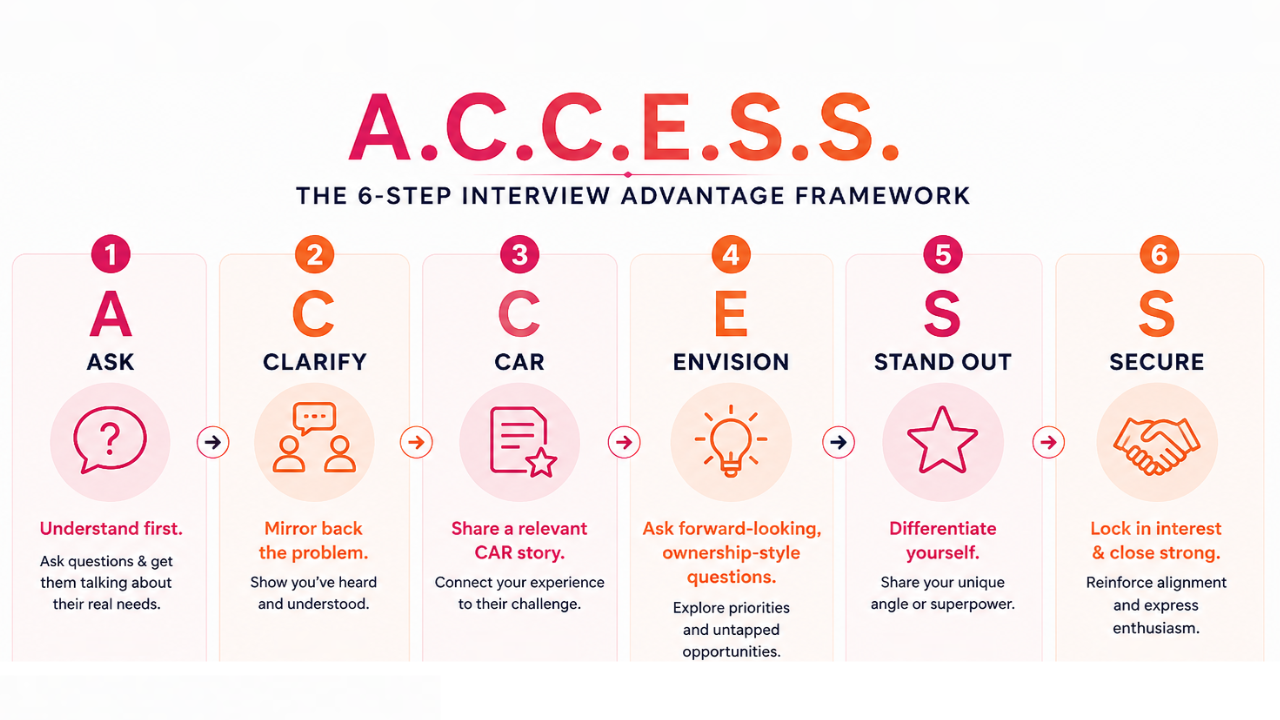
A.C.C.E.S.S. — Ask, Clarify, CAR, Envision, Stand Out, Secure
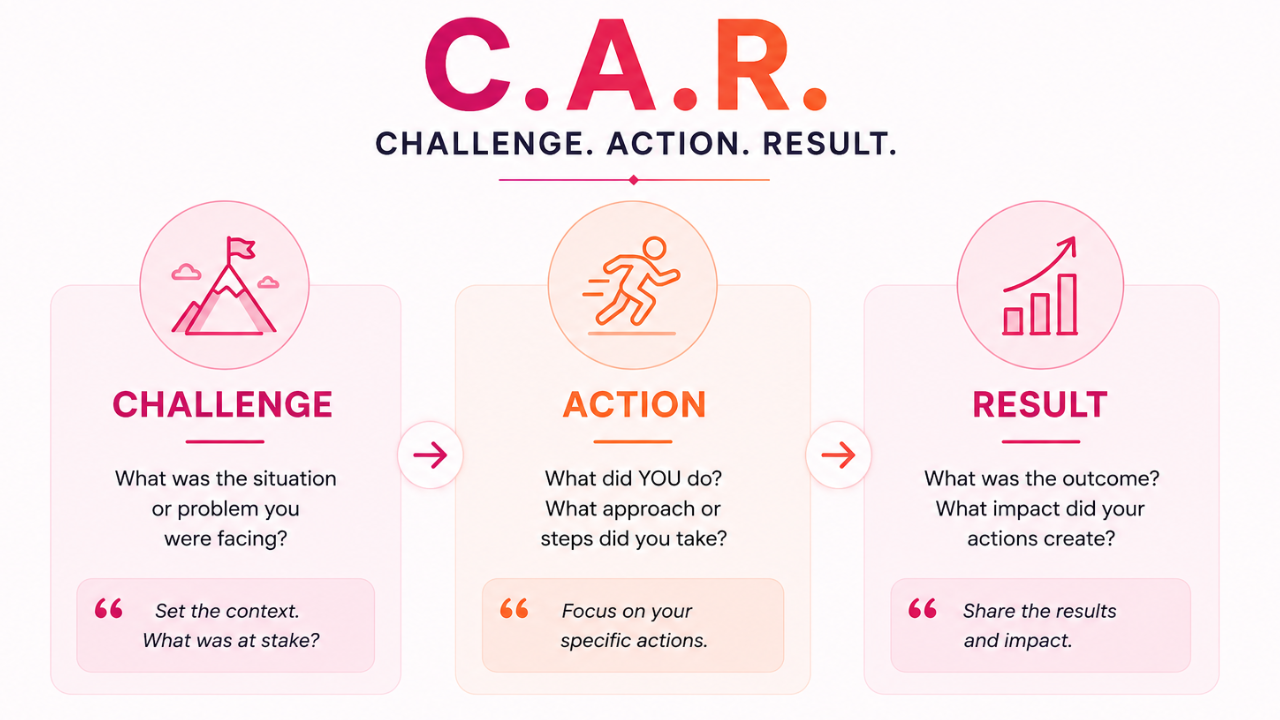
C.A.R. — Challenge, Action, Result
We’ll follow my client Mira, who’s interviewing for a Director of Organizational Development role, so you can see exactly how this works in a real conversation.
The Mindset Shift: From Answering To Operating In The Role
Most candidates in conversational interviews just “play catch” with questions: they wait, they answer, they wait again. Strong candidates gently steer the conversation toward the business: problems, priorities, and outcomes. They sound less like hopeful applicants and more like future peers who already think in terms of value.
Here’s the core principle you’ll use:
Understand what matters → Align your experience → Show how you create results.
That’s A.C.C.E.S.S.:
A — Ask: Approach conversation as: I’m here to understand what’s actually needed and see if I can help. Ask questions & get them talking about their real needs.
C — Clarify: Mirror back the problem “So it sounds like the main challenge is X, especially because of Y, and what you really need is someone who can Z—does that sound right?”
C — CAR: “That’s actually really interesting, because in my previous role… (use the most relevant of your CAR stories, for example: we had a similar issue where X wasn’t [problem], and I ended up doing Y [action], which led to Z [result]. So hearing you describe this, it feels very familiar.)
E — Envision: Ask forward-looking, ownership-style questions, for example “I’m curious, if I were stepping in, where would you want me focused first so we start making progress quickly?” or “From your perspective, what’s the highest-leverage thing here that hasn’t been tackled yet?”
S — Stand out: Differentiate yourself: One thing I’ve found that often makes the difference in this kind of role is [your superpower/unique angle].
S — Secure: Lock in interest & close strong “This was really helpful. Honestly, the problems you’re describing are exactly the kind of work I enjoy most. If it’s useful, I’d love to explore how I could help tackle these.”
When you do this well, the interviewer starts thinking:
- “They really understand what we need.”
- “They’ve handled something similar before.”
- “I can picture them doing this work here.”
You can do that, too.
Scenario 1: Using This Approach In A Conversational / Unstructured Interview (like a casual chat with the potential hiring manager):
You’re likely familiar with normal (structured) job interviews that follow a consistent, predefined set of questions.
But what do you do if you find yourself in an unstructured interview that is more like a conversation versus a job interview?
Knowing how to approach such an interview makes this a goldmine for a prepared candidate because it gives them the rare opportunity to shape the conversation, highlight their value strategically, and guide the interviewer toward seeing them in the role.
Let’s walk through the ten steps using my client Mira as our example.
Start With Natural Rapport And Direct Answers
In a conversational interview, don’t rush to “take control” or force your own structure. That feels stiff and scripted. Instead:
- Answer questions clearly and directly.
- Match the tone: friendly, present, professional.
- Ask simple, human questions back (about the team, how their day is going, etc.).
This builds trust. It tells the interviewer, “You’re easy to talk to”—which is a bigger deal than most candidates realize in senior and cross-functional roles.
Mira example
The VP Talent asks, “So, Mira, tell me a bit about your background and what brought you here today.”
Mira gives a concise overview of her career, highlighting her last couple of roles and why Organizational Development is her focus. Then she adds:
“I’ve been following your growth and the shift you’re making around leadership capability, and that’s really what excited me about this conversation.”
It’s direct, genuine, and sets a collaborative tone.
Step 1: Transition Into Understanding What Matters (The Ask in A.C.C.E.S.S.)
After 1–2 questions, you begin to pivot from “about me” to “about what you need.” You do this by asking thoughtful, targeted questions that surface their reality:
Examples you can borrow:
- “What would success look like for someone in this role in the first few months?”
- “What are the biggest challenges the team is working through right now?”
- “What’s most important to solve quickly once someone steps in?”
You’re no longer just a candidate answering questions; you’re a professional trying to understand the business context.
Mira example
After answering a question about leading change, Mira gently shifts:
“To make sure I’m answering in a way that’s most useful, could you share what success would look like in the first 3–6 months for this Director of Organizational Development role?”
This sounds natural, but it immediately refocuses the conversation on their priorities.
Listen For The Signals In Their Answers
When they respond, your job is to listen like a consultant. Pay attention to:
- Repeated themes (e.g., “alignment,” “engagement,” “speed of change”)
- Urgency (“we really need to address this this quarter”)
- Stakeholders (executive team, front-line leaders, HR business partners)
- Emotions (frustration, pressure, excitement, ambition)
You are mentally mapping three things:
- Pain points (what hurts)
- Priorities (what matters most right now)
- Desired outcomes (what “good” looks like)
Mira’s example:
The VP says something like:
“In the first six months, we really need someone to create more consistency in how our leaders handle performance conversations and change communications. Right now it’s very ad hoc, and it’s creating anxiety in the org. We’re also under pressure to support a big systems rollout that’s coming in Q4.”
Mira now knows: inconsistency, anxiety, and a big change rollout are high on the list. Those are her anchors.
Step 2: Reflect Back What You Heard (The Clarify in A.C.C.E.S.S.)
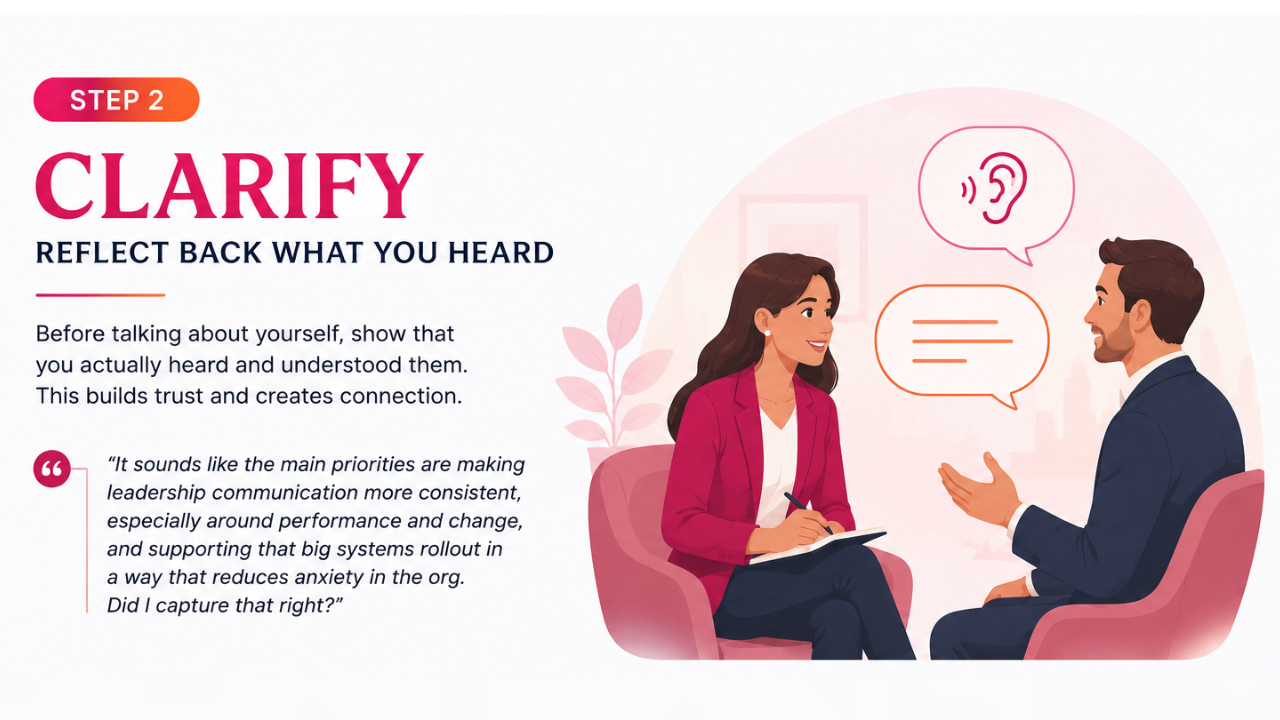
Before talking about yourself, show that you actually heard and understood them. This is a small step that has an outsized impact on trust and rapport.
You might say:
“It sounds like the main priorities are making leadership communication more consistent, especially around performance and change, and supporting that big systems rollout in a way that reduces anxiety in the org. Did I capture that right?”
Why this works:
- Shows active listening.
- Demonstrates synthesis: you can distill multiple points.
- Opens space for them to clarify or add nuance.
Most candidates skip this. When you do it, you instantly stand out.
Step 3: Use CAR Stories To Show How You Solve Problems
Now you connect what you’ve understood with what you can offer. A simple, confident bridge phrase is enough:
- “That’s actually where I believe I could contribute strongly.”
- “That aligns really well with the work I’ve been doing recently.”
- “I’m glad you mentioned those, because that’s been a big focus in my last role.”
Mira’s example:
Mira says:
“That’s really helpful context, and it’s actually where I think I can contribute strongly, because my last role was focused on building manager capability during a major transformation.”
This shifts the conversation from understanding → relevance.
Now you illustrate your value using CAR: Challenge → Action → Result.
A strong CAR story:
- Starts with a clear, specific challenge.
- Focuses on what you actually did (actions, decisions, leadership).
- Ends with a concrete result that shows impact.
Mira example (CAR story)
“In my previous company, we were going through a shift to a new operating model, and managers were handling performance conversations very inconsistently—some avoided them entirely, others were overly blunt. That inconsistency was driving low engagement and high regrettable turnover in two critical teams.
What I did was start by partnering with HRBPs and business leaders to map out the ‘critical moments’ in a manager’s year—performance reviews, mid-year check-ins, and change announcements. We built a manager playbook, a short skills program focused on real scenarios, and introduced a simple feedback framework managers could easily remember and use in conversations. I also created a feedback loop with HR and People Analytics so we could track adoption and adjust.
As a result, within nine months, manager confidence scores in performance conversations went up by 24%, voluntary turnover in the two critical teams dropped by 15%, and we started to see a noticeable shift in how employees talked about fairness and clarity in internal surveys.”
That’s specific, outcome-oriented, and directly relevant.
The magic move is not just telling a good story, it’s connecting it explicitly to their situation.
You might say:
“Given what you shared, I’d likely approach it similarly here, by first identifying your critical leadership moments and then building simple, repeatable tools and experiences around those.”
Now you are:
- Translating past success to future value.
- Showing how you think in their environment.
- Helping them visualize you in the role.
Mira’s example:
Mira adds: “Here, I’d want to start by understanding your most sensitive moments, like how leaders communicate performance ratings and how they’re expected to show up during that Q4 rollout. From there, I’d co-design a small number of clear, practical tools leaders can actually use, and test them with a pilot group so we can adapt quickly.”
Now the VP can picture her doing the work.
Step 4: Offer A Thoughtful Forward View (The Envision in A.C.C.E.S.S.)
You want to show initiative without sounding like you think you already run the place. The way to do that is to position your ideas as informed starting points, not final answers.
Examples:
- “My initial focus would probably be A, B, and C, while learning more about your systems and team dynamics.”
- “I’d want to start by listening and understanding the existing work, and then shape a plan around what’s already working.”
Mira’s example:
“My initial focus in the first 90 days would probably be threefold: getting close to your leaders’ day-to-day reality, understanding what’s already working in your current programs, and then shaping one or two visible ‘early wins’ around manager communication in the rollout. I’d want to learn from your team as I go so we’re building on what’s already here.”
This signals confidence, humility, and adaptability all at once.
Step 5: S — Stand out:
Differentiate yourself: One thing I’ve found that often makes the difference in this kind of role is [your superpower/unique angle], then connect how you’d apply that thinking there.
Step 6: S — Secure:
Lock in interest & close strong:
“This was really helpful. Honestly, the problems you’re describing are exactly the kind of work I enjoy most. If it’s useful, I’d love to explore how I could help tackle these.”
Optional: Reinforce With A Second Targeted Example
If the interviewer has mentioned multiple priorities or pain points, you can briefly repeat the pattern with a second CAR story to show your range and pattern recognition.
Keep it short; you’re reinforcing, not giving a speech.
Mira’s example:
The VP had mentioned anxiety around change and cross-functional alignment. Mira might say:
“You also mentioned cross-functional alignment for the systems rollout. In another role, I partnered closely with IT and Operations on a similar initiative…”
Then she gives a shorter CAR story focused on building cross-functional steering groups and communication cadences, ending with a measurable outcome (e.g., adoption rates, fewer escalations).
Now there’s a pattern: she consistently listens, aligns, and delivers.
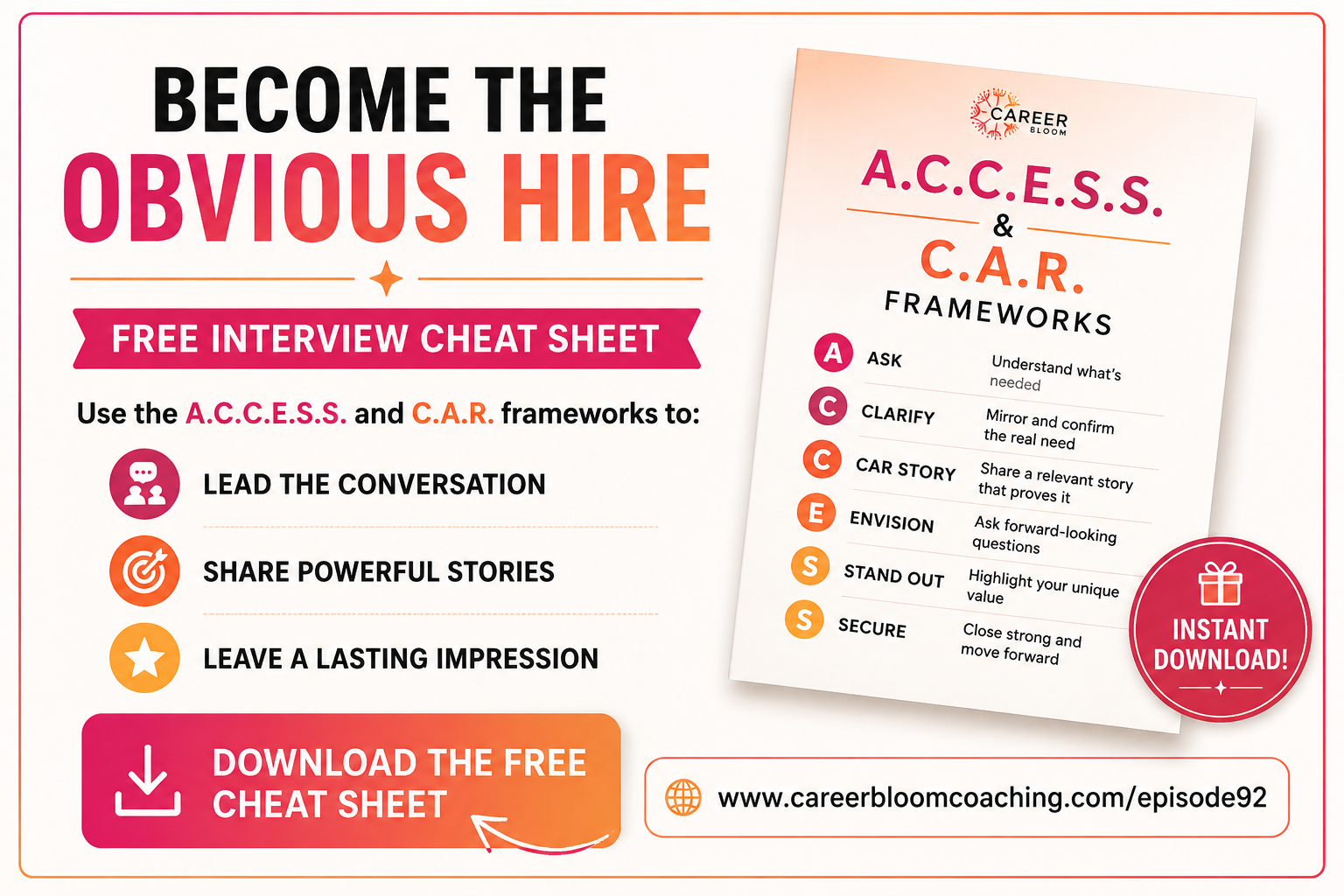
Ready to feel more confident in your next interview? Download the Free Interview Cheat Sheet
Keep It Conversational And Collaborative
Throughout the whole process, you are shaping the conversation, not dominating it. You:
- Pause and let them respond.
- Ask, “Does that align with how you’re thinking about it?”
- Invite their perspective: “Is there anything you’d approach differently?”
This creates a peer dynamic: you’re co-thinking, not performing. Interviewers in senior and cross-functional roles are often looking for exactly that.
Mira’s example:
“Does that approach to building leadership consistency fit with how you’ve been thinking about the role? Is there anything you’d want to be sure we did differently here?”
Now the interview feels like a working session, with you already operating in the job.
Scenario 2: Using A Shorter Version At The End Of A Structured (Normal) Interview
Sometimes your interview is highly structured: behavioral questions, competencies, limited back-and-forth. You might not get to shape the conversation as much early on.
But you almost always get one key opportunity: the “Do you have any questions for us?” moment at the end.
Most candidates:
- Ask about the timeline or next steps.
- Ask something they could have found on the website.
- Ask nothing because they’re tired.
You’re going to use a Mini-A.C.C.E.S.S. instead, to create a meaningful, memorable closing exchange.
What Interviewers Actually Care About At The End
By the end, they’re silently asking themselves:
- “Do I feel confident about this person?”
- “Do they understand what we need?”
- “Can I see them succeeding here?”
Your questions should speak directly to those three.
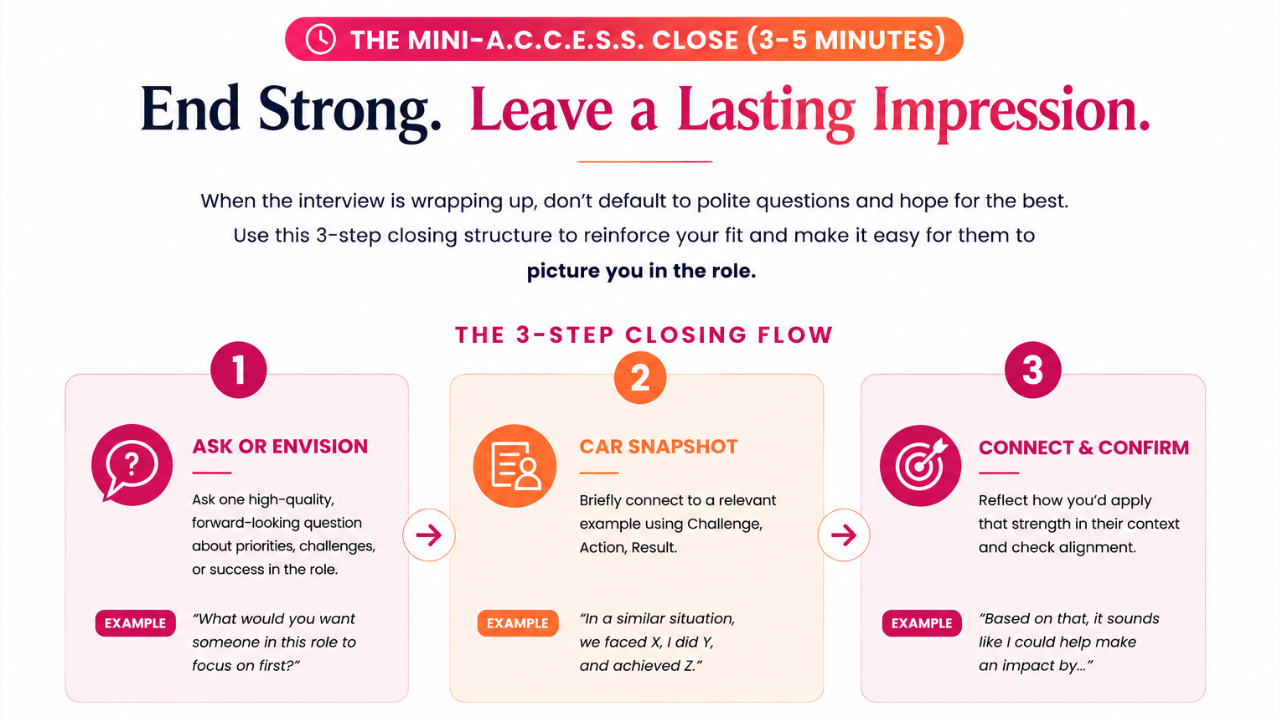
The Mini-A.C.C.E.S.S. Close (3–5 Minutes)
Here’s the structure you can use:
- Ask or Envision: Ask one high-quality question about success, challenges, priorities, or ask a forward-looking, ownership-style questions
- CAR: Briefly connect to a relevant strength or CAR story.
- Stand out: Reflect back how you’d apply that strength in their context and check alignment.
Step 1: Ask One High-Impact Question
Options:
- “As you think about the person who will be most successful in this role, what would you want them to accomplish in the first 90 days?”
- “What’s the biggest challenge you’d love to see this role really move the needle on?”
- “If we were looking back six months from now and this hire had gone really well, what would you want to be true?”
Mira’s example:
At the end of a more structured interview, Mira asks:
“Before we wrap up, I’d love to ask: if we were looking back six months after this role is filled, what would you want to feel really proud we’d improved together?”
The hiring manager shares their view: maybe it’s leadership consistency, smoother change rollout, or better engagement scores.
Step 2: Briefly Illustrate Your Fit
You respond with a short link to something you’ve already shared or another quick CAR highlight:
“That’s very aligned with where I tend to do my best work. In my current role, for example, we focused on improving manager capability during a major transformation…”
Then she gives a tight CAR snapshot in 20–30 seconds, ending with the result.
Step 3: Envision And Check Alignment
You finish by connecting that strength into their context and inviting confirmation:
“If I were to step into this role, I’d be excited to focus on building those same kinds of practical tools and rhythms for your leaders, particularly around that Q4 rollout you mentioned. Does that line up with where you’d want this role to have impact?”
This does several things at once:
- Reinforces that you understand what matters.
- Reminds them of your relevant strengths and results.
- Helps them visualize you doing the work.
- Signals that you think in terms of partnership.
You’ve taken what is usually a throwaway moment and turned it into a powerful closing impression.
Putting It All Together: How To Practice This Approach
You don’t have to be naturally extroverted to do this well. You just need a bit of preparation and practice.
Here’s a simple way to get ready:
- Map the role’s likely priorities. Based on the job description and your research, list 3–5 likely pain points, priorities, and desired outcomes.
- Prepare 3–5 CAR stories. Choose examples that show you solving problems similar to those priorities, using the Challenge → Action → Result structure.
- Pick your favorite questions. Select 2–3 questions for each step that feel natural to you. Make your questions feel natural by adding a soft lead-in:
- “I’m curious…”
- “Just so I understand…”
- “From your perspective…”
- “Out of curiosity…”
- Practice the transitions. Out loud, practice phrases like:
- “To make sure I’m responding in the most helpful way, could you share…”
- “It sounds like your main priorities are…”
- “Given that, I’d likely approach it by…”
- Rehearse the Mini-A.C.C.E.S.S. close. Practice a 3–5 minute closing where you ask one strategic question, link to a CAR story, and connect it back to their context.
If you do this even a couple of times before your interviews, you’ll feel more grounded and less reactive, and that confidence will show.
Quick Reference: The A.C.C.E.S.S. & C.A.R. Frameworks:
If you’re thinking, “there’s no way I’m remembering all of this in an interview…” you’re not alone.
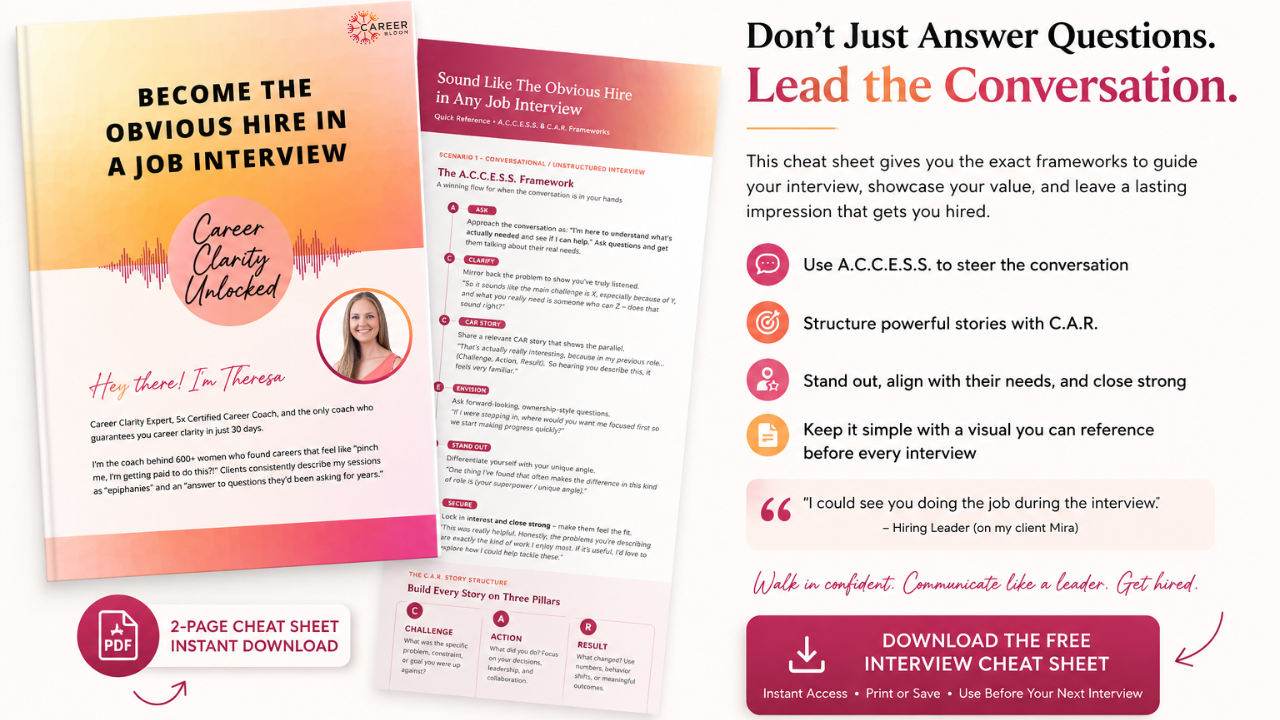
That’s exactly why I turned this into a simple, easy-to-use Interview Cheat Sheet you can review right before your next job interview.
It walks you through:
- how to use A.C.C.E.S.S. step-by-step
- how to structure your answers using C.A.R.
- and how to close strong so you’re remembered
👉 Download the “Become the Obvious Hire” Cheat Sheet here
You Can Learn To “Sound Like The Hire”
If you’ve ever left an interview thinking, “I wish they could have really seen what I can do,” this approach is for you.
Instead of waiting for the perfect question, you create the moments that show your value. You guide the conversation toward the work that actually matters and demonstrate how you think, how you solve problems, and how you operate in the role.
Mira used to feel like she was always “close, but not chosen” for senior roles. Once she shifted into using A.C.C.E.S.S. and C.A.R., her interviews started feeling different. More like working sessions, less like tests.
Within a few months, she landed a Director of Organizational Development role. The hiring leader told her, “I could already see you doing the job during the interview.”
That’s the shift.
And it’s something you can learn.
About Career Coach & Author
Theresa White, Career Clarity Expert, 5x Certified Career Coach, and the Founder of Career Bloom, is known for her expertise in guiding people to get unstuck and find the direction they need to move forward in their careers—fast. In a time when so many people are re-evaluating their work, Theresa offers actionable insights that empower clients to identify their true strengths and pursue work that genuinely aligns with their goals.
Theresa’s clients often call her sessions “epiphanies” and “transformational.” She brings immediate clarity to career goals, helping people unlock a deep understanding of what makes work fulfilling for them. Past participants consistently describe her approach as “spot on” and an “answer to questions they’d been asking for weeks.”
Theresa’s approach is empathetic yet practical, and she’s known for empowering clients with a clear direction in as little as 30 days, guaranteeing results.
Connect with Theresa on LinkedIn, listen to the Career Clarity Unlocked Podcast, or schedule your free 30-minute career clarity consultation.

What Other Job Seekers Are Reading
- What to do when you're feeling stuck in career
- How to Find Your Perfect Career
- 8 progressive companies to work for
- 7 Message Templates to Reach Out to Recruiters
- How to Use AI to Find a Job in 2025: Why Soft Skills Still Matter
- Free Job Search Tracker
- Get Career Clarity In Just 30 Days!
- Take this 60 second quiz to see if a free career clarity call with my team is your next best step.
Subscribe now to never miss the latest blog!
Every Thursday, we cover an important topic, actionable advice, and inspiring content to help you find work that makes you feel like *pinch me* I'm getting paid to do this???
We hate SPAM. We will never sell your information, for any reason.