
Burnout can make one thing painfully clear: you cannot keep doing this.
What it usually does not tell you is what you should do instead.
That is where many experienced women get stuck. You can name everything you are tired of. The endless administrative work. The projects that go nowhere. The culture you no longer believe in. The lack of growth. The feeling that another eight hours of your life just disappeared into work that does not matter.
But when you open LinkedIn and try to answer, Okay, so what am I looking for now? your brain goes blank.
Or worse, it starts spinning.
One of the women I recently worked with was in exactly that place. I’ll call her Claire. She had spent years building experience at a large national company. She was capable, reliable, and successful by traditional standards. But she was exhausted, underutilized, and increasingly aware that the career she had built no longer fit.
She knew what she didn’t want anymore.
Our job was to turn that information into something much more useful:
These are the actual roles worth investigating next.
That distinction matters because career clarity after burnout does not come from finding the fastest escape. It comes from understanding what has been burning you out, what kind of work fits you better, and where that intersects with the experience you already have and opportunities that actually exist in the market.
Here is how I work through that.
Burned Out at Work? Burnout Gives You Clues, Not a Career Answer
When Claire and I first talked, there were plenty of reasons to leave.
She had spent nearly two months manually building a competitor analysis that was requested, completed, and then essentially went nowhere.
That wasn’t an isolated experience. She had become increasingly frustrated by the amount of effort she was putting into work that felt meaningless.
Her title suggested one kind of job. Her actual day-to-day work was something very different. Roughly 85% of her time was spent on repetitive administrative tasks, data work, tracking, and account support.
There was very little learning.
Very little creation.
Very little sense that she was using the best of what she could offer.
A failed attempt to move internally had become another turning point. She had applied for a learning and development position and was rejected after being told her presentation wasn’t “corporate enough.”
At first, that rejection felt like more evidence that she needed to get out.
But I was interested in a different question:
Would that role actually have solved the problem?
Because when you are burned out, a different department, manager, or company can look like the answer simply because it is different.
Sometimes it is.
Sometimes it recreates the same career mismatch in a new package.
The women who come to me often describe this exact fear: “I’m looking to have a career pivot, but I don’t want to accidentally fall into the same role, just at a different company.” Or, “I know something needs to change, but I don’t trust myself to choose the right next step.”
That is why I don’t treat burnout as a job-title generator.
I treat it as data.

Career Burnout or the Wrong Work Environment? Separate the Two
One of the most useful things we can do when someone is unhappy in her career is separate two questions:
What is wrong with this particular workplace?
And:
What is wrong with the actual work?
Claire had legitimate environment concerns. She had watched company priorities and cultural values shift in ways that left her feeling less connected to the organization. Work was being created and abandoned. She no longer believed strongly in aspects of what she was being asked to represent.
Those things could change at another employer.
But they did not explain everything.
Even in a wonderful company, Claire would still have been spending most of her day doing repetitive administrative work.
Even with a better manager, she would still have had too little opportunity to learn, create, and develop something new.
Even with a mission she believed in, a role dominated by tracking and repetitive execution would eventually drain her.
That told us we weren’t dealing only with an employer problem.
We were dealing with a career-fit problem.
And that changes the search completely.
How to Identify the Work That Actually Energizes You
This is where career clarity becomes less about asking, “What jobs sound interesting?” and more about decoding the patterns already present in someone’s career.
As Claire and I talked, several energizing patterns kept appearing.
She loved learning something new and getting deep enough into it to understand it well.
She liked creating.
She enjoyed writing, storytelling, developing content, shaping ideas, and even editing video.
She liked taking information and turning it into something structured and useful.
She enjoyed mentoring and supporting people, but not endless shallow or transactional interaction. She wanted relationships that allowed for real connection.
And purpose mattered. She wanted to believe in the product, organization, or mission behind the work.
The interesting part was that none of these were random interests disconnected from her professional history.
They had already been showing up.
Her problem was that her current role gave them very little room.
That is an important distinction.
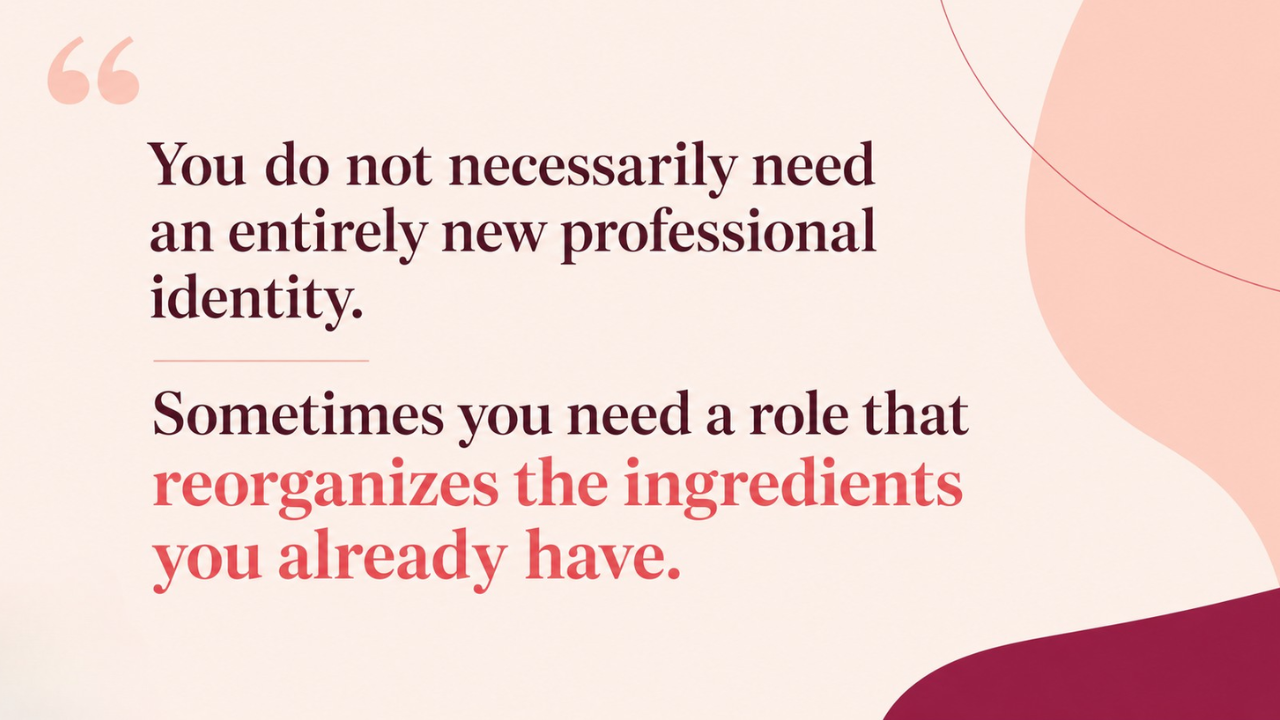
You do not necessarily need an entirely new professional identity.
Sometimes you need a role that reorganizes the ingredients you already have.
Before You Change Careers, Identify What You Do Not Want to Rebuild
Career-fit criteria are not only a wish list of things you want.
We also need to understand what repeatedly drains you enough that it should not dominate your next role.
For Claire, that included heavy repetitive administration, work with little learning curve, transactional interactions, output that seemed to disappear without impact, and representing something she did not genuinely believe in.
This helped us revisit that learning and development job she had been disappointed not to get.
On the surface, training sounded promising. She liked learning. She liked helping people. She could create frameworks and educational material.
But if the role mainly involved delivering the same training again and again, the learning curve would eventually flatten.
The job she had viewed as an escape might have recreated one of the exact patterns we were trying to leave behind.
That is the kind of distinction that is easy to miss when your only question is:
How do I get out?
A better question is:
What specifically needs to be different so I do not build the same problem again?
How to Change Careers Without Starting Over
This is where many women accidentally make career change harder than it needs to be.
They assume that if their current career no longer fits, they need to dream up something completely different.
“What else could I do?”
“What career would I choose if I started over?”
“What sounds interesting?”
Those questions can send you into an enormous universe of possibilities with no useful way to evaluate them.
I work in the opposite direction.
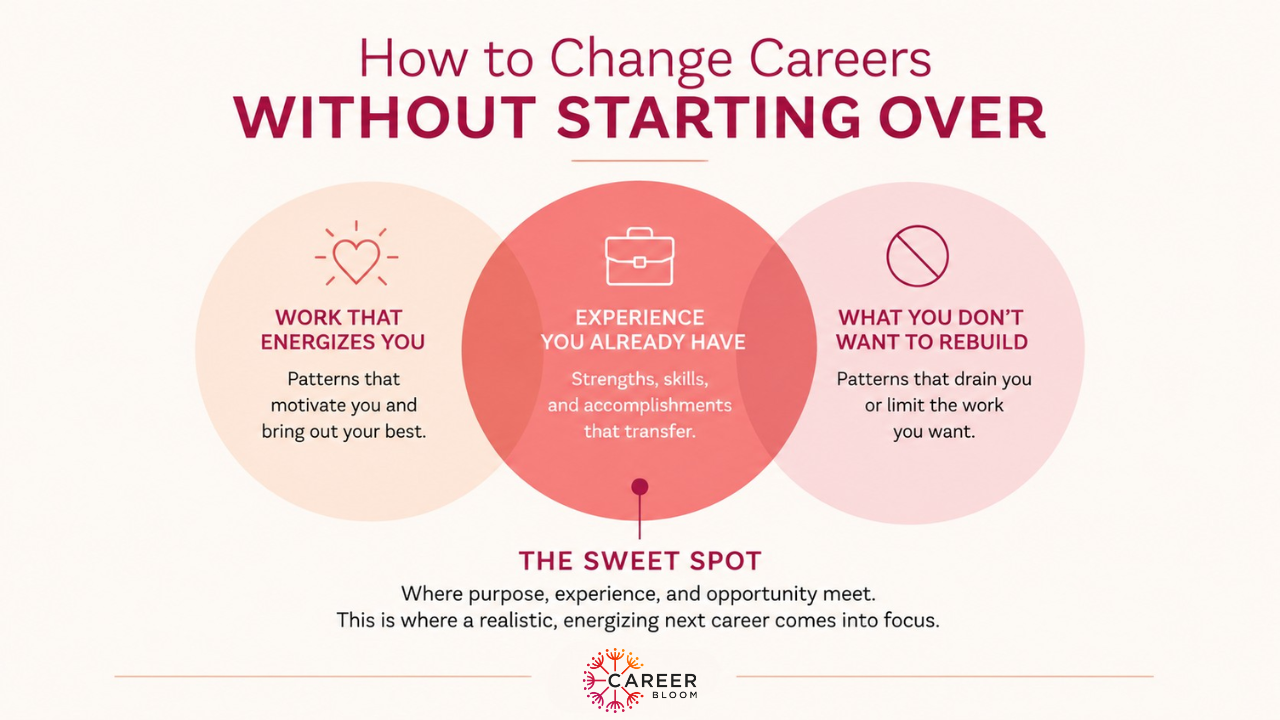
Once we understand your energizing patterns and your “do not rebuild this” patterns, we compare them against what you already know how to do.
Claire had years of experience working with accounts, organizing information, building relationships, developing materials, communicating ideas, understanding customer needs, and operating inside a large organization.
She did not need to throw that experience away.
She needed to translate it.
The goal was to find directions that met several conditions at once: work she was more likely to find energizing, a realistic use of the experience she had already built, and a path that did not require an unnecessary financial or professional restart.
That overlap is where a useful career direction starts to emerge.
Career Clarity Requires More Than Knowing Your Strengths
Pattern recognition alone is not enough.
I can identify that someone loves storytelling, learning, meaningful relationships, and creating from scratch. That does not automatically tell us which jobs she should pursue.
We have to translate those patterns into the labor market.
So instead of stopping with broad ideas like “something creative” or “something mission-driven,” I research where those criteria show up in actual roles.
For Claire, that led us toward role families such as learning-content or course development and marketing or brand-focused work that combined storytelling, creative execution, and relationship-building.
And there was an important qualifier attached to the second direction: she needed to believe in what she was representing.
A marketing role for a product she felt disconnected from would miss the point.
This is the intellectual work behind the roadmap.
I am looking for the overlap between:
How you naturally create value.
What kinds of work give you energy.
What you no longer want to spend your days doing.
What experience you can carry forward.
And where the market has realistic opportunities for someone with your background.
That is how we move from “Maybe marketing? Maybe training? Maybe something creative?” to a much smaller set of directions that are actually worth your time.
How to Test a New Career Direction Before Making the Leap
Even after we identify promising directions, I do not want a client choosing based on a job description alone.
Two roles can sound almost identical on paper and feel completely different in practice.
That is why the next stage is often targeted informational conversations.
Not vague networking.
Not asking strangers to “pick their brain.”
We are trying to answer specific career-fit questions.
What percentage of the job is creating versus maintaining?
How often are you learning something new?
How much of the work is independent versus relationship-driven?
Are you developing new material or repeatedly delivering existing material?
What does a normal week actually look like?
What pressures or frustrations never appear in the job posting?
Those conversations help distinguish a promising title from a genuinely promising direction.
And they reduce the risk of making another reactive move simply because you are desperate to leave the one you have.
You Do Not Need to Know Your Dream Career Before You Begin
If you are burned out right now, you may not be able to answer, “What do I want?”
That does not mean you have no direction.
It may mean the question is too big.
Start with the evidence.
What is draining because of your workplace?
What is draining because you simply do not want that kind of work to dominate your days anymore?
Where do you repeatedly come alive?
What kinds of problems do you enjoy solving?
What parts of your experience are worth carrying forward?
Then we can begin translating those answers into career-fit criteria, realistic directions, and eventually specific roles worth investigating.
That is the shift I want for women like Claire.
Not simply:
“I know what I don’t want anymore.”
But:
“I understand why this career stopped fitting. I know what needs to be different. And I have a small number of realistic directions I can now investigate with confidence.”
If you are so burned out that even thinking through those questions feels overwhelming, that comes first.
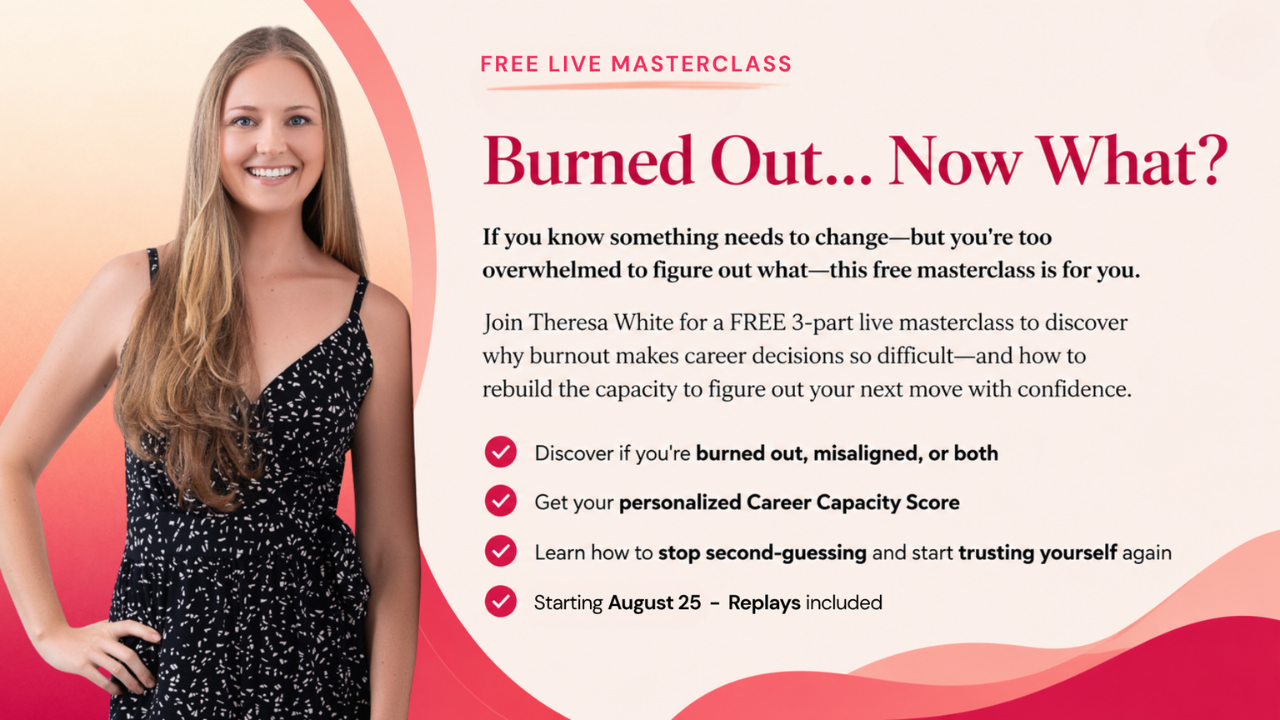
My free 3-part live masterclass, Burned Out… Now What?, introduces my Career Capacity Framework to help you restore the mental bandwidth needed to make a clear career decision, reclaim your energy and confidence, and then redirect that capacity toward the right next move instead of another guess.
You can reserve your free seat here: https://www.careerbloomcoaching.com/burned-out
About Career Coach & Author
Theresa White, Career Clarity Expert, 5x Certified Career Coach, and the Founder of Career Bloom, is known for her expertise in guiding people to get unstuck and find the direction they need to move forward in their careers—fast. In a time when so many people are re-evaluating their work, Theresa offers actionable insights that empower clients to identify their true strengths and pursue work that genuinely aligns with their goals.
Theresa’s clients often call her sessions “epiphanies” and “transformational.” She brings immediate clarity to career goals, helping people unlock a deep understanding of what makes work fulfilling for them. Past participants consistently describe her approach as “spot on” and an “answer to questions they’d been asking for weeks.”
Theresa’s approach is empathetic yet practical, and she’s known for empowering clients with a clear direction in as little as 30 days, guaranteeing results.
Connect with Theresa on LinkedIn, listen to the Career Clarity Unlocked Podcast, or schedule your free 30-minute career clarity consultation.

Frequently Asked Questions About Career Change After Burnout
How do I know what career to choose after burnout?
Do not start by asking yourself to name the perfect new career. Burnout often makes it easier to recognize what you cannot keep doing than to immediately see what you want instead.
Start by separating what is specific to your current employer from what is intrinsic to the work itself. Then look for repeated patterns in the work that energizes you, the work that consistently drains you, and the strengths and experience you want to keep using.
From there, those patterns can be translated into career-fit criteria and compared against realistic roles in the market. The goal is not to generate as many possibilities as possible. It is to identify a small number of career directions that fit who you are now and are worth investigating further.
Should I change careers if I am burned out at work?
Burnout can be a sign that something needs to change, but it does not automatically mean you need an entirely new career.
Sometimes the primary problem is the environment: an unsustainable workload, poor leadership, a toxic culture, or values conflict. Other times, the actual work has become a mismatch because it is repetitive, underutilizes your strengths, offers too little growth, or requires you to spend most of your time doing work that drains you.
The important question is not simply, “Should I quit?” It is, “What needs to be different in my next role so I do not recreate the same problem somewhere else?”
How can I make a career change without starting over or taking a big pay cut?
A career change does not have to mean abandoning everything you have built.
For experienced professionals, I look first at how existing strengths, accomplishments, industry knowledge, leadership experience, and transferable skills can carry into a different type of role. Then I compare those assets with your career-fit criteria and research where there is realistic market overlap.
That allows you to evaluate adjacent and transferable career paths before assuming you have to begin again at the bottom.
The goal is not change for the sake of change. It is to find a direction that uses more of what you are good at, removes more of what has been draining you, and makes strategic use of the experience you have spent years building.
What Other Job Seekers Are Reading
Subscribe now to never miss the latest blog!
Every Thursday, we cover an important topic, actionable advice, and inspiring content to help you find work that makes you feel like *pinch me* I'm getting paid to do this???
We hate SPAM. We will never sell your information, for any reason.