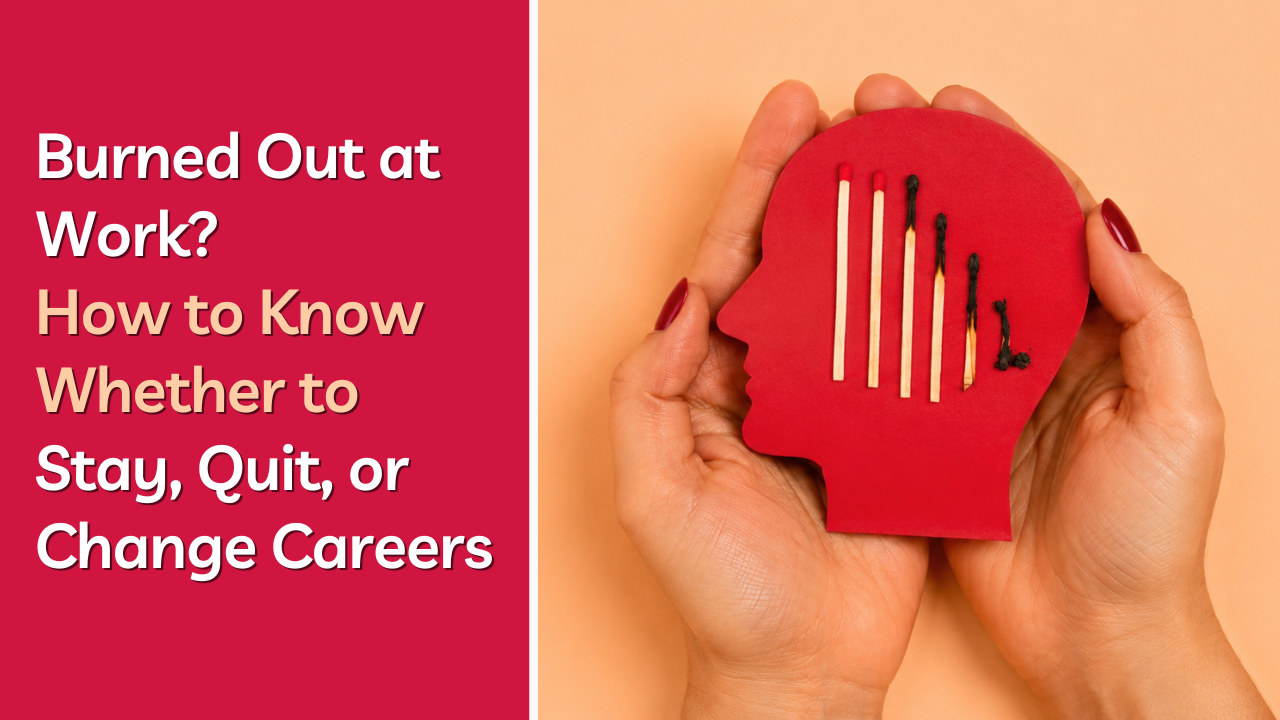
You know you can’t keep doing this.
Sunday night arrives and the dread starts. You’re exhausted after work. Your brain is still replaying conversations when you’re supposed to be sleeping. Your laundry list never seems to get shorter.
And somewhere underneath all of that is the question you can’t stop asking:
What now?
Do I stay and try to make this job sustainable?
Do I find another company?
Do I need a completely different role?
Have I outgrown this career entirely?
Or am I so burned out that everything looks wrong right now?
I hear versions of this constantly from successful women. “I’m pretty sure I’m burnt out.” “It just keeps spinning and I can’t think anymore.” “I know something needs to change, but I don’t trust myself to choose the right next step.”
If that’s where you are, I don’t think your first job is to answer, Should I stay or should I go?
Your first job is to understand what kind of problem you’re actually dealing with.
Because burnout can be a signal that something about your career needs to change. But when you’re depleted, it can also become much harder to determine what needs to change.
That distinction matters.
What should you do when you feel burned out at work?
Start by separating three things that are very easy to confuse:
Capability. Functioning. Capacity.
Capability is what you’re capable of doing: your intelligence, experience, judgment, leadership, problem-solving ability.
Functioning is what you are currently managing to do: running the meeting, delivering the presentation, solving the problem, taking care of your team, meeting the deadline.
Capacity is what you actually have available beyond the demands already consuming your resources.
That last one is the piece high-achieving women often miss.
You can still be performing extremely well while having almost nothing left.
That was one of the biggest realizations in Day 1 of my free three-part Burned Out… Now What? Career Clarity Masterclass. We looked at four signals of Career Capacity: Energy, Cognitive, Recovery, and Future. Participants then calculated where their capacity is most constrained right now.
The conversations and realizations coming out of Day 1 were exactly why I created this masterclass.
Because so many capable women have been using their continued performance as evidence that they should be able to keep going.
But functioning is not the same thing as having capacity.
And if you missed Day 1, you haven’t missed your chance. You can still join the free masterclass, get the Day 1 replay and Career Capacity Assessment, and join us for Days 2 and 3.
Because identifying that you’re depleted is only the beginning.

Why burnout makes the “What should I do with my career?” question so difficult
Think about what you’ve probably been doing to solve this.
You open LinkedIn.
You scroll job postings.
You Google careers that might use your transferable skills.
You save 17 jobs.
You take another assessment.
You wonder whether you should leave your industry.
Then you find five other possibilities.
Instead of three potential directions, you now have twelve.
And somehow you feel less clear.
There’s a reason for that.
Researching requires capacity. Comparing options requires capacity. Imagining a different future requires capacity. Making a high-stakes decision when there is no objectively correct answer requires capacity.
If most of yours is already going toward getting through the week, adding more information may simply give your depleted brain more to process.
This is why I don't want you treating burnout as only a job-search problem.
And I don't want you treating it as only a recovery problem, either.
You need to understand the relationship between your capacity and your career.
Before you quit your job, figure out what’s actually draining you
One of the most tempting conclusions when you’re burned out is:
I need to get out.
Maybe you do.
There are very real External Drains that can make a job unsustainable: more work than realistically fits into a normal workday, constant urgency, work extending into evenings, poor leadership, politics, dysfunction, or work that simply doesn't fit anymore.
Those things matter.
But there is another layer I want you to examine before deciding what happens next.
Because many high-achieving women are being drained from two directions at once.
There is what the environment is demanding from you.
And there is what you have learned to do in response.
Maybe when something needs to get done, you step in, even when it doesn't really need to be yours.
Maybe you keep performing at the level everyone expects even when you're exhausted.
Maybe your workday technically ends, but your brain keeps working.
Maybe uncertainty sends you into research and analysis.
Maybe you have trouble stopping while there is still something you could be doing.
These patterns are not evidence that you caused your burnout.
In fact, many of them are the shadow side of the strengths that made you successful.
You’re responsible.
You solve problems.
You anticipate what people need.
You make sure nothing drops.
You can handle a lot.
But here’s the pattern I want you to notice:
When high-achieving women find themselves in an unsustainable situation, their first instinct is often to become better at sustaining it.
We work harder.
Organize better.
Research more.
Step in.
Push through.
Those strategies may have served you beautifully for years.
At some point, though, a successful strategy can become very expensive.
You don’t recover by becoming better at enduring depletion.
That’s exactly what we’re working on in Day 2 of Burned Out… Now What?
If you’re reading this Thursday morning, come join us. You can watch the Day 1 replay first, or simply bring what you already know about your burnout, and then join us as we identify what is draining your capacity and where you actually have room to create relief.
You won’t leave with ten more things you’re supposed to fix.
You’ll leave with one place to begin carrying less.

What if career burnout means the real problem is your career?
This is where burnout advice often stops too soon.
Because yes, creating some breathing room matters.
But what if you create more breathing room…and still hate the work?
What if your workload improves, but you’re still underutilized?
What if you become better at stopping at 5:30, but eight hours of your day are still spent doing work that feels meaningless?
What if the problem isn't simply that you have too much work, but that the career you built no longer fits the woman you've become?
This is why I don't believe the answer to career burnout is automatically “set better boundaries.”
Sometimes something around the work needs to change.
Sometimes something about how you're carrying the work needs to change.
And sometimes the work itself needs to change.
The important thing is figuring out which one is true for you before you make another career decision.
Because if you only know what you want to escape, almost any job that looks different can feel like an answer.
Until you get there.
And six months later you realize:
Different company. Same problem.
That is exactly the cycle so many women come to me determined not to repeat: “Every time I go from company to company, I'm in the same role.” “I don't want to jump back in the same.” “I'm looking to have a career pivot, but I don't want to accidentally fall into the same role, just at a different company.”
Leaving burnout behind is not enough.
You need to know what you're moving toward.
You do not have to be completely recovered from burnout before you figure out what’s next
I want to be careful here, because there are two mistakes you can make.
The first is trying to force a major career decision while you are so depleted that you have virtually nothing available beyond getting through the day.
The second is deciding:
I can't think about my career until I'm completely recovered.
Most people can't put their lives on hold until they feel 100%.
You do not need full capacity to begin.
You need enough capacity to engage with what comes next, and a way of finding clarity that doesn't waste the capacity you have.
That’s a very different standard.
And it leads to a much more useful question than:
“Should I quit?”
The question becomes:
What does my career actually need from me next?
Burnout out at work? There are three very different answers to “What now?”
This is where we're going in the final session of Burned Out… Now What?
We're going to bring two pieces together:
Your Career Capacity.
And your Career Direction.
Because they are not the same problem.
You might discover that your capacity is so depleted that your immediate priority needs to be creating enough breathing room to engage with your career.
You might discover that you have enough capacity to begin, but you don't actually know what work you want to pursue or where you want to pursue it.
Or you might discover that you already know what you're moving toward and you're ready to turn that direction into a strategic move.
Those require different next steps.
In the masterclass, we call them:
RESTORE. RECLAIM. REDIRECT.
That is the answer I want you to leave with.
Not a vague sense that you should “take care of yourself.”
Not another list of 25 possible careers.
Not pressure to resign tomorrow.
A diagnosis of what you actually need next.
Because once we know the real problem, the next step becomes much easier to identify.
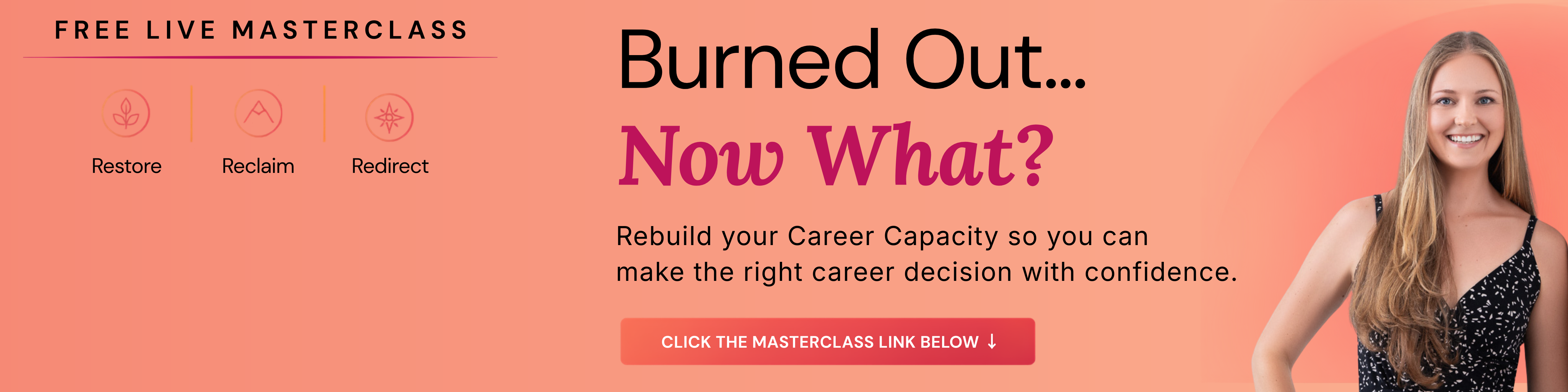
If you're burned out at work and asking “What now?”, join us
Day 1 of Burned Out… Now What? is already complete, and it was powerful. Women began putting language and structure around something that had felt vague and overwhelming: I'm functioning, but I have very little left.
You can still join us.
When you register, you'll get access to the Day 1 replay and the Career Capacity Assessment so you can identify how much capacity you actually have and where it's most constrained.
Then join me for Day 2, where we'll uncover what's draining that capacity and identify one concrete place where you can begin creating relief.
And in Day 3, we'll answer the question underneath this entire experience:
What do I actually need next for my career?
Because you already know you can't keep doing this indefinitely.
You don't need to figure out your entire future today.
But you do need to stop assuming that your only choices are to keep enduring the career you have or make a desperate escape into something else.
There is a step between burnout and your next move.
It is understanding what is happening, getting clear on what actually needs to change, and choosing the right next step for where you are now.
That’s what we're going to do together inside Burned Out… Now What?
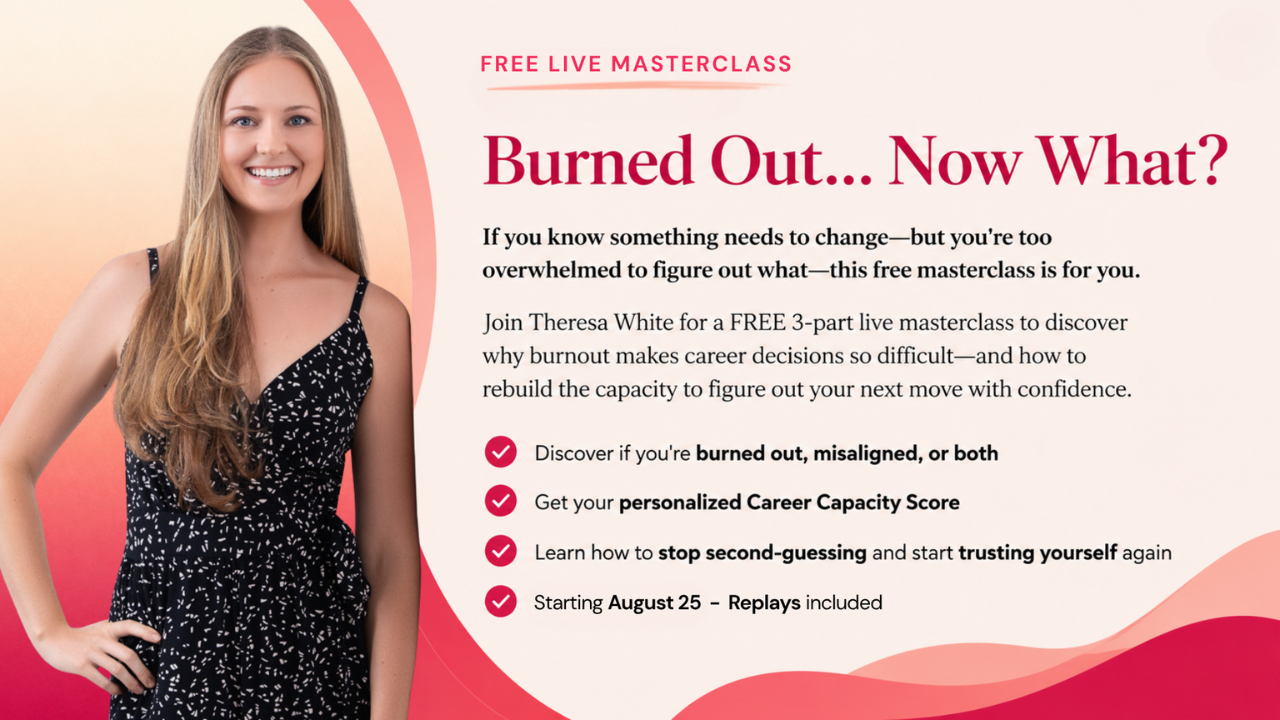
Join the free three-day masterclass here.
Catch the Day 1 replay, then come finish your Career Capacity Roadmap with us for Days 2 and 3.
You already know something needs to change.
Now let's figure out what.
About Career Coach & Author
Theresa White, Career Clarity Expert, 5x Certified Career Coach, and the Founder of Career Bloom, is known for her expertise in guiding people to get unstuck and find the direction they need to move forward in their careers—fast. In a time when so many people are re-evaluating their work, Theresa offers actionable insights that empower clients to identify their true strengths and pursue work that genuinely aligns with their goals.
Theresa’s clients often call her sessions “epiphanies” and “transformational.” She brings immediate clarity to career goals, helping people unlock a deep understanding of what makes work fulfilling for them. Past participants consistently describe her approach as “spot on” and an “answer to questions they’d been asking for weeks.”
Theresa’s approach is empathetic yet practical, and she’s known for empowering clients with a clear direction in as little as 30 days, guaranteeing results.
Connect with Theresa on LinkedIn, listen to the Career Clarity Unlocked Podcast, or schedule your free 30-minute career clarity consultation.

Frequently Asked Questions About Burnout and Career Change
How do I know if burnout means I need a new job or a new career?
Burnout does not automatically mean you need to change careers. The more useful question is whether the main source of the problem is your workload, your work environment, or the work itself. If the work still feels draining or unfulfilling even when the conditions improve, that can be a sign that your career direction needs a closer look.
Can burnout make it harder to know what career I want next?
Yes. When most of your mental and emotional capacity is going toward getting through the week, it becomes harder to compare options, imagine a different future, or make a high-stakes decision. That is why career clarity after burnout often starts with creating enough capacity to think clearly, then identifying the patterns in the work that energizes you, drains you, and fits who you are now.
What should I do before quitting my job because of burnout?
Before making a major move, try to identify what specifically needs to change so you do not recreate the same problem somewhere else. Look at the role itself, the environment, the workload, the expectations you are carrying, and the parts of the work that no longer fit. The goal is not to convince yourself to stay; it is to make your next move from clarity rather than exhaustion.
What Other Job Seekers Are Reading
Subscribe now to never miss the latest blog!
Every Thursday, we cover an important topic, actionable advice, and inspiring content to help you find work that makes you feel like *pinch me* I'm getting paid to do this???
We hate SPAM. We will never sell your information, for any reason.