
At some point, it stops being “I need a new job” and starts being “I can’t keep living like this.”
And when you hit that point where you’re thinking, “I can’t do this anymore,” your brain usually jumps to one extreme or the other:
Quit immediately.
Or stay stuck and push through.
But there is a third option most people don’t think about, and it can be one of the smartest, most strategic moves you make in your career.
It is called a bridge job.
A bridge job is not giving up or settling. It is a deliberate step into a lower-pressure role that gives you space to recover, get clear, and figure out what you actually want next, without blowing up your financial stability.
A bridge job can be incredibly powerful, but only if it is the right move for you.
Because for some people, it is exactly what they need. And for others, it just delays a bigger decision they are avoiding.
So how do you know the difference?
In this guide, I will walk you through exactly how to decide if a bridge job is the right move for your situation, and if it is, how to approach it strategically in today’s job market.
Bridge Job Example: What It Looks Like When Burnout Meets Strategy
When I first started coaching burned-out mid- and senior-career professionals, most of them came in saying some version of the same thing:
“I can’t do this anymore. I just want something easier. I just want to breathe.”
One client, Victoria, was a senior manager carrying an overwhelming workload. She was navigating layoffs, holding her team together emotionally, and absorbing pressure from every direction.
By the time she came to me, she was done.
Her initial instinct was to quit and take the first low-stress remote job she could find. Something simple. Something that would give her relief.
But instead of rushing into that decision, we slowed things down.
We separated:
- What was temporary burnout.
- What was true misalignment with her career path.
- What she actually needed next: rest, stability, or a full pivot.
For Victoria, the answer was not a full career pivot. It was a reset.
She eventually chose a 12-month bridge role. A lower-intensity operations coordinator position, hybrid, fewer hours, lower pay, but with enough structure and benefits that she could heal and think again.
Another client in a very similar situation went through the same process and made a completely different decision.
She looked at the same questions and said, “No, I want to stay where I am, renegotiate my role, and build my exit plan on the side.”
Both were good decisions, because both were intentional.
That is what I want for you.
If you’re in that “I can’t do this anymore” moment and want a simple, structured way to figure out your next move, I walk through this step-by-step in my free masterclass: Make a Career Change in 3 Simple Steps.

Step 1: How to Identify What Is Actually Causing Your Career Burnout
Before you decide “bridge job or not,” get uncomfortably specific about why you’re done.
Ask yourself:
- What is actually making me unhappy? Is it the workload, the people, my manager, the culture, the lack of meaning, or something outside of work?
- Is this situational, meaning this company or this role, or is it structural, meaning this entire field or lifestyle no longer fits me?
- When was the last time I felt energized at work? What was different then?
- If my workload dropped by 30 percent, would I still want to leave?
This level of clarity matters more than people think.
If your main issue is the environment, for example a toxic culture, lack of support, or an inflexible schedule, a bridge job in a healthier setting could completely change your experience.
But if the core issue is deeper, meaning the entire career path you are on no longer fits who you are, then a lighter version of the same job may still feel wrong.
You are not making a decision yet. You are gathering data.
Give yourself permission to write down the real answers, even if they are messy, contradictory, or uncomfortable.
That is how you start making a decision that actually works for your life.
Step 2: Get Clear on What You Actually Want From Your Next Career Move
A bridge job is not “giving up on your potential.” It’s choosing a phase with a different purpose. The key is knowing what that purpose is.
Ask yourself:
- What am I optimizing for right now: recovery, exploration, income stability, or skill‑building?
- Do I want to heal, pivot, or both?
- If I took a bridge role, what would I want my day‑to‑day to feel like?
You might land on something like:
- “I want to sleep through the night, stop crying after work, and have energy for my family.”
- “I want enough mental space to explore a new field or build a side business.”
- “I want a softer landing that keeps money coming in while I rethink my direction.”
Once you name this, you can evaluate your options differently.
Instead of measuring your next move against old definitions of success, like prestige, title, or speed of advancement, you start asking a different question:
What actually supports me right now?
A bridge job. Staying where you are. Making a direct pivot.
All of these can be the right move, depending on what this phase of your life is meant to do.
Step 3: Consider the Job Market and Your Financial Reality Before You Make a Move
We have to talk about the 2026 job market and your finances, because they shape what’s actually safe and sustainable.
Right now:
- Confidence in “finding a quality job” has dropped sharply; only a minority of workers think it’s a great time to move.
- Many mid‑career professionals feel stuck between burnout and a slower hiring market.
- At the same time, easier‑to‑enter remote roles (customer support, data entry, virtual assistant, AI data trainer, basic admin) continue to hire steadily because turnover is high and barriers to entry are low.
Now zoom in on your numbers:
- How many months of living expenses do I have saved?
- What is my minimum viable income (the lean version of my life)?
- How long can I sustain earning less without constantly panicking?
- Do I have health insurance options and other non‑negotiables covered?
Bridge roles like customer support, data entry, virtual assistant, and basic operations often fall roughly in the 35–60k/year range or 20–30 dollars/hour for full‑time, sometimes less.
That can absolutely work as a “recovery salary,” but only if you run the math and feel reasonably safe.
If your numbers don’t support a big drop, a bridge job might still be possible, but you’ll want to:
- Target higher‑paying “easy entry” roles (for example, virtual assistant or AI data trainer for more specialized clients, or remote support roles at larger companies).
- Or create a “half bridge”: stay where you are while negotiating scope down and building an exit plan.
Any of these options are different strategies for the same goal: a healthier, more sustainable career.
Step 4: Burnout vs. Career Misalignment. Do You Need a Break or a Bigger Change?
Another important question to ask is whether you actually need to leave your job, or whether you need to change how you are working.
Ask yourself:
- Have I tried fixing this in my current role—delegation, boundary setting, saying no, asking for support, using benefits like PTO or leave?
- When was the last time I took real, uninterrupted time off?
- Am I deeply exhausted (burnout) or mainly resentful and disengaged (misalignment), or both?
- If I took 2–4 weeks fully off and truly rested, would I see the situation differently?
Burnout and misalignment can feel the same, but they are not the same problem.
If burnout is acute, meaning trouble concentrating, emotional swings, or physical symptoms, even a lighter role can still feel like too much unless it’s truly quiet and low‑pressure. You may need a bigger reset (time off, leave, or very part‑time work) before you can even evaluate your options clearly.
If misalignment is the louder issue, you’re not burned out so much as “I’ve outgrown this,” then your best strategy is to work with a career clarity coach to identify your best next step.
If you want support figuring out your next move without spinning in circles, my free masterclass Make a Career Change in 3 Simple Steps walks you through exactly how to get clarity and take action.

Step 5: How a bridge job affects your future story
Let’s talk about your narrative, the story future employers will hear.
In a slower, more cautious job market, hiring managers are paying closer attention to résumés. A downshift can either look like a red flag or a sign of intentional decision-making, depending on how you frame it.
Ask yourself:
- If I take a bridge job, can I clearly explain it as a deliberate choice?
- Will this role help me maintain or build at least some skills I care about?
- Does this move keep doors open, or does it close them for a while?
A bridge job is not the problem. The story around it is what matters.
The good news: bridge roles are easier to explain than ever because burnout, caregiving pressures, and the demand for flexibility are in the public conversation. You’re not the only one feeling this.
A strong narrative might sound like:
- “I intentionally stepped into a lower‑intensity, remote operations role for a year to recover from burnout and focus on building skills in X.”
- “I took a customer support position in a new industry to understand it from the inside while I explored a longer‑term pivot into Y.”
This is fundamentally different from, “I just couldn’t take it anymore, so I left.” The story is not that you fled, it’s that you chose
Step 6: When a Bridge Job Makes Sense (and When It Doesn’t)
Let’s weigh both options:
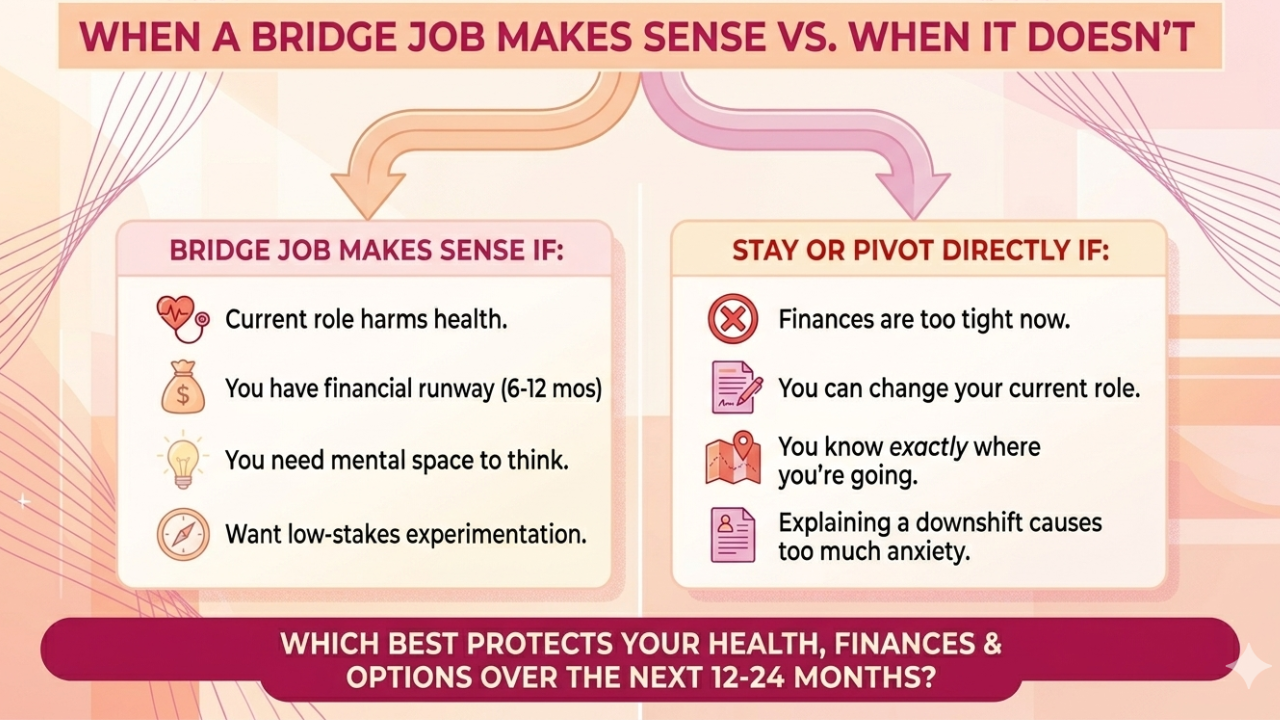
A bridge job might be right for you if:
- Your current role is harming your mental, emotional, or physical health in ways that rest and boundaries aren’t fixing.
- You have (or can create) enough financial runway to tolerate lower pay for 6–12 months.
- You want structure and income, but at a much lower intensity, so you can think clearly and rebuild your life.
- You want to experiment in a new industry or type of work without the pressure of a “forever move.”
Staying put (for now) or pivoting directly might be right for you if:
- Your finances feel too tight to risk a pay drop or temporary underemployment.
- You still have some capacity to advocate for change: reduced scope, partial remote, internal transfer, or a sabbatical/leave.
- You already know exactly where you want to go next and have a realistic path to get there without needing an intermediate step.
- The thought of explaining a downshift on your résumé makes you more anxious than the idea of redesigning your current role.
There is no universally “right” choice here.
The better question is:
Which option best protects your health, your finances, and your future options over the next 12 to 24 months?
Step 7: What Bridge Jobs Actually Look Like in Today’s Job Market
If you decide, “Yes, a bridge job is my next step,” here’s what the current market is actually offering.
Common “easy‑entry” bridge job categories
- Customer support / chat support
- Think: Customer Support Rep, Chat Agent, Member Services.
- Often remote or hybrid, heavy on scripts and training, and focused on straightforward tasks.
- Operations, admin, and coordinator roles
- Think: Administrative Assistant, Operations Assistant, Project Coordinator, Scheduling Coordinator.
- Many hybrid/remote openings, especially in healthcare, education, and professional services.
- Data entry, transcription, and back‑office
- Think: Data Entry Specialist, Medical Transcriptionist, Scribe, Records Clerk.
- Low barrier to entry, often flexible hours, limited direct conflict.
- Content moderation and quality review
- Think: Content Moderator, Trust & Safety Reviewer, AI Data Trainer / Rater.
- Frequently remote, sometimes asynchronous; stress level depends on the type of content, so you can target text‑only or non‑graphic queues.
- Simple online education / support roles
- Think: Online Tutor (basic subjects), Student Success Coach, Course Support Specialist.
- Steady demand, often remote, can be part‑time, good fit if you enjoy helping people learn.
Across these categories, platforms like FlexJobs, Indeed, and remote‑specific boards are seeing consistent listings for “easy remote jobs” that emphasize straightforward tasks, low training requirements, and flexibility.
Step 8: How to Make Sure Your Bridge Job Is Actually Low Stress (Not Just a New Hamster Wheel)
Even a “simple” job can become stressful if you land in the wrong environment. To protect your nervous system, be picky about the structure and culture.
When you search, look for postings that mention:
- “Flexible schedule,” “asynchronous work,” “output‑based,” or “part‑time.”
- “Remote” or “hybrid” plus clear, predictable hours.
- “No nights or weekends” if that matters to you.
Pay attention to red‑flag language:
- “Fast‑paced, high‑pressure, competitive,” “rockstars,” “must thrive under intense deadlines.”
- Commission‑only roles or heavy quotas unless that genuinely energizes you.
- Vague expectations with lots of responsibilities and little structure.
Look for companies that show up on lists of top remote/flexible employers, because they’ve already done the work of building systems around flexibility instead of bolting it on.
For a true bridge, you are allowed to choose something that actually feels manageable day to day.
You are not trying to impress anyone. You are rebuilding yourself.
If you want a simple, structured roadmap for making a career change, not just landing a bridge job but deciding your best long-term move, this is exactly what I teach inside Make a Career Change in 3 Simple Steps.

Step 9: Concrete Steps to Land a Bridge Job
If you’re feeling a “yes” toward a bridge role, here’s a simple plan you can follow.
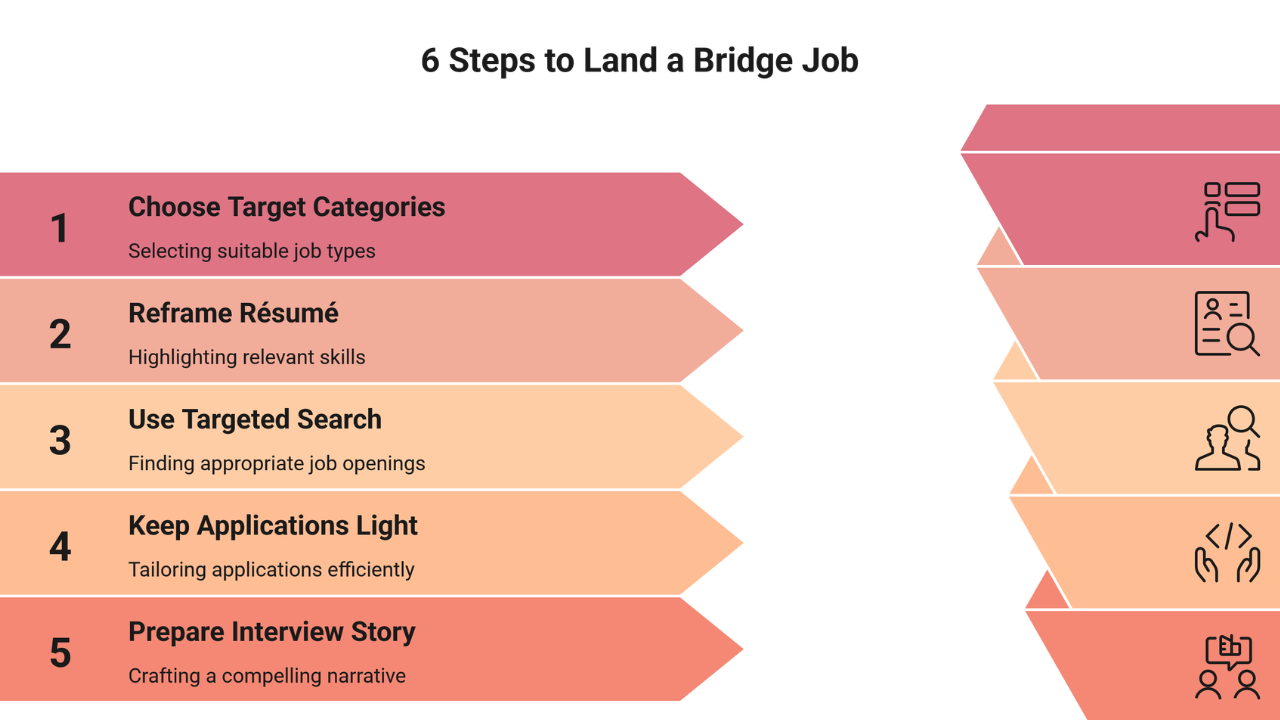
1. Decide your bridge job criteria
Write down:
- Ideal weekly hours (for example, 20–30 for a true downshift, 32–40 for a softer full‑time).
- Pay floor (the lowest number you can realistically accept).
- Non‑negotiables (for example, full remote vs. hybrid, no phone calls, certain time zones).
- Types of tasks that feel calming or neutral (data entry, email support, scheduling, etc.).
This becomes your filter so you’re not applying from panic.
2. Choose 1–2 target categories
Based on the list above, pick one or two categories that feel most tolerable, or even quietly enjoyable,for the next 6–12 months. For example:
- “Remote chat/email support + data entry.”
- “Online education support + operations coordinator.”
Focusing like this helps you tailor your résumé and talking points.
3. Reframe your résumé for “calm competence”
For a bridge job, your résumé doesn’t need to show ambition, it needs to show reliability, emotional maturity, and the specific tasks you can take off someone’s plate.
Try:
- Shrinking the emphasis on strategic leadership and expanding bullets that sound like the target job: handling inquiries, documenting processes, solving routine problems, managing schedules, using tools.
- Using a simple headline like “Customer Support & Operations Professional” or “Remote Administrative & Client Support” instead of senior‑level titles.
- Highlighting any past roles or projects where you did steady, repeatable work with clear systems.
This tells a hiring manager: “I will show up, learn your systems, and keep things running smoothly. I’m not here to take your job.”
4. Use targeted search phrases and platforms
On job boards, combine your category with your key filters:
- “Remote data entry – part time – flexible schedule”
- “Customer support chat – remote – no weekends”
- “Virtual assistant – remote – 20 hours – flexible”
- “Student success coach – remote – hybrid”
Prioritize:
- Remote‑first boards (FlexJobs, We Work Remotely, PowerToFly, similar sites).
- Larger employers known for remote work, which often list multiple entry‑level roles at once.
Set alerts so you’re seeing roles early, but don’t apply to everything; stick to your criteria.
5. Keep applications light but intentional
Because these roles often emphasize volume hiring and basic communication skills, you don’t need a 100% bespoke application each time, but you do want enough tailoring to show you’ve read the posting.
You can:
- Create one base résumé per category (for example, support vs. admin) and tweak a few bullet points per role.
- Write one or two short, reusable paragraphs for cover letters explaining your intentional downshift:
- “I’m intentionally seeking a steady, remote support role where I can contribute reliably and focus on delivering excellent customer experiences.”
- Emphasize: dependability, calm under pressure, comfort with tools, and willingness to learn.
6. Prepare a clear, confident story for interviews
You will likely be asked, “Why this role?” and “Why now?” In a cautious job market, interviewers want to know you won’t leave the minute you feel better.
You might say something like:
- “After several years in a high‑intensity leadership role, I made a deliberate decision to step into a more focused, execution‑oriented position. I want to bring my experience into a role where I can contribute steadily, have a reliable schedule, and do excellent work without being in the spotlight. This kind of role is exactly what I want for the next phase of my career.”
You’re not oversharing about burnout, but you’re honest about wanting a different rhythm.
Step 10: Set an Exit Plan for Your Bridge Job Phase
If you do choose a bridge job, one of the most loving things you can do for your future self is to define what “temporary” actually means.
Decide:
- How long you want this phase to last (for example, 6, 9, or 12 months).
- What success looks like for this season:
- Health: “I’m sleeping, my anxiety is down, I feel human again.”
- Clarity: “I’ve explored at least two potential next paths.”
- Skills: “I’ve completed a course, certification, or portfolio project toward my next step.”
- When you’ll start planning your next move (for example, “At month 4, I’ll start informational interviews again.”)
Think of it as a mini‑sabbatical inside the workforce: you’re working, yes, but the job’s primary purpose is to support your healing and exploration while keeping you safe financially.
If You’re Still Torn: A Simple Way to Decide Your Next Move
When you feel stuck between staying, leaping, or downshifting, it can help to look at three axes:
- Health (mental and physical)
- Money (stability and runway)
- Trajectory (future options and skills)
Ask yourself:
- Which option protects at least two of these three for me over the next 12 months?
- Which option feels like I’m abandoning myself?
- Which option feels like I’m backing myself?
A bridge job might protect your health and give you space to think, while putting some pressure on your finances.
Staying and renegotiating might protect your money and trajectory while you do the inner work and boundary‑setting.
A direct pivot might prioritize trajectory and money while asking more of your energy in the short term.
There is no one “right” answer here, only the answer that best serves the version of you that will be here a year from now.
If you’re ready to stop overthinking and make a clear, confident career move, my free masterclass Make a Career Change in 3 Simple Steps will walk you through exactly how to do it.

About Career Coach & Author
Theresa White, Career Clarity Expert, 5x Certified Career Coach, and the Founder of Career Bloom, is known for her expertise in guiding people to get unstuck and find the direction they need to move forward in their careers, fast. In a time when so many people are re-evaluating their work, Theresa offers actionable insights that empower clients to identify their true strengths and pursue work that genuinely aligns with their goals.
Theresa’s clients often call her sessions “epiphanies” and “transformational.” She brings immediate clarity to career goals, helping people unlock a deep understanding of what makes work fulfilling for them. Past participants consistently describe her approach as “spot on” and an “answer to questions they’d been asking for weeks.”
Theresa’s approach is empathetic yet practical, and she’s known for empowering clients with a clear direction in as little as 30 days, guaranteeing results.
Connect with Theresa on LinkedIn, listen to the Career Clarity Unlocked Podcast, or schedule your free 30-minute career clarity consultation.

Frequently Asked Questions About Bridge Jobs, Burnout, and Career Changes
What is a bridge job?
A bridge job is a temporary role designed to support a specific phase, usually recovery, clarity, or transition. It is not about long-term growth. It is about giving you enough stability and space to make a better next decision.
How do I know if I need a bridge job or a full career change?
If you are exhausted but still interested in the type of work, you are likely dealing with burnout. If you feel disconnected from the work itself, even when things are manageable, that points to misalignment. That distinction determines whether you need a reset or a bigger shift.
What should I focus on if I feel stuck in my career right now?
Focus on what you need this next phase to do for you, not what looks best on paper. If you want help working through that clearly and making a decision you feel confident in, I walk through this step by step in my free masterclass, Make a Career Change in 3 Simple Steps.
What Other Job Seekers Are Reading
- What to do when you're feeling stuck in career
- How to Find Your Perfect Career
- 8 progressive companies to work for
- 7 Message Templates to Reach Out to Recruiters
- How to Use AI to Find a Job in 2025: Why Soft Skills Still Matter
- Free Job Search Tracker
- Get Career Clarity In Just 30 Days!
- Take this 60 second quiz to see if a free career clarity call with my team is your next best step.
Subscribe now to never miss the latest blog!
Every Thursday, we cover an important topic, actionable advice, and inspiring content to help you find work that makes you feel like *pinch me* I'm getting paid to do this???
We hate SPAM. We will never sell your information, for any reason.