If you’ve ever sat at your desk, looked at your screen, and thought, “There has to be more than this…” you’re not alone.
I’ve had this conversation with hundreds of professionals over the years. Smart, driven, successful people… who feel deeply unfulfilled. Not because they’re doing poorly, but because something is missing.
And more often than not, what’s missing is impact.
The desire to contribute. To do work that matters. To feel like your effort is creating something good in the world.
But then the doubt creeps in:
- “I don’t have experience in social impact…”
- “I’d have to start from scratch…”
- “I can’t afford to take a huge pay cut…”
I hear this every single day.
So let me tell you something clearly, right from the start:
You do not need prior experience to transition into a social impact career.
And not only that, this might actually be one of the best times to make that transition.
Let me show you exactly how.
A Real Career Change Story: From Corporate to Social Impact
A client of mine—we’ll call her Sarah—came to me completely stuck.
She was working in corporate strategy at a large company. Great salary. Impressive title. Stable career.
And completely drained.
She told me, “I feel like I’m optimizing things that don’t matter.”
What she really cared about? Climate change. Sustainability. She had been thinking about it for years, but always dismissed it.
“That’s not my background.”
“I didn’t study that.”
“I wouldn’t even know where to start.”
Sound familiar?
Fast forward 9 months, Sarah is now working in a climate-focused startup, using the exact same strategic skills she used before… just applied to something she deeply cares about.
She didn’t go back to school.
She didn’t start over.
She didn’t take a massive pay cut.
She just learned how to position herself differently.
You can do that, too.
Prefer to listen? Tune into the full episode with Dolores Rio on Spotify
Expert Insight: Building a Social Impact Career with Dolores Rio
In a recent conversation, I sat down with Dolores Rio, a former humanitarian leader with over 23 years of experience in global public health, leading child nutrition programs and crisis response efforts in high-risk environments.
She has spent her career working on complex global challenges, and her perspective on building a meaningful career is both practical and grounded in real experience.
We talked about what it actually takes to transition into social impact work, especially for people coming from corporate backgrounds who feel like they are starting from scratch.
One of the most powerful insights Dolores shared with me was this:
Step 1: There Is a Place for You in Social Impact Careers
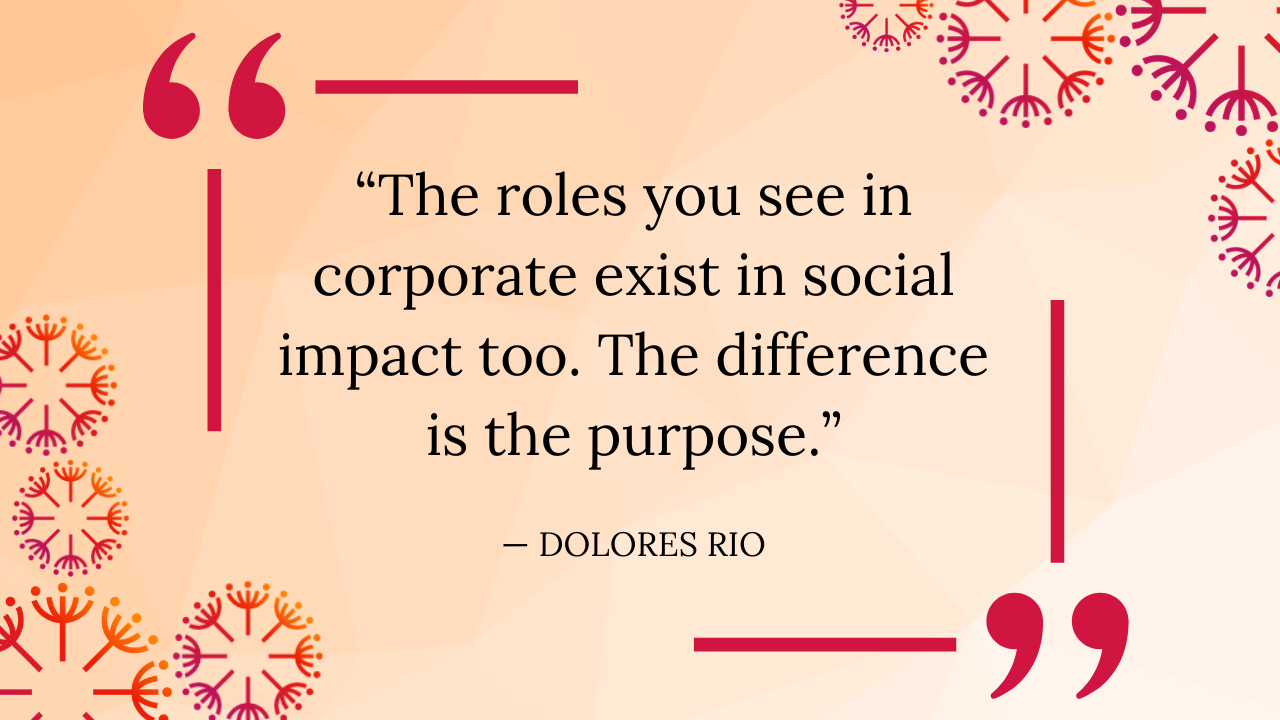
The roles you see in corporate exist in social impact too. The difference is the purpose.
Let that sink in.
You don’t need to become a completely different person.
If you’re in:
- Marketing → nonprofits and social enterprises need marketing
- Finance → they need financial modeling and budgeting
- Operations → they need people who can scale impact
- HR → they need talent strategy
The skills are transferable. The context changes.
Dolores put it beautifully:
It’s not about what you do. It’s about what your work is contributing to.
And here’s the part most people miss:
The social impact sector needs people like you.
It needs:
- New thinking
- Business acumen
- Innovation
- Efficiency
This isn’t charity work. This is complex, evolving, high-stakes work that benefits from diverse experience.
Step 2: How Social Impact Careers Are Expanding
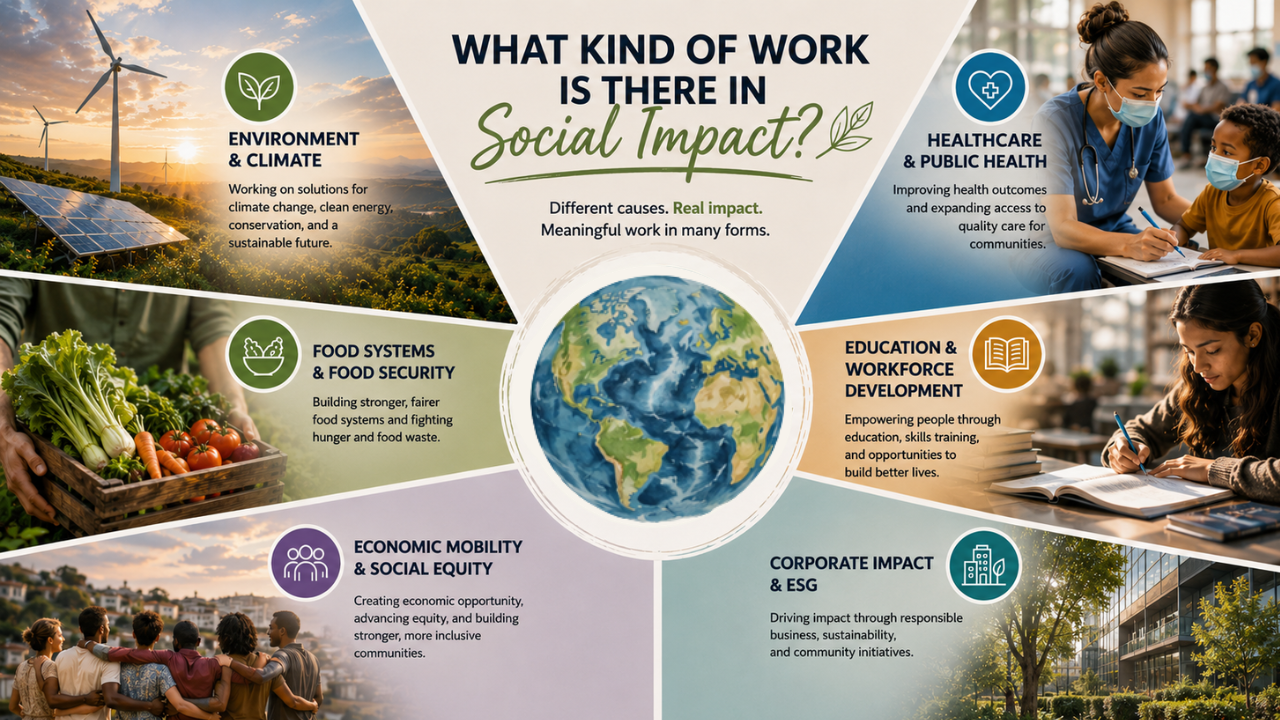
If you’re picturing social impact as only nonprofits and NGOs, we need to update that mental model.
Because the field has expanded—massively.
Dolores highlighted something incredibly important:
Social impact is no longer confined to traditional organizations.
It’s now happening in:
- Corporate Social Responsibility (CSR) teams
- Sustainability departments
- Tech startups (especially climate and health)
- B Corps and social enterprises
- Philanthropic organizations
In other words:
There are more entry points than ever before.
This is exactly how Sarah made her move.
She didn’t jump straight into a nonprofit. She transitioned into a climate-tech company, where her existing skill set was highly valuable.
So instead of asking:
“How do I break into nonprofit work?”
Ask:
“Where is impact happening, and where do my skills fit into that?”
Step 3: Choose Your Entry Point Strategically
Let’s make this practical.
Here are three powerful ways to transition, depending on your situation:
🔹 Option 1: Transition Within Your Current Company
This is often the easiest and most overlooked path.
Look for:
- CSR (Corporate Social Responsibility)
- ESG (Environmental, Social, Governance)
- Sustainability initiatives
Dolores calls this a “natural move,” because you’re staying in your environment while shifting your focus.
Action step:
- Search internally for CSR or sustainability teams
- Reach out to someone working there
- Ask how your skills could support their work
🔹 Option 2: Move Into Adjacent Impact Spaces
Think:
- Climate-tech startups
- Health-tech companies
- Social enterprises
- B Corps
These organizations often value corporate experience highly.
Action step:
- Identify 10 companies aligned with causes you care about
- Analyze their teams: what roles exist?
- Look for overlaps with your current skill set
🔹 Option 3: Transition Into Philanthropy or Nonprofits
Yes, this is still an option, but here’s the key:
Don’t position yourself as “starting from zero.”
Dolores emphasized this clearly:
- Organizations need expertise
- They invest in talent
- They are not looking for beginners, they’re looking for value
Step 4: Stop Leading With Experience (And Start Leading With Value)
This is where most people get stuck.
They say:
- “I don’t have experience in this field…”
And immediately disqualify themselves.
But here’s the shift that changes everything:
Hiring managers don’t hire experience. They hire value.
Your job is to translate your experience into their world.
Instead of saying:
“I’ve worked in operations for 5 years.”
Say:
“I’ve scaled systems that improved efficiency by 30%, and I see opportunities to apply that to expand your program reach.”
See the difference?
Dolores put it this way:
You need to connect the dots for them.
🔧 Action Exercise: Build Your “Impact Translation”
Write this out:
- What have I done?
(skills, achievements, results) - What impact did that create?
(efficiency, growth, savings, reach) - How does that apply to this organization’s mission?
This becomes your narrative.

Step 5: How to Network for a Career Change (Before You Apply)
This might surprise you.
But one of the most important pieces of advice from Dolores is:
Don’t just apply. Talk to people first.
Why?
Because:
- Job descriptions are incomplete
- You don’t fully understand the role yet
- You don’t know what they actually need
And more importantly:
Conversations position you as someone who already understands the space.
🗣️ How to Do This (Step-by-Step)
- Find people in roles you’re interested in (LinkedIn is your best friend)
- Send a simple message:
“I’m exploring a transition into [field] and would love to learn about your experience.” - Ask:
- What challenges are you facing in your role?
- What skills are most valuable right now?
- What would make someone stand out?
- Listen carefully, and take notes
- Reflect:
- Where do your skills align?
- Where are the gaps?
Why This Works
Because when you do apply, you won’t sound like an outsider.
You’ll sound like someone who:
- Understands the challenges
- Speaks their language
- Knows how to contribute
That’s a completely different candidate.
Step 6: Let’s Talk About Money (Honestly)
We need to address this.
Because it’s real.
Yes, there can be a pay difference.
Dolores shared that sometimes:
It may be around 10–20% lower initially
But that’s not the whole picture.
Here’s what I want you to consider:
1. Growth Potential
When you’re aligned, you grow faster.
When you grow faster, you earn more long-term.
2. Quality of Life
What is it worth to:
- Feel fulfilled
- Be energized by your work
- Stop dreading Mondays
3. It’s Not Always a Pay Cut
Especially in:
- International roles
- Senior positions
- Specialized impact sectors
Many professionals are well-compensated.
The real question is not:
“Will I lose money?”
It’s:
“What kind of life am I optimizing for?”
Step 7: Redefine What “Impact” and Meaningful Work Mean to You
Here’s something I want you to pause and think about:
Impact does not look the same for everyone.
Dolores shared a powerful example of someone who realized:
Her greatest impact wasn’t global policy.
It was raising her children well.
And that mattered just as much.
So ask yourself:
- Do I want local impact or global impact?
- Do I want direct impact or strategic impact?
- What problems do I feel drawn to solve?
There’s no right answer.
Only your answer.
Step 8: Your First Step to Transition Into a Social Impact Career (Start Here)
If you take one thing from this entire post, let it be this:
Clarity comes from engagement, not overthinking.
So here’s your starting point:
Step 1: Get Honest With Yourself
Ask:
- What problems in the world do I care about?
- Where do I feel that pull consistently?
Step 2: Map Your Skills
Write down:
- What you’re good at
- What you’ve achieved
- What impact you’ve already created
Step 3: Start Conversations
- Reach out to 3 people this week
- Learn, listen, explore
Free Resources to Help You Find Career Clarity
Feeling like this might be your next step, but not sure where to start?
Book a free 30-minute Career Clarity Call with my team and let’s map out what this could actually look like for you.
We’ll look at where you are, what you want, and how to start moving toward work that feels aligned, without starting over.
Final Thoughts on Transitioning Into Meaningful Work
You don’t need permission to do meaningful work.
You don’t need to “start over.”
You don’t need to have it all figured out.
What you need is:
- Clarity
- Courage
- And a willingness to take the first step
Because once you do, things start to move.
Opportunities open up.
Conversations lead somewhere.
And suddenly, what once felt impossible… becomes real.
Just like it did for Sarah.
And just like it can for you.
You can do that, too.
About Career Coach & Author
Theresa White, Career Clarity Expert, 5x Certified Career Coach, and the Founder of Career Bloom, is known for her expertise in guiding people to get unstuck and find the direction they need to move forward in their careers—fast. In a time when so many people are re-evaluating their work, Theresa offers actionable insights that empower clients to identify their true strengths and pursue work that genuinely aligns with their goals.
Theresa’s clients often call her sessions “epiphanies” and “transformational.” She brings immediate clarity to career goals, helping people unlock a deep understanding of what makes work fulfilling for them. Past participants consistently describe her approach as “spot on” and an “answer to questions they’d been asking for weeks.”
Theresa’s approach is empathetic yet practical, and she’s known for empowering clients with a clear direction in as little as 30 days, guaranteeing results.
Connect with Theresa on LinkedIn, listen to the Career Clarity Unlocked Podcast, or schedule your free 30-minute career clarity consultation.

FAQs About Transitioning Into a Social Impact Career
Do I need experience to work in social impact?
No, you don’t need direct experience in social impact to make the transition.
What matters most is how you position your existing skills. The same roles that exist in corporate environments also exist in social impact organizations. The difference is the purpose behind the work. If you can clearly show how your experience creates value in a mission-driven context, you are already more qualified than you think.
Can I transition into nonprofit or impact roles without taking a pay cut?
It depends, but not always.
There can be situations where salaries are slightly lower, especially during a transition or if you are moving into a completely new type of role. But that’s not the full picture.
Many nonprofit and social impact organizations understand that they need strong talent to create real results. They are not looking for people without expertise. They invest in people who can bring skills, structure, and impact. Because of that, many roles, especially at the mid-career and senior level, are well compensated.
In some cases, particularly in global or specialized sectors, compensation and benefits can be very competitive. The more important question becomes what kind of work you are growing in and what that leads to over time.
What skills are most valuable in social impact careers?
The most valuable skills are often the same ones that are valued in the corporate world.
Organizations need people who can think strategically, manage projects, communicate clearly, and make decisions based on data. They need people who can lead teams, build systems, and help ideas turn into real outcomes.
The difference is not the skill itself. It’s how that skill is being used and what it is contributing to.
What Other Job Seekers Are Reading
- What to do when you're feeling stuck in career
- How to Find Your Perfect Career
- 8 progressive companies to work for
- 7 Message Templates to Reach Out to Recruiters
- How to Use AI to Find a Job in 2025: Why Soft Skills Still Matter
- Free Job Search Tracker
- Get Career Clarity In Just 30 Days!
- Take this 60 second quiz to see if a free career clarity call with my team is your next best step.
Subscribe now to never miss the latest blog!
Every Thursday, we cover an important topic, actionable advice, and inspiring content to help you find work that makes you feel like *pinch me* I'm getting paid to do this???
We hate SPAM. We will never sell your information, for any reason.