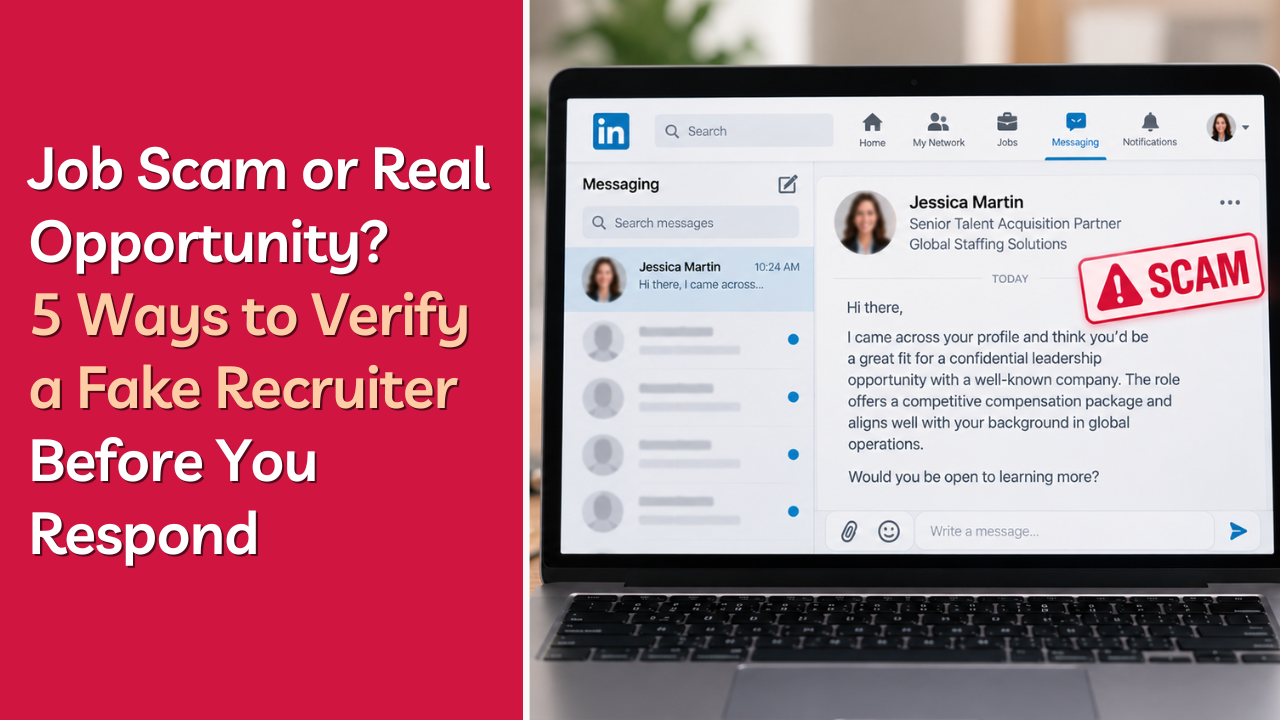
A client recently forwarded me an email about a job opportunity that, at first glance, looked promising.
A recruiter said she was reaching out about a confidential leadership opportunity with an attractive compensation package. She referenced the candidate's background in enough detail to make the message feel personal. Her signature identified her as an HR recruiter for a well-known staffing company and included a LinkedIn profile.
There was just one thing that bothered my client.
The message came from Gmail.
She asked me, essentially, Is this real? Am I being too suspicious?
So I started looking.
The Gmail address was unusual. The supposed recruiter wouldn't provide much information about the employer or position. When my client suggested a phone conversation, the sender steered her back toward continuing over email.
More important, the LinkedIn profile belonged to a real person who had once worked in recruiting. But current public information indicated that person had moved into an entirely different profession.
That changed the question.
It wasn't, "Is this recruiter a real person?"
It was, "Is the person sending these emails actually the person she claims to be?"
Those are two very different questions.
And if you're looking for your next role, knowing that distinction can save you a lot of trouble.
Job scams are real. But not every questionable job is a scam.
I don't want you approaching your job search convinced that everyone is trying to deceive you. That's neither useful nor accurate.
But the problem is significant enough that some basic verification now needs to be part of a smart job search.
FTC data shows that reports of job scams tripled between 2020 and 2024, while reported losses increased from $90 million to $501 million.
Even LinkedIn reports that 72% of professionals now stop at least sometimes to consider whether a job is legitimate before applying.
There's also another problem you've probably heard about: ghost jobs.
In July 2026, the Texas Attorney General opened an investigation into LinkedIn over allegations that the platform advertised or profited from fake or misleading job opportunities while selling Premium subscriptions. The investigation is ongoing, so this is an allegation, not a finding that LinkedIn violated the law.
But here's an important distinction.
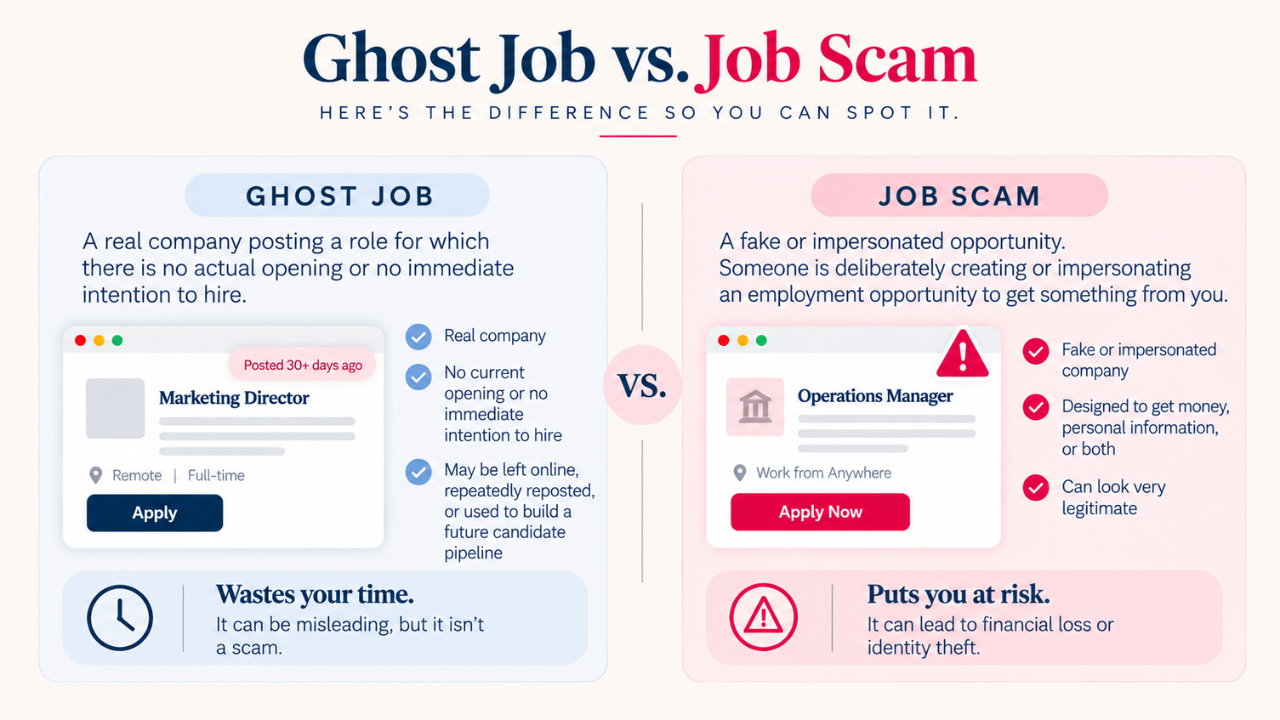
A ghost job is generally a posting for which there is no actual opening or no immediate intention to hire. It may have been left online, repeatedly reposted, or used to build a future candidate pipeline.
A job scam has a different purpose.
Someone is deliberately creating or impersonating an employment opportunity to get something from you.
Usually money, personal information, or both.
That distinction matters because the way you protect yourself is different.
A fake recruiter can look surprisingly real
This is where the email my client received becomes useful.
The sender hadn't invented a ridiculous company. She claimed to represent a major staffing organization.
She hadn't invented an obviously fake recruiter, either.
There was a real LinkedIn profile.
The email signature included a photo, employment history, location, biography, and LinkedIn link. The outreach referenced my client's professional background and explained why her experience might fit the supposed opportunity.
That's exactly what makes sophisticated recruiter impersonation so convincing.
The FBI has warned that scammers use legitimate company information to create fraudulent job postings and impersonate businesses. The FTC has also documented scammers posing as recruiters for well-known companies on LinkedIn and other job platforms.
Imagine how easy the personalization has become.
Your LinkedIn profile tells someone where you've worked, what you do, where you went to school, what you've accomplished, and sometimes that you're looking for a job.
A scammer doesn't need to write, "Dear Applicant."
They can write:
Your background in global operations, strategic partnerships, and program development really caught my attention.
That feels different.
But it may simply mean someone, or an AI tool, read your LinkedIn profile.
Personalized doesn't necessarily mean verified.
How fake recruiter scams typically work
The first message may not ask for anything dangerous.
That's important.
A scammer may simply want you to respond.
The FTC warned in 2026 about fake recruiters who start with vague job opportunities and ask recipients to reply that they're interested. Only later does the request for money appear.
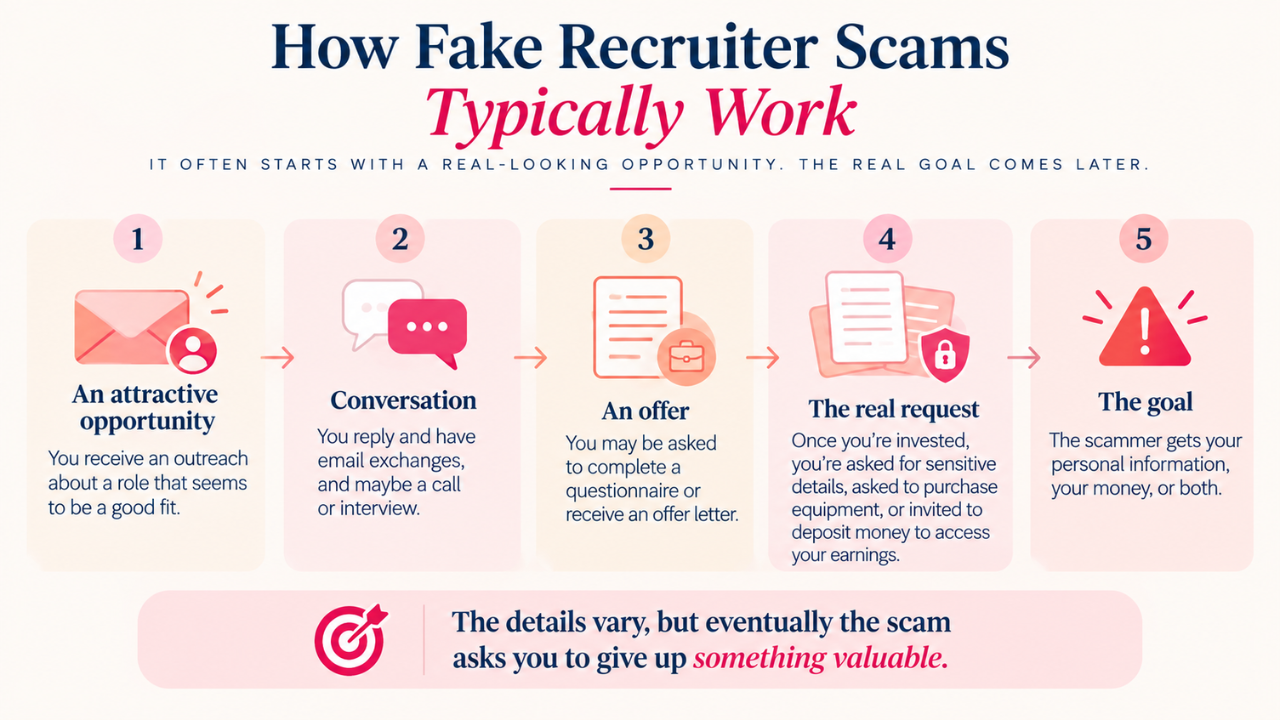
So think of the process in stages.
First comes the attractive opportunity.
Then conversation.
Then perhaps an interview or questionnaire.
Then an offer.
Only after you've become invested in the possibility of getting the job does the real objective appear.
That could be "onboarding paperwork" requesting your Social Security number, driver's license, bank information, or other identity data.
Or you're told that the company will send you a check to purchase your home-office equipment. You deposit it, buy equipment from an "approved vendor," and later discover that the original check was fraudulent. The bank reverses the check. The money you sent was real.
Another version involves simple online work, like rating products or completing “optimization” tasks. You appear to earn commissions until you're told you need to deposit your own money, often in cryptocurrency, before you can access your earnings. The FTC warns that those earnings may never have been real in the first place.
The details vary, but eventually the scam asks you to give up something valuable.
Why job scams are getting harder to spot
There isn't one type of scammer.
Some schemes can be run by individuals or small groups. Others are more organized operations using multiple fake identities, websites, email addresses, job postings, and payment accounts.
And you can no longer depend on bad grammar to save you.
A message can be polished. A résumé can be studied. A recruiter can appear knowledgeable about your industry. An offer letter can carry the correct logo.
That means appearance is becoming less useful as proof.
A professional-looking message isn't proof that the person behind it is legitimate. That's why you have to verify what you're being told instead of relying on how convincing the outreach looks.
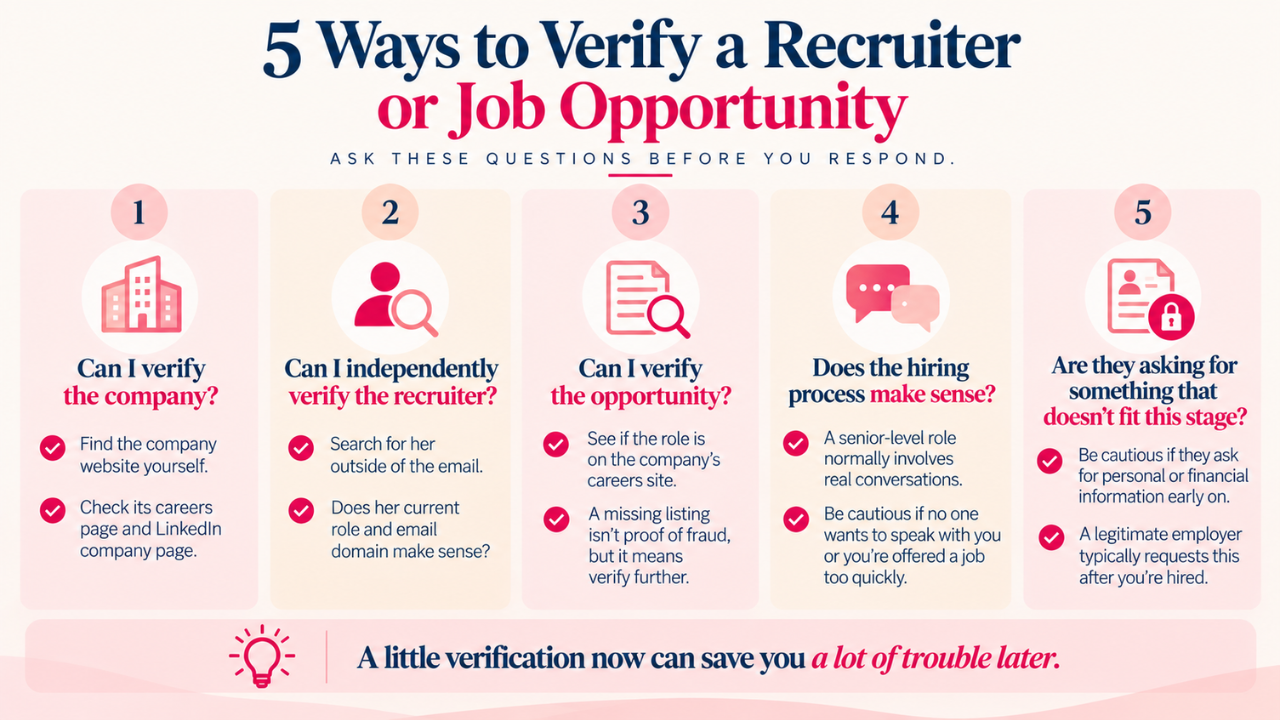
5 ways to verify a recruiter or job opportunity
This is the part I most want you to take away.
If you've been looking for months, you're already dealing with enough uncertainty. The answer isn't to distrust every recruiter who contacts you.
It's to change how you decide whom to trust.
I recommend five questions:
1. Can I verify the company?
Find its website yourself. Check its careers page. Look at its LinkedIn company page and broader online presence.
2. Can I independently verify the recruiter?
Don't only click the LinkedIn link in her email. Search for her independently. Does her current employment match what she's telling you? Does the email domain make sense?
Most important, remember our earlier example: finding a real person with that name doesn't prove the person emailing you is that person.
3. Can I verify the opportunity?
If you found the job on LinkedIn or another board, see whether it appears on the employer's careers site. LinkedIn's 2026 survey found that 57% of professionals search for the company or role independently, while 47% check the company's careers site.
A missing listing isn't automatic proof of fraud. Executive recruiters conduct confidential searches. Companies use outside agencies.
It simply means you verify further.
4. Does the hiring process make sense?
A senior-level search normally involves real conversations.
If you're supposedly being considered for a $175,000 leadership position but nobody wants to speak with you, that's worth questioning.
So is being offered a job almost immediately.
5. Are they asking for something that doesn't fit this stage?
This may be the easiest test of all.
A legitimate employer eventually needs sensitive information. Once you're hired, providing tax information, identity documents, and direct-deposit details is normal.
Providing them before you've had a legitimate interview and verified the employer is very different.
Watch for clusters of red flags
One odd detail doesn't automatically make something a scam.
A recruiter using Gmail? I'd investigate.
A confidential employer? That's possible.
An unsolicited recruiter message? Completely normal.
But Gmail plus no identifiable position plus an unusually attractive compensation package plus no live conversation plus pressure to provide personal information?
Now we have a pattern.
Other reasons to stop and verify include pressure to move immediately to WhatsApp or Telegram, urgency, vague job responsibilities, requests for sensitive information early in the process, or a recruiter who becomes evasive when you ask basic questions.
LinkedIn says 90% of scam messages reported in its 2026 research involved attempts to move conversations to private messaging.
You don't need to diagnose the scam.
You just need enough uncertainty to justify checking.
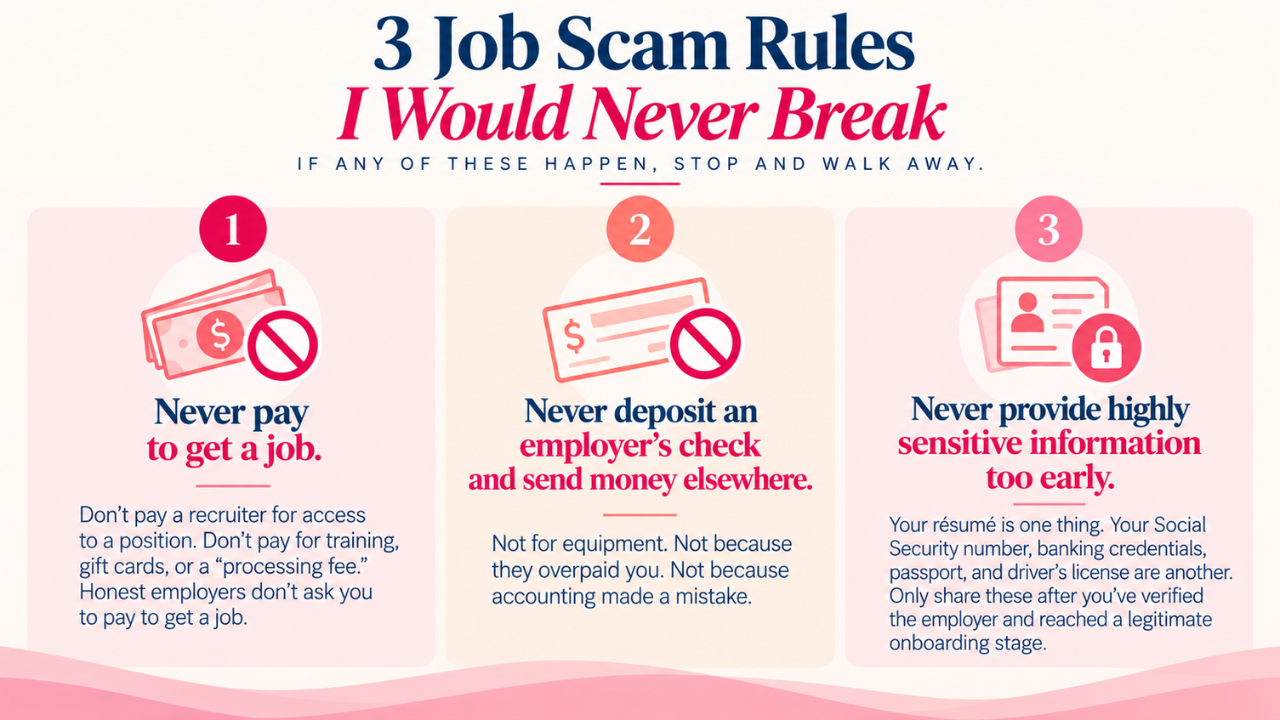
3 job scam rules I would never break
There are three places where I would stop rather than investigate further.
Never pay to get a job.
Don't pay a recruiter for access to a position. Don't pay an employer for training before they'll hire you. Don't buy gift cards. Don't pay a "processing fee." The FTC's guidance is wonderfully uncomplicated here: honest employers don't ask you to pay to get a job.
Never deposit an employer's check and send money somewhere else.
Not for equipment. Not because they overpaid you. Not because accounting made a mistake.
Never provide highly sensitive information until you've independently verified the employer and reached a legitimate onboarding stage.
Your résumé is one thing. Your Social Security number, banking credentials, passport, and driver's license are another.
It's okay to test the recruiter
You don't have to accuse anyone of being a scammer.
Try something simple:
Thanks for reaching out. I'm interested in learning more. Could you send the full job description from your company email and share a few times for a 15-minute phone or video conversation?
Then pay attention to what happens.
A legitimate recruiter should be able to answer reasonable questions about the position and establish who they are.
If someone repeatedly avoids reasonable attempts to verify who they are or discuss the role live, I wouldn’t keep moving forward until I could independently confirm the opportunity.
And if you’re contacted through LinkedIn, don’t be too eager to move somewhere else. Staying on the platform initially gives you additional identity and reporting signals.
Before you get excited about the opportunity, check two things
When a recruiter reaches out with an interesting role, there are really two separate questions to answer.
Is this opportunity legitimate?
And:
Is this actually a role I want?
Those questions can get blurred together, especially when you’ve been searching for a while or you’re ready to leave your current job. A flattering message, impressive title, or bigger salary can make an opportunity feel more compelling before you’ve really looked at whether it fits.
That’s why I want you to verify the recruiter and the opportunity first.
Then, if it checks out, evaluate the role on its own merits.
Does the work actually interest you?
Would you be using the strengths you want to keep using?
Does the role move you toward the kind of career you want next, or is it another version of what you already know you don’t want?
That second part is the work I do with women every day.
If you know something needs to change but you’re still not clear on what the right next move looks like, book your free 30-minute career clarity call. We can start by getting clear on what you actually want to target, so you’re not evaluating every opportunity from scratch when it lands in your inbox.
A promising opportunity still needs two green lights:
It needs to be real. And it needs to be right for you.
About Career Coach & Author
Theresa White, Career Clarity Expert, 5x Certified Career Coach, and the Founder of Career Bloom, is known for her expertise in guiding people to get unstuck and find the direction they need to move forward in their careers—fast. In a time when so many people are re-evaluating their work, Theresa offers actionable insights that empower clients to identify their true strengths and pursue work that genuinely aligns with their goals.
Theresa’s clients often call her sessions “epiphanies” and “transformational.” She brings immediate clarity to career goals, helping people unlock a deep understanding of what makes work fulfilling for them. Past participants consistently describe her approach as “spot on” and an “answer to questions they’d been asking for weeks.”
Theresa’s approach is empathetic yet practical, and she’s known for empowering clients with a clear direction in as little as 30 days, guaranteeing results.
Connect with Theresa on LinkedIn, listen to the Career Clarity Unlocked Podcast, or schedule your free 30-minute career clarity consultation.

FAQ: How to Spot Job Scams and Fake Recruiters During Your Job Search
How can I tell if a recruiter is real or a job opportunity is a scam?
Don’t rely on how professional the message looks. Instead, verify the recruiter somewhere other than the place they contacted you.
Go directly to the staffing agency or company website, confirm that the recruiter currently works there, and check whether their email address matches the company’s domain. If you’re still unsure, contact the company using information you find independently rather than a phone number or link provided in the recruiter’s message.
Also remember that finding a real LinkedIn profile isn’t enough. Scammers can impersonate real recruiters. You’re trying to verify that the person contacting you is actually the person they claim to be.
Can a job posting be fake even if it’s on LinkedIn or another legitimate job site?
Yes. A legitimate platform can still contain fraudulent job postings, and scammers can also impersonate real companies or recruiters.
Before applying or sharing sensitive information, search for the company independently and see whether you can verify the opportunity through its official website or recruiting team. If you can’t find the position on the company’s careers page, that doesn’t automatically mean it’s a scam. Some companies use outside recruiters or conduct confidential searches. It does mean you should verify the opportunity another way before moving forward.
And distinguish a job scam from a ghost job. A ghost job may come from a real company that doesn’t currently intend to fill the advertised position. A job scam is deliberately designed to deceive you, often to obtain money or personal information.
What should I do if a recruiter contacts me about a job I’m interested in?
Verify the opportunity before letting the excitement of being recruited make the decision for you.
First, confirm that the recruiter and job are legitimate. Then ask a separate question: Would I actually want this job if it hadn’t landed in my inbox?
Look beyond the title and salary. Consider the work you’d actually be doing, the strengths you’d be using, the problems you’d be solving, the environment you’d be working in, and whether the role moves you toward what you want next or simply gives you another version of a career you’re trying to leave.
If that second question is the harder one, book a free 30-minute Career Clarity Call. We’ll start figuring out what actually fits you now, so you have clearer criteria for deciding which opportunities deserve your attention and which ones don’t.
What Other Job Seekers Are Reading
- What to do when you're feeling stuck in career
- 8 progressive companies to work for
- 7 Message Templates to Reach Out to Recruiters
- Free Job Search Tracker
- Get Career Clarity In Just 30 Days!
- The Job Search Strategy That Doubles Your Chances of Getting Hired
- How to Ask for a Job Referral Without Sounding Entitled
- My Top 5 Tips to Succeed in a Job Interview
- Take this 60 second quiz to see if a free career clarity call with my team is your next best step.
Subscribe now to never miss the latest blog!
Every Thursday, we cover an important topic, actionable advice, and inspiring content to help you find work that makes you feel like *pinch me* I'm getting paid to do this???
We hate SPAM. We will never sell your information, for any reason.