
Job interviews can feel intimidating. Your palms get sweaty, your mind races, and suddenly you forget every accomplishment you’ve ever had.
If you’ve ever walked out of an interview replaying every answer in your head or wondering why someone else got the offer, you know exactly how frustrating the process can feel.
I’ve spent years coaching professionals through career transitions, interviewing candidates as a recruiter, and helping clients land opportunities that completely changed the trajectory of their lives. And one thing I can tell you with absolute certainty is this:
Interviewing is a skill.
It is not something you’re simply “good” or “bad” at. It’s something you can learn, practice, and improve.
In today’s job market, competition is real.
But here’s the good news: most candidates are not preparing strategically. They’re applying to jobs, hoping for interviews, and then walking into those interviews without a clear plan for how to stand out. That means you already have an advantage if you prepare intentionally.
The truth is, you do not need to be the most qualified person in the room to get hired. You need to be the person who communicates your value most clearly and confidently.
And you can absolutely do that.
Over the years, I’ve identified five things that consistently separate candidates who get offers from candidates who don’t.
If you master these five interview strategies, you will dramatically increase your chances of turning interviews into job offers.
Let’s dive in.
Prefer to listen? Tune into the full episode here on Spotify.
1. How to Answer “Tell Me About Yourself” in a Job Interview
The beginning of the interview matters more than most people realize.
Within the first few minutes, interviewers are already making assumptions about whether you are someone they should pay close attention to. That doesn’t mean the interview is decided immediately, but first impressions absolutely shape the rest of the conversation.
And that’s why your answer to “Tell me about yourself” is so important.
This question might also sound like:
- “Walk me through your resume.”
- “Tell me a little about your background.”
- “How did you get here?”
Most candidates make one major mistake: they simply summarize their resume chronologically.
But that’s not what the interviewer actually wants.
The interviewer already has your resume.
What they’re really asking is:
“Do you understand what we need, and are you the person who can help us solve it?”
That’s the mindset shift that changes everything.
Here’s how to structure a powerful answer:
Start with the problem the role exists to solve.
Before your interview, ask yourself:
- Why does this role exist?
- What challenge is the company trying to solve?
- What result are they hoping this person will create?
Then begin your answer by speaking directly to that.
For example:
“What excites me most about this role is the opportunity to help organizations build stronger client relationships and grow meaningful community engagement.”
Immediately, the interviewer knows you understand the bigger picture.
Briefly introduce your background.
Share:
- Your current or most recent role
- Your industry
- Your years of experience
Keep it concise.
Highlight your superpower.
What do you want to be known for?
Maybe it’s:
- Building relationships
- Leading teams
- Solving complex problems
- Driving growth
- Creating systems and structure
This is your differentiator.
Back it up with a quick accomplishment.
Don’t just tell them you’re great at something. Show them.
For example:
“In my previous role, I helped grow community participation by over 200% within 14 months through strategic outreach and engagement initiatives.”
Tie it back to this role.
Finish by connecting your experience to the position you’re interviewing for and express genuine enthusiasm.
And please, let yourself sound excited.
One of the biggest things I noticed as a recruiter was that nervousness often caused candidates to become overly robotic or stoic.
But companies don’t just hire qualifications. They hire energy, motivation, and people who genuinely care about the work.
You don’t need to be over the top. But your passion should come through.
Because confidence and excitement are contagious.
2. Prepare Accomplishment Stories Using the CAR Method
This is where most interview preparation goes wrong.
Candidates try to memorize answers to every possible interview question.
That approach usually backfires.
Instead, prepare five strong accomplishment stories that demonstrate the skills most important for the role.
Why?
Because most interviews are built around behavioral questions like:
- “Tell me about a time you handled conflict.”
- “Describe a challenging project.”
- “Tell me about a time you showed leadership.”
- “How have you dealt with difficult stakeholders?”
The interviewer is trying to understand how you think, solve problems, and operate in real situations.
And generic answers are forgettable.
If someone asks:
“Tell me about a difficult customer situation.”
And you respond with:
“Well, generally when customers are upset, I try to listen carefully…”
…you’re staying too abstract.
Instead, walk them through one specific example.
I personally prefer the CAR Method over the traditional STAR Method because it’s easier to remember and more impactful.
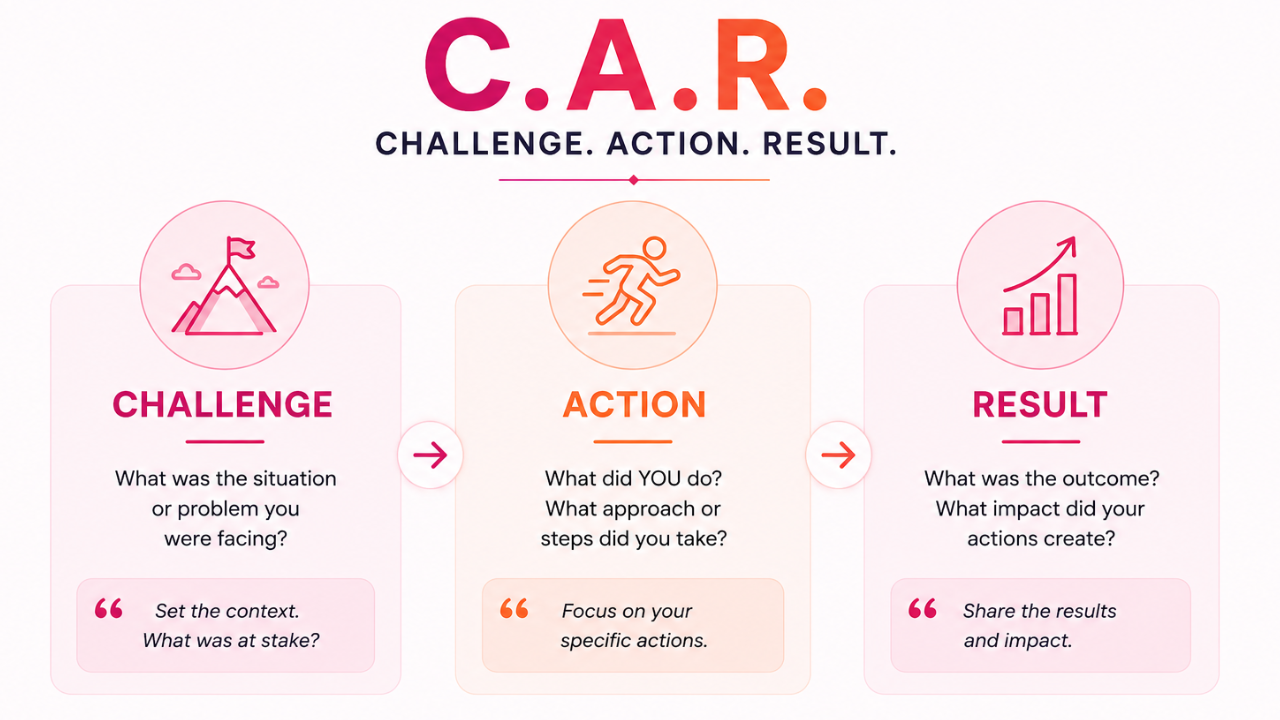
CAR stands for:
- Challenge
- Action
- Result
Step 1: Explain the Challenge
Set the scene clearly.
What problem existed?
What was at stake?
For example:
“Our team experienced a significant decline in community event participation, which threatened future funding tied to engagement metrics.”
Now the interviewer understands the context and urgency.
Step 2: Explain Your Action
What did you specifically do?
This is where many candidates undersell themselves.
Be detailed enough that the interviewer can actually picture you solving the problem.
For example:
“I launched a community feedback initiative to identify participation barriers, redesigned our communication strategy across social media and newsletters, and introduced themed events based on resident interests.”
Now they can visualize your leadership and strategy in action.
Step 3: Share the Result
What happened because of your work?
Whenever possible, quantify it.
For example:
“Within six months, event attendance increased by 35%, and we secured 20% more funding from local business partners.”
That’s powerful.
The interviewer is no longer imagining whether you could succeed.
They’re remembering proof that you already have.
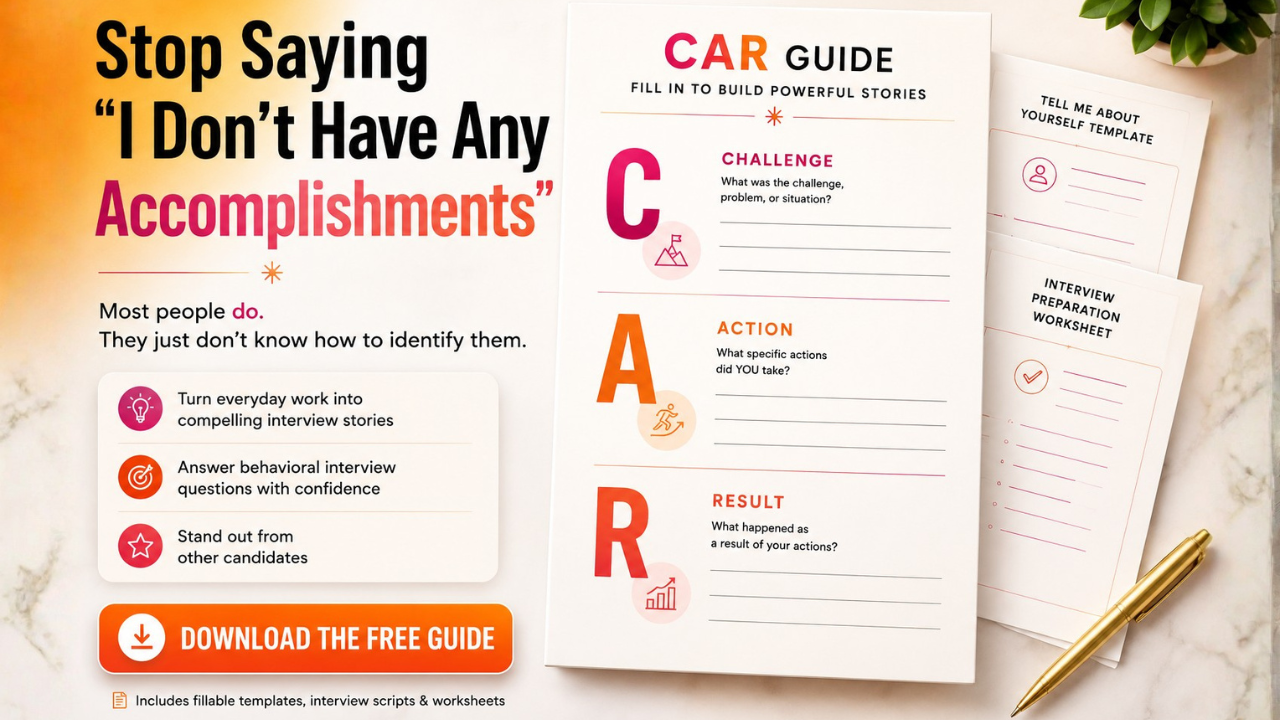
Stop Saying You Don't Have Accomplishments
I hear this all the time:
“But I don’t really have accomplishments.”
Yes, you do.
Most people simply don’t recognize them.
An accomplishment does not have to mean:
- Winning an award
- Leading a huge team
- Generating millions in revenue
If your actions created a better outcome than what would have happened otherwise, that counts.
Ask yourself:
“What would have happened if I had not done this?”
If the answer is:
- things would have taken longer,
- clients would have been frustrated,
- projects would have stalled,
- communication would have broken down,
- deadlines would have been missed,
…then your work mattered.
That is an accomplishment.
What if you don’t have measurable results?
That’s okay too.
You can still quantify the environment around your work.
Weak
- Helped streamline internal processes.
Stronger
- Standardized operational procedures across 5+ internal teams, helping reduce duplicate work and minimizing delays during high-volume periods.
Weak
- Reviewed contracts and policies.
Stronger
- Managed review processes for 25+ vendor agreements annually, helping reduce legal risk and improve turnaround time for cross-functional approvals.
Weak
- Assisted customers with issues.
Stronger
- Resolved high-volume customer inquiries while maintaining service support for 100+ client accounts during peak operational periods.
See the difference?
Numbers create credibility and scale.
And you do not need exact data to make your experience stronger. Honest estimates are perfectly acceptable if you clearly communicate them appropriately.
The goal is not perfection.
The goal is helping the interviewer understand the scope and impact of your work.
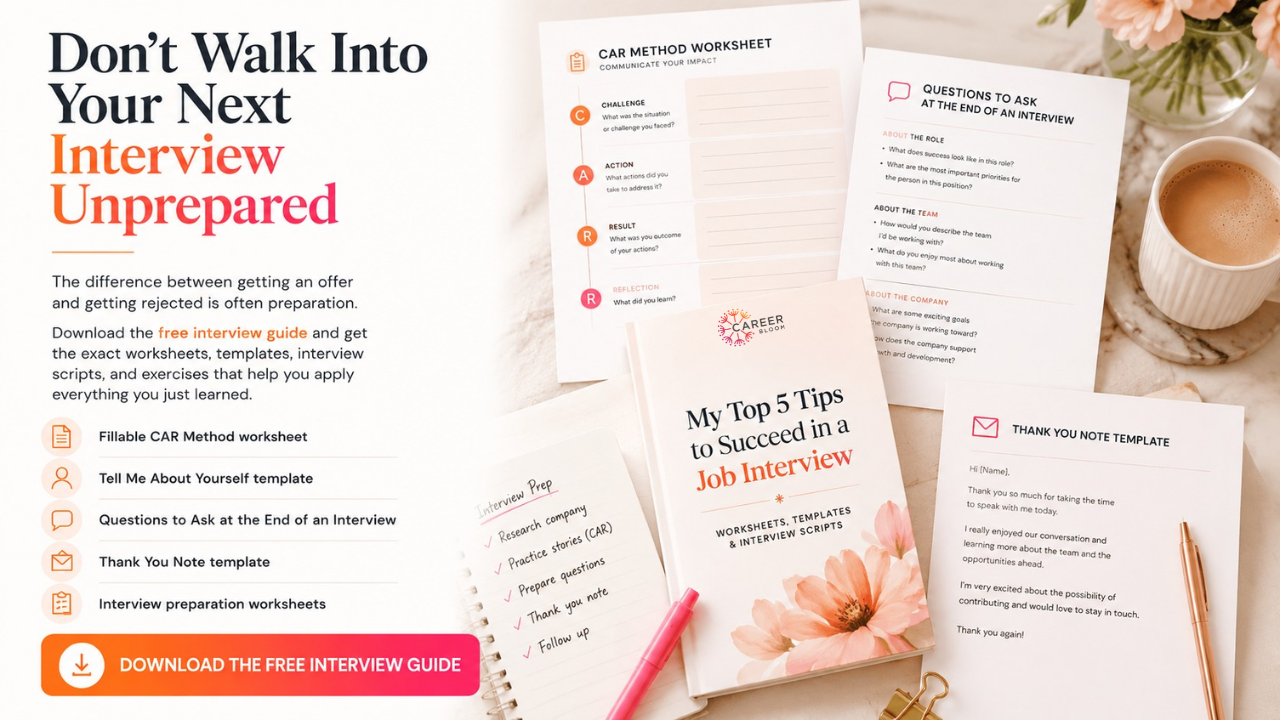
Download the free CAR Method worksheet and interview guide here.
3. Ask Thoughtful Questions at the End of a Job Interview
Please do not say:
“Nope, I don’t have any questions.”
I cannot emphasize this enough.
When I worked in recruiting, this was one of the biggest red flags.
Think about it:
You are potentially deciding where you will spend 40 hours a week. How could you possibly have no questions?
Interviews are a two-way conversation.
Yes, the company is evaluating you.
But you should also be evaluating them.
Thoughtful questions demonstrate:
- curiosity,
- engagement,
- preparation,
- strategic thinking,
- and genuine interest.
I recommend preparing at least five questions in advance.
You may only ask three, but some might already get answered naturally during the conversation.
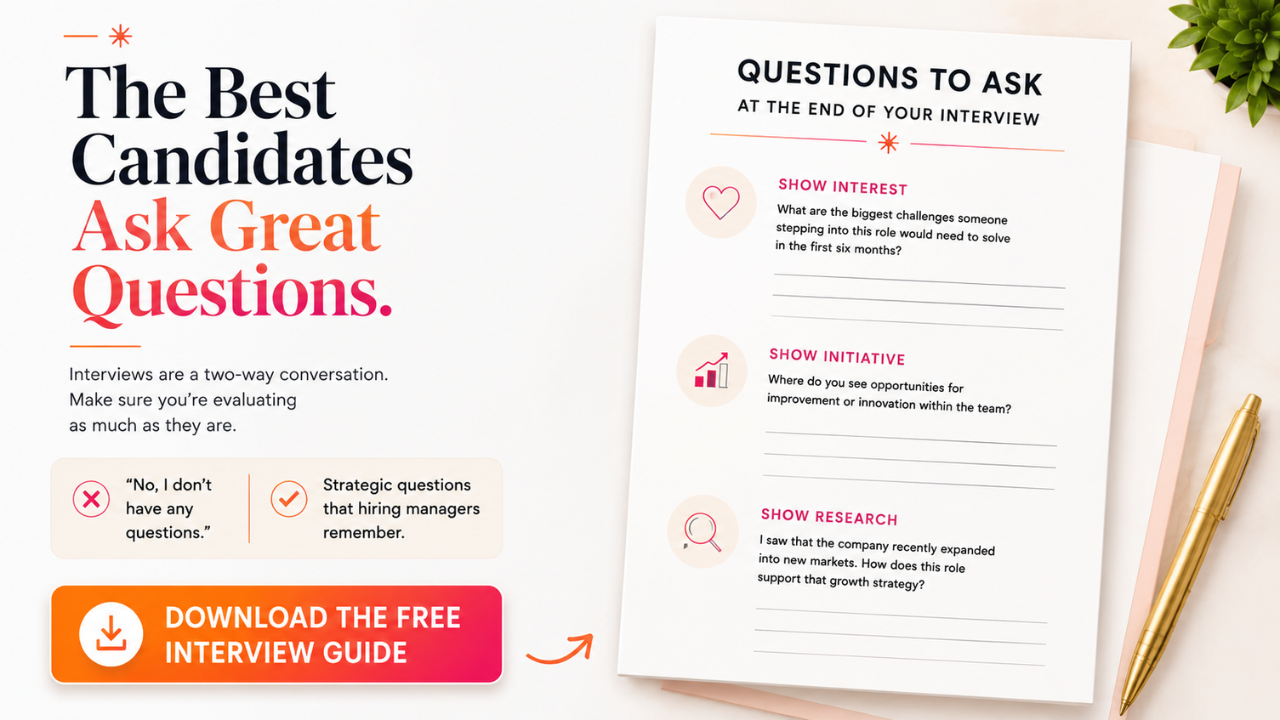
Here are the three types of questions I recommend asking:
1. Questions that show interest in the role
For example:
“What are the biggest challenges someone stepping into this role would need to solve in the first six months?”
This shows you’re already thinking proactively.
2. Questions that show drive and initiative
For example:
“Where do you see opportunities for improvement or innovation within the team?”
This communicates ambition and strategic thinking.
3. Questions that show you researched the company
Mention something specific:
- a recent initiative,
- product launch,
- expansion,
- mission statement,
- company value,
- or industry trend.
For example:
“I saw that the company recently expanded into new markets. How does this role support that growth strategy?”
That level of preparation stands out immediately.
Because very few candidates do it.
4. How to Close a Job Interview Strong
The first and last few minutes of an interview leave the strongest impressions.
Most candidates waste the ending.
When the interviewer asks:
“Do you have anything else you’d like to add?”
…that is your opportunity to reinforce your value one final time.
Do not simply say:
“No, thank you.”
Prepare a strong closing statement in advance.
A great closing statement should:
- Thank the interviewer
- Reinforce your enthusiasm
- Remind them why you are the right fit
For example:
“Thank you again for taking the time to speak with me today. I’m genuinely excited about the opportunity to contribute to your team because I’m deeply passionate about creating impactful learning experiences that drive meaningful change. I truly believe my combination of strategic thinking, relationship-building, and program development experience would allow me to make a strong impact in this role.”
That kind of close sticks with people.
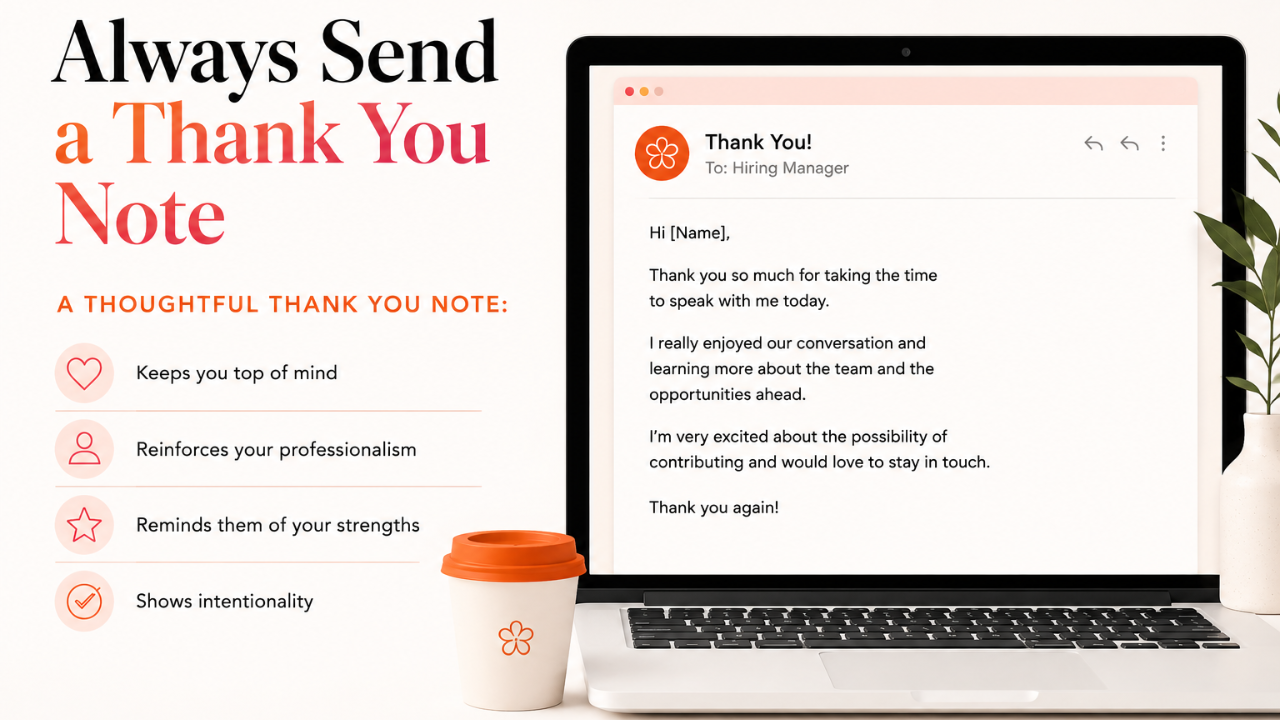
5. Always Send a Thank You Note
And then, once the interview is over, send the thank you email.
Almost nobody does this consistently.
And that’s exactly why it works.
A thoughtful thank you note:
- keeps you top of mind,
- reinforces your professionalism,
- reminds them of your strengths,
- and shows intentionality.
I once coached a client who was rejected after interviewing for a role she deeply wanted.
Instead of disappearing, we crafted a gracious follow-up email thanking the hiring manager, expressing continued interest in the organization, and asking whether there might be another team where her background could be a stronger fit.
That hiring manager was so impressed by her professionalism that he introduced her to another department leader.
Within a month, she had a job offer.
That is the power of handling rejection with grace and staying visible.
Because sometimes the “no” you receive is not the end of the story.
It’s simply redirecting you toward the right opportunity.
Final Thoughts: How to Succeed in a Job Interview
I know the job market can feel overwhelming right now.
I know rejection can feel personal.
And I know interviews can bring up self-doubt, anxiety, and fear.
But I also know this:
You are far more capable than you think you are.
The key is learning how to communicate your value clearly and confidently.
So let’s recap your five interview success strategies:
- Start strong with a powerful “Tell Me About Yourself” answer
- Prepare accomplishment stories using the CAR Method
- Ask thoughtful, strategic questions
- Close confidently
- Send a thank you note
Remember, you do not need every company to say yes.
You just need one right opportunity.
One interview can change the trajectory of your career, and even your life.
So prepare intentionally. Practice consistently. Believe in the value you bring.
And most importantly, remember that you are not powerless in your career journey.
You have agency.
You can take the driver’s seat.
And you can absolutely create a career that feels aligned, fulfilling, and exciting.
About Career Coach & Author
Theresa White, Career Clarity Expert, 5x Certified Career Coach, and the Founder of Career Bloom, is known for her expertise in guiding people to get unstuck and find the direction they need to move forward in their careers—fast. In a time when so many people are re-evaluating their work, Theresa offers actionable insights that empower clients to identify their true strengths and pursue work that genuinely aligns with their goals.
Theresa’s clients often call her sessions “epiphanies” and “transformational.” She brings immediate clarity to career goals, helping people unlock a deep understanding of what makes work fulfilling for them. Past participants consistently describe her approach as “spot on” and an “answer to questions they’d been asking for weeks.”
Theresa’s approach is empathetic yet practical, and she’s known for empowering clients with a clear direction in as little as 30 days, guaranteeing results.
Connect with Theresa on LinkedIn, listen to the Career Clarity Unlocked Podcast, or schedule your free 30-minute career clarity consultation.

Frequently Asked Questions About Job Interviews and Interview Preparation
How Long Should Job Interview Answers Be?
Most job interview answers should be between 60 and 90 seconds long. You want to provide enough detail to demonstrate your experience without overwhelming the interviewer. For behavioral interview questions, using a framework like the CAR Method (Challenge, Action, Result) can help you stay concise while showcasing your accomplishments.
What If I Don't Know the Answer to an Interview Question?
If you don't know the answer to an interview question, stay calm and be honest. Hiring managers are often evaluating your problem-solving skills, communication style, and professionalism as much as the answer itself. Take a moment to think, ask clarifying questions if needed, and explain how you would approach finding a solution.
How Do I Calm Nerves Before a Job Interview?
The best way to reduce interview anxiety is through preparation. Practice your "Tell Me About Yourself" answer, prepare accomplishment stories using the CAR Method, research the company, and create thoughtful questions to ask at the end of the interview.
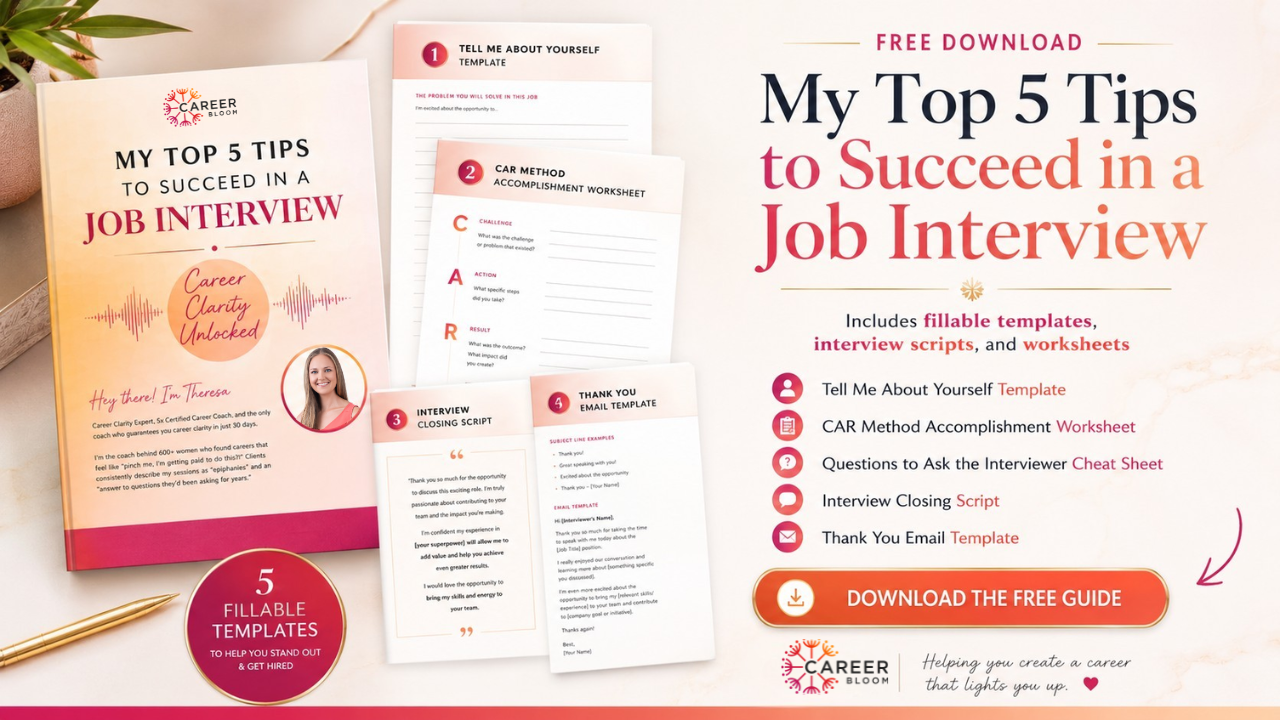
That's exactly why I created the free interview guide featured throughout this article. It includes the templates, worksheets, and interview scripts I recommend to help job seekers feel more confident and prepared before their interviews.
Confidence comes from preparation, not perfection.
What Other Job Seekers Are Reading
Subscribe now to never miss the latest blog!
Every Thursday, we cover an important topic, actionable advice, and inspiring content to help you find work that makes you feel like *pinch me* I'm getting paid to do this???
We hate SPAM. We will never sell your information, for any reason.