Let me start with something that might feel both surprising and relieving at the same time:
You don’t need to have everything figured out to move forward in your career.
In fact, most people who feel stuck aren’t lacking direction. They’re lacking clarity on what’s already there.
If you’ve ever found yourself thinking:
- “I don’t hate my job… but I’m not excited either.”
- “I feel like there’s something else I’m meant to do.”
- “Do I need to start over completely?”
I want you to know, you are not alone. And more importantly, you are not starting from zero.
I recently worked with someone, let’s call her Maria, who came into our session feeling exactly like this. She felt pulled in two directions: her corporate career on one side, and her passion for wellness and coaching on the other.
She thought she had to choose.
She thought she might need to start over.
But by the end of our conversation, something shifted.
She realized she wasn’t at the beginning. She was already on the path.
And what got her there wasn’t a brand new plan.
It was answering a few simple questions in a different way.
Today, I want to walk you through the 3 questions that helped her find clarity, and that can help you uncover what your next step should be too.
Prefer to listen? Tune into the full live coaching session with Maria on Spotify.
The 3 Questions That Reveal Your Next Career Move
Before we get into this, I want to make this as practical as possible for you.
These 3 questions aren’t just something to read through, they’re meant to help you actually figure out what’s next in your own career.
As you go through this, pause and reflect. Write things down. Notice patterns.
That’s where the clarity comes from.
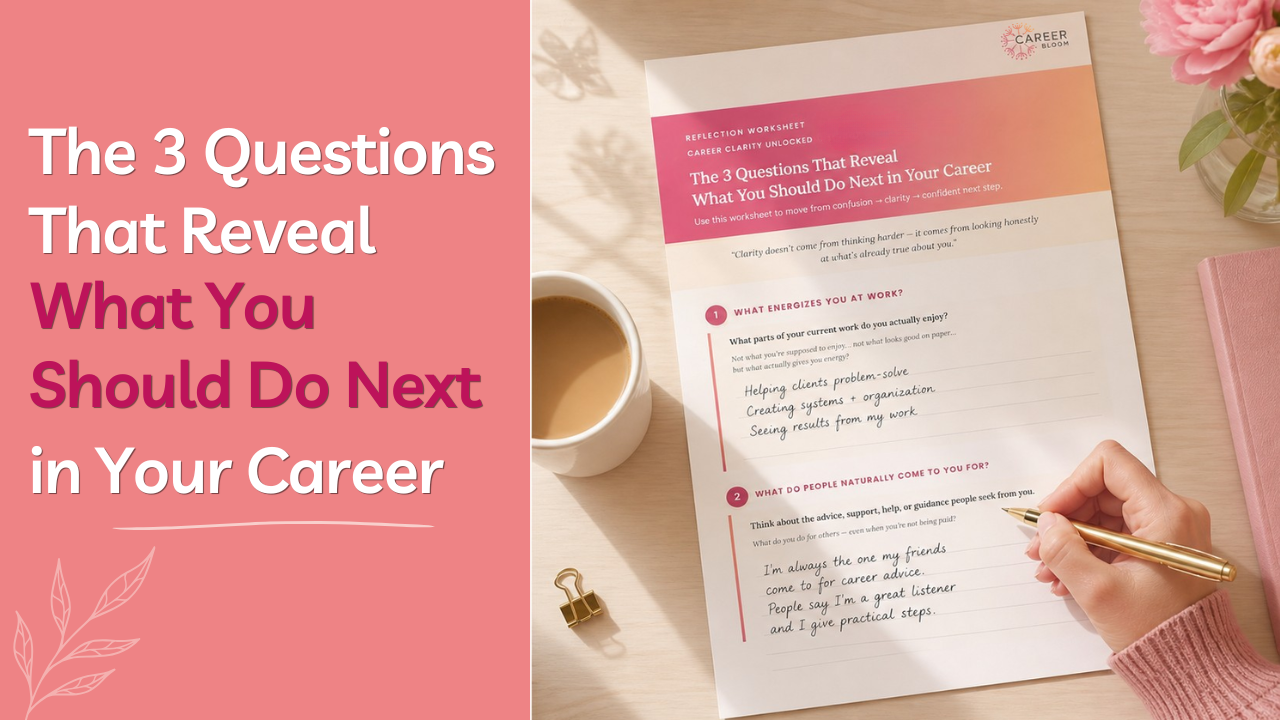
And if you want something a little more structured to guide you through it, I put these into a simple worksheet with prompts you can follow step by step.
You can download the free 3 Questions Career Clarity Worksheet here.
Alright, let’s get into it.
Question 1: What Parts of Your Current Work Do You Actually Enjoy?
Not what you’re supposed to enjoy.
Not what looks impressive on paper.
Not even what you’re objectively good at.
What actually energizes you?
This is where most people get tripped up. They confuse competence with fulfillment.
Just because you’re good at something doesn’t mean it’s what you should build your future around.
When I asked Maria this question, her answer was incredibly specific:
She told me she loved doing analysis, sharing insights, and making recommendations.
She lit up when she described moments like:
- Putting together a document that explains what happened
- Recommending next steps
- Presenting her work and seeing it land
She said she loved having the freedom to propose ideas and the ability to showcase her thinking.
Now here’s where it gets interesting.
When we looked at what drained her, the contrast was just as clear:
- Repetitive weekly reports
- Doing the same task over and over
- Work that felt like it didn’t lead to meaningful outcomes
She said, “I would rather provide insights… not just run the report.”
That one sentence tells you everything.
✨ Your Takeaway
Start paying attention to this pattern in your own work:
- What are the moments where you feel engaged, focused, and proud?
- What are the tasks that feel heavy, repetitive, or draining?
Then go one step deeper.
Don’t just list tasks. Identify the why behind them.
For Maria:
- Energizing = analysis → insight → recommendation
- Draining = repetition without meaning
🛠 Action Step
For the next 5 days, track your work like this:
At the end of each day, write down:
- 1 task that gave you energy
- 1 task that drained you
Then ask:
What was I actually doing in that moment?
You’re not looking for job titles. You’re looking for patterns of energy.
Question 2: What Do People Naturally Come to You For (Your Hidden Strengths)?
This question is powerful and often overlooked.
Because what people come to you for… is usually what you’re already great at.
And most of the time, you’re doing it without realizing it counts.
When I asked Maria this, she didn’t hesitate.
She shared that people often come to her for:
- Advice on health and fitness
- Guidance on building routines
- Support in improving their lifestyle
She said:
“People admire that and I’m always like, ‘Hey, here’s what I do. I recommend X, Y, Z.’”
That’s not casual advice.
That’s coaching.
She also shared that she had helped friends navigate their careers. Guiding them through:
- Choosing roles
- Breaking into new industries
- Finding direction
And afterward, they reached out to thank her.
Not because she had a certification.
Not because she was officially “a coach.”
But because she helped them move forward.
💡 Here’s the Truth Most People Miss
You don’t need permission to recognize your strengths.
If people consistently come to you for something, that’s not random.
That’s a signal.
Maria wasn’t “trying to become a coach.”
She was already acting like one.
✨ Your Takeaway
Ask yourself:
- What do people ask me for help with?
- When do I find myself giving advice naturally?
- What do I enjoy helping others figure out?
And here’s the most important part:
👉 Don’t dismiss it just because you’re not getting paid for it.
That experience still counts.
🛠 Action Step
Send a message to 3–5 people you trust and ask:
“What do you think I’m naturally good at helping people with?”
You’ll be surprised how consistent the answers are.
That consistency is your clue.

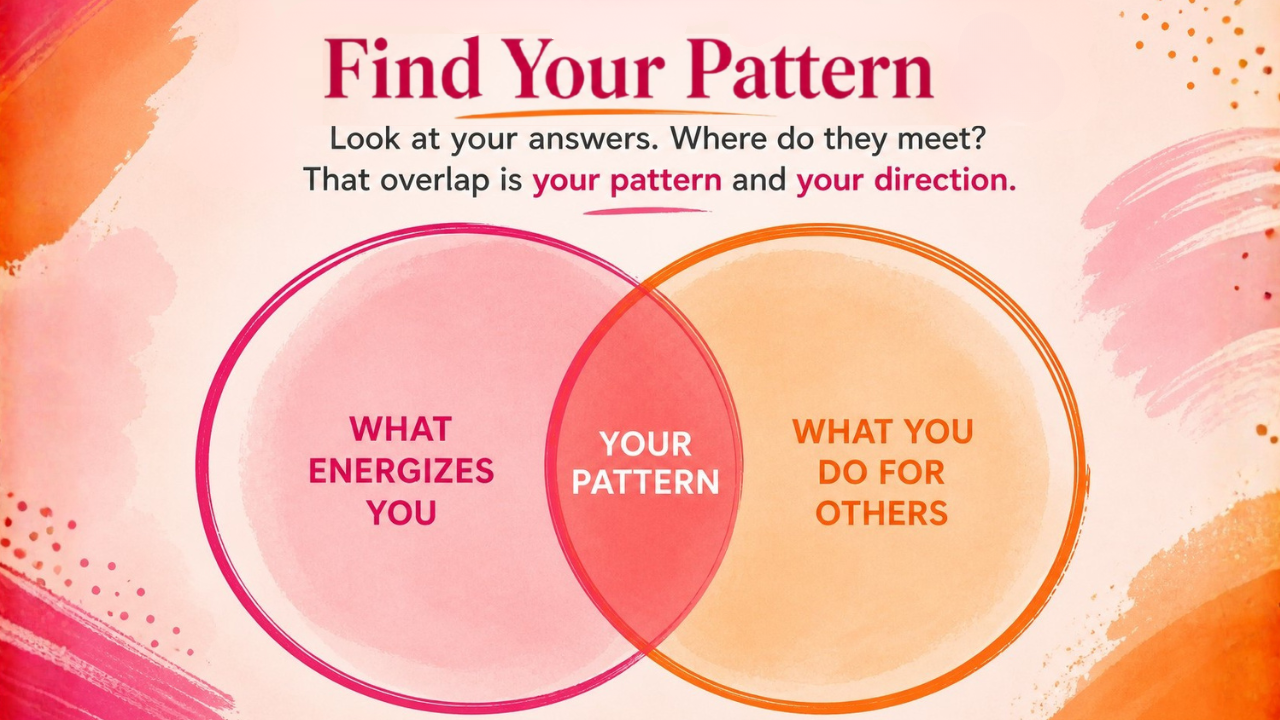
Question 3: Where Do These Overlap? (This Is Your Career Pattern)
This is where everything comes together.
When Maria looked at:
- What energized her
- What people came to her for
She started to see something she hadn’t noticed before.
There was a clear overlap.
In both her corporate role and her personal life, she was doing the same thing:
- Looking at a situation
- Breaking it down
- Finding the real problem
- Creating a clear plan
- Helping others move forward
I said to her:
“You’re taking messy inputs, finding the real problem, and turning it into clear recommendations and a plan.”
And in that moment, everything clicked.
She paused and said:
“Yeah… I see a lot of connections now.”
Then came the shift:
“It’s not like I’m starting from scratch… I already have a good foundation.”
That’s the moment I want for you.
Because this is where career clarity actually comes from.
Not from choosing between two paths.
But from realizing…
👉 They were never separate paths to begin with.
💡 The Core Insight
- Same skill → different context
- Job ≠ identity
- Pattern = direction
Maria wasn’t choosing between being a data analyst or a coach.
She was someone who:
- Analyzes problems
- Creates clarity
- Guides people forward
That skill can exist in multiple careers.
And the same is true for you.
✨ Your Takeaway
Your next step isn’t about picking a completely new identity.
It’s about asking:
Where else can I apply what I already do best?
🛠 Action Step
Write this sentence:
“The thing I do naturally is ______.”
Then fill it in based on your patterns.
Not your job title.
Not your degree.
Your actual behavior.
The Biggest Career Change Myth That Keeps You Stuck
Let’s address this directly:
You do not need to start over.
I know your brain might be telling you:
- “I don’t have the right experience.”
- “I would have to go back to school.”
- “I’m not ready.”
That’s not truth.
That’s fear trying to protect you from change.
Maria thought the same thing.
Until she realized:
She had been building the foundation all along.
And once she saw that, everything changed:
- Her confidence increased
- Her options expanded
- Her next steps became clear
What to Do Next to Gain Career Clarity (Simple and Practical Steps)
Clarity doesn’t come from thinking endlessly.
It comes from using what you’ve discovered.
So here’s what I want you to do:
Step 1: Identify Your Pattern
Use the 3 questions we covered.
Step 2: Apply It Once
Don’t overcomplicate this.
- Help someone with it
- Share something online
- Give advice
- Mentor someone
Step 3: Notice How It Feels
Ask yourself:
- Did this feel natural?
- Did I enjoy this?
- Did it feel like me?
You don’t need to build a new career overnight.
You just need to take one aligned step.
Final Thoughts on Finding Career Clarity
You are not as far away as you think.
The clarity you’re looking for isn’t somewhere out there in a completely different career.
It’s already showing up in your life, in your work, in your conversations, and in the way you help others.
Your job now is not to reinvent yourself.
It’s to recognize yourself.
And once you do that?
Everything opens up.
You can do that, too.
About Career Coach & Author
Theresa White, Career Clarity Expert, 5x Certified Career Coach, and the Founder of Career Bloom, is known for her expertise in guiding people to get unstuck and find the direction they need to move forward in their careers—fast. In a time when so many people are re-evaluating their work, Theresa offers actionable insights that empower clients to identify their true strengths and pursue work that genuinely aligns with their goals.
Theresa’s clients often call her sessions “epiphanies” and “transformational.” She brings immediate clarity to career goals, helping people unlock a deep understanding of what makes work fulfilling for them. Past participants consistently describe her approach as “spot on” and an “answer to questions they’d been asking for weeks.”
Theresa’s approach is empathetic yet practical, and she’s known for empowering clients with a clear direction in as little as 30 days, guaranteeing results.
Connect with Theresa on LinkedIn, listen to the Career Clarity Unlocked Podcast, or schedule your free 30-minute career clarity consultation.

FAQs: How to Find Career Clarity Without Starting Over
- Do I have to start over to change careers in my 30s or 40s?
No. A career change at this stage isn’t a "reset," it’s a rebrand. You aren't losing your experience; you’re just applying your existing skills to a new context. The goal is to move toward what energizes you without blowing up your progress.
- What should I ask myself if I feel stuck but not "unhappy"?
Ask yourself: "What do people naturally come to me for?" and "What parts of my work actually give me energy?". Most people confuse being good at a task with being fulfilled by it. Look for the patterns where your natural strengths overlap with work that feels light, not heavy.
- How do I find a new role without getting another degree?
Focus on your transferable patterns, not just your job title. Identify the core problems you solve, like creating clarity from a mess or guiding others through transitions. Once you see that you’re already doing the work in a different form, you realize you don’t need more schooling; you just need to own your value.
What Other Job Seekers Are Reading
- What to do when you're feeling stuck in career
- How to Find Your Perfect Career
- 8 progressive companies to work for
- 7 Message Templates to Reach Out to Recruiters
- How to Use AI to Find a Job in 2025: Why Soft Skills Still Matter
- Free Job Search Tracker
- Get Career Clarity In Just 30 Days!
- Take this 60 second quiz to see if a free career clarity call with my team is your next best step.
Subscribe now to never miss the latest blog!
Every Thursday, we cover an important topic, actionable advice, and inspiring content to help you find work that makes you feel like *pinch me* I'm getting paid to do this???
We hate SPAM. We will never sell your information, for any reason.