The Boredom-to-Burnout Cycle: Why Being Good at Your Job Can Keep You Stuck in the Wrong Career
Sep 17, 2026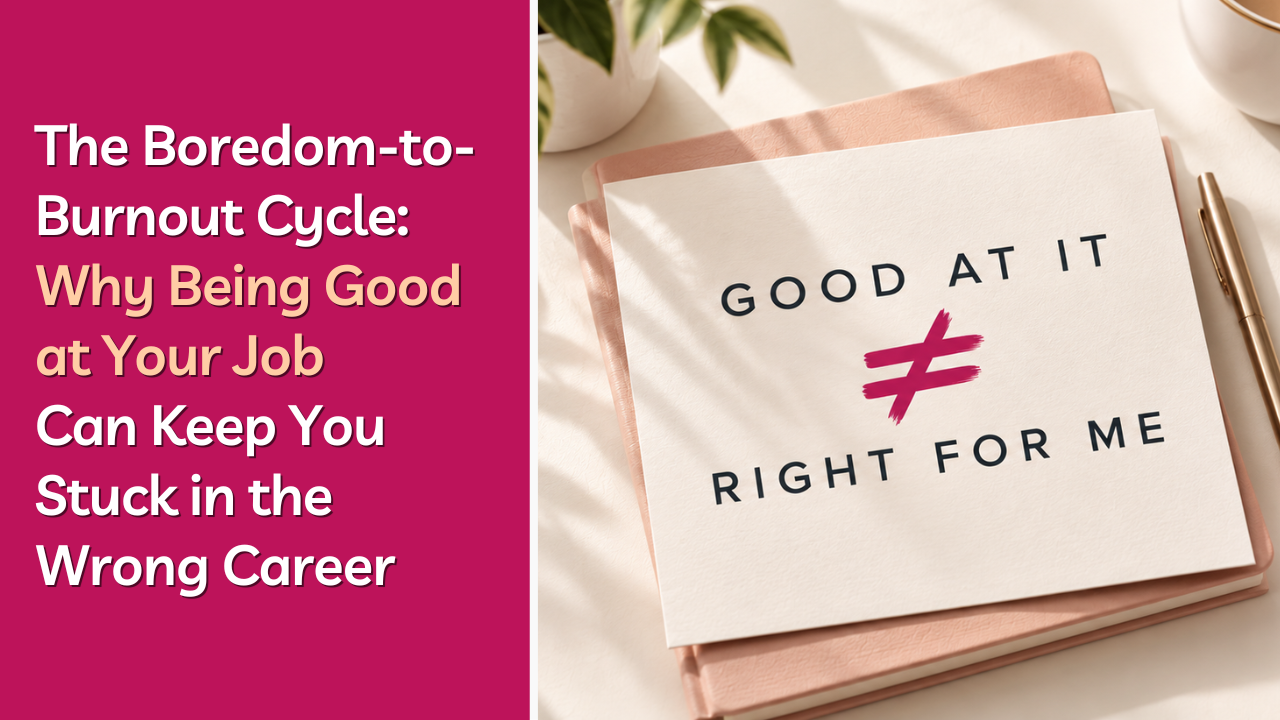
Priya had a phrase for her career.
“Boring, burnout, boring, burnout.”
She said it almost matter-of-factly on our first call. She wasn’t exaggerating. She was describing a pattern she had watched repeat for more than a decade.
On paper, her current job looked like the one that should have finally broken the cycle.
Good pay. Remote. Flexible 30-hour week. A firm that valued her enough to restructure her role and keep her working on newer technology.
It was, by most measures, a “good job.”
And every time new work landed on her desk, she cringed.
“I’m getting so bored of taxes,” she told me. “I don’t love it. I can do it. I don’t like it.”
That last sentence is the one I want you to notice.
I can do it. I don’t like it.
Because one of the biggest career traps I see successful women fall into is assuming that because they’re good at something, it must belong in their next career.
It doesn’t.
And if you keep choosing jobs based on the skills you’ve already proven, without looking closely at which parts of your work actually fit you, you can spend years changing companies, titles, workloads, and industries while recreating the same career problem.
That was what Priya’s “boring, burnout, boring, burnout” cycle was actually telling us.

Why Do I Keep Getting Bored or Burned Out at Work?
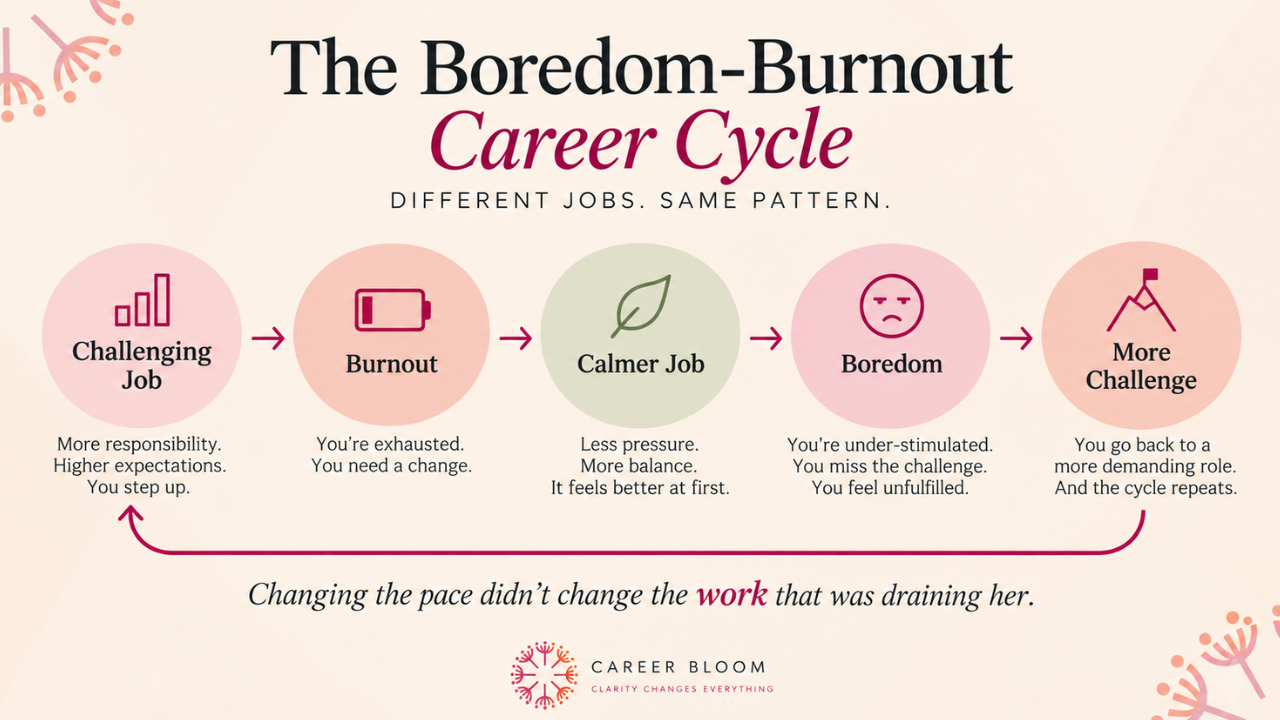
When we laid Priya’s career out chronologically, the pattern was almost impossible to miss.
She started at a large accounting firm.
There was a steep learning curve. New problems. New information. A lot to figure out.
She loved that part.
Then the workload intensified. The culture rewarded pushing harder. Eventually, she burned out.
So she did what most reasonable people would do: she found a calmer job.
She moved into an industry role with better hours and a more manageable pace.
At first, it felt like relief.
Then, about two years later, she was bored.
So she went back to public accounting, where there was a new firm to learn, a new role to grow into, and enough challenge to make work interesting again.
And eventually?
Burnout again.
For 12 years, she had been moving between two poles: I need something less demanding and I need something more challenging.
Each move made sense in isolation.
The problem was that she kept changing the intensity of her work without changing enough of the work itself.
A “Chiller Job” Can Still Be the Wrong Job
This is where career change gets tricky.
When you’re exhausted, it’s natural to assume the exhaustion is the problem.
So you search for better hours. More flexibility. Fewer meetings. A nicer boss. A less intense company.
Those things matter. A lot.
But they can’t make fundamentally mismatched work feel fulfilling.
Priya had changed firms. She had moved between public accounting and industry. She had experienced demanding environments and calmer ones.
Yet several things kept following her.
Tax work.
Client meetings.
Live conversations.
Being asked questions on the spot without enough time to research and prepare.
She had changed the container around the work. She hadn’t changed the parts of the work that were consistently costing her energy.
That distinction matters if you’re thinking, I know something needs to change, but I don’t trust myself to choose the right next step.
Because the answer may not be “find a better company.”
It may not even be “find a less stressful job.”
Before you decide where to go, you need to understand what, specifically, is not fitting anymore.
Being Good at Your Job Can Make Career Misalignment Harder to See
Priya was perfectly capable of client-facing work.
In fact, she was good at it.
“I very much can do the client-facing interaction,” she told me.
Then came the part that mattered more:
“I just don’t enjoy it.”
This is one of the most important distinctions I make with women who come to me for career clarity:
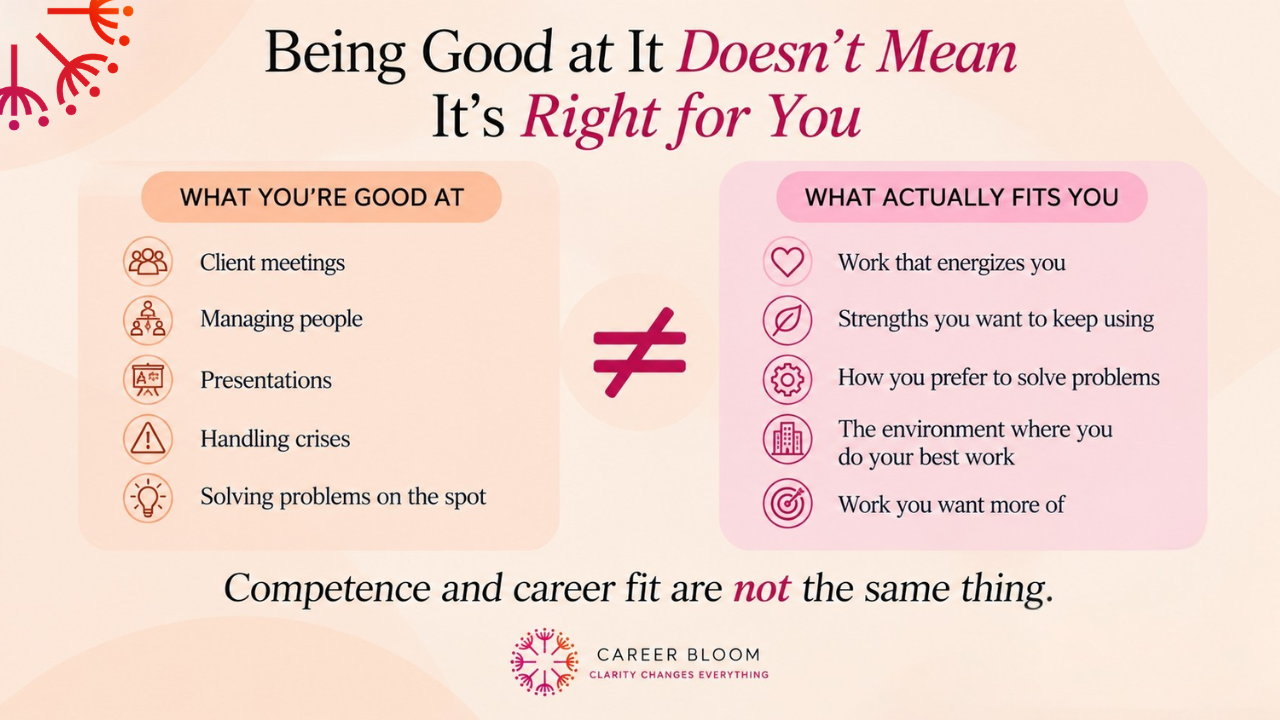
Competence and career fit are not the same thing.
You can be excellent at managing people and not want another management role.
You can be the person everyone trusts to handle a crisis and hate spending your days putting out fires.
You can give polished presentations and feel depleted after every one.
You can be fantastic with clients and wish you could spend far more of your time researching, writing, building, analyzing, or solving problems independently.
And the better you are at the draining thing, the easier it is to get trapped doing more of it.
People praise you for it. You get promoted because of it. Recruiters see it on your résumé and bring you opportunities that require even more of it.
Eventually, your career can become increasingly optimized around a strength you no longer want to use all day.
That’s when women tell me things like, “I feel stuck,” “I keep ending up in jobs I don’t want,” or “I don’t want to accidentally fall into the same role, just at a different company.”
The question isn’t only:
What are you good at?
It’s also:
Which of your strengths do you actually want your next career to require from you?
What Her Career Pattern Revealed
When we dug deeper into Priya’s work patterns, a very different picture emerged.
She loved learning.
The beginning of a new role was often exciting because there was so much to absorb and figure out. Once the learning curve flattened, her interest tended to flatten with it.
She also loved creating order out of chaos.
Give her scattered information, conflicting versions of documents, an inefficient system, or a pile of material nobody had organized properly, and something in her switched on.
She remembered organizing folders and labeling materials even as a teenager helping someone clean out an office.
That detail might sound insignificant.
It wasn’t.
Because career clarity often lives in patterns that are easy to dismiss when you look only at job titles.
“Accountant” tells me what Priya was hired to do.
It doesn’t tell me how her brain likes to work.
So instead of asking, “What other jobs can someone in tax do?” we started decoding the deeper pattern:
She likes learning and researching.
She likes making sense of complexity.
She likes creating structure.
She likes turning messy information into something clear and usable.
She can communicate complex information, but she would rather have time to think, research, and prepare than constantly respond live.
“It always feels like you’re just put on the spot without being able to research,” she said. “At least if they had told me, this is what we’re going to talk about, be prepared.”
Now we had something much more useful than “I’m bored with taxes.”
We had career-fit criteria.
Career Clarity Comes From Decoding the Work, Not Just Picking a New Title
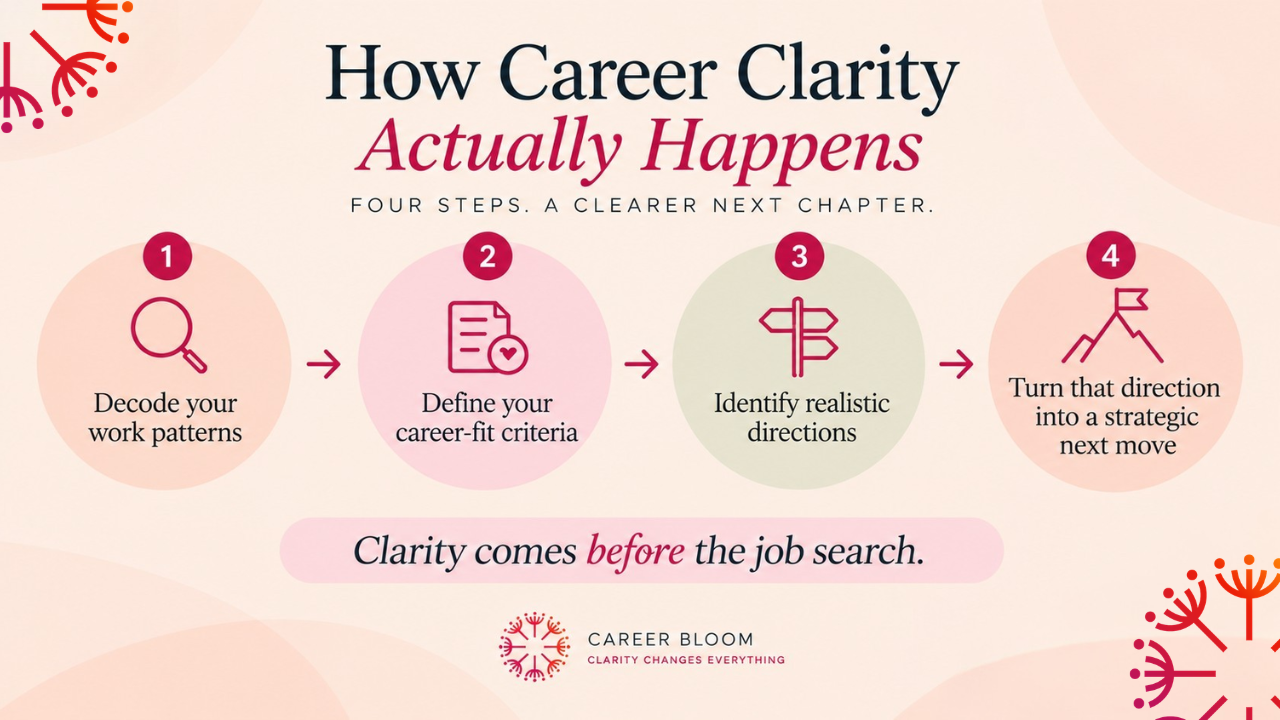
This is the process I use when someone tells me, “I don’t even know what job to look for.”
We don’t start with job boards.
We start by decoding the work.
What has consistently energized you across roles, projects, and industries?
What has consistently drained you, even when you were good at it?
When have you felt challenged in a satisfying way rather than simply overloaded?
How do you naturally solve problems?
Do you want to create, analyze, advise, organize, lead, build, write, teach, influence, investigate, or some combination?
Which strengths do you want to keep using?
And which ones have you mastered but would be very happy to stop monetizing quite so heavily?
From there, we define the criteria your next career actually needs to meet.
Then we identify realistic directions that match those criteria.
Only then do we translate those directions into specific roles, industries, positioning, and next steps.
That order matters.
Because if you jump straight from “I hate this” to LinkedIn, you’re searching before you know what you’re searching for.
Four Career Directions Appeared, Without Throwing Away 12 Years of Experience
Once we stopped asking whether Priya needed a more challenging or more relaxed accounting job, the possibilities changed.
Four directions surfaced.
Content and training development. She could translate complex tax expertise into useful materials that teach other people, with much more emphasis on writing and structured communication.
Instructional design for finance or compliance teams. Instead of repeatedly explaining something live, she could help design how people learn complicated systems and information.
Knowledge management. That lifelong instinct to organize scattered information into something people can actually find and use? There are jobs built around it.
Technical documentation. Her ability to understand complex financial information and explain it clearly could transfer into work centered on research, organization, and writing.
Notice what we didn’t do.
We didn’t throw away 12 years of expertise and tell her to “follow her passion.”
We also didn’t assume that because she had spent 12 years in tax, her only financially realistic option was another tax role.
We looked underneath her title at how she creates value, then identified other places where that same value could matter.
That is how you make a career pivot without automatically starting over.
Before Your Next Career Move, Find the Variable You Haven’t Changed Yet
If you’ve made more than one career move that felt better initially and somehow ended up feeling wrong again, don’t immediately assume you made another bad decision.
Get curious about the pattern.
Maybe every job has required constant stakeholder management when you want more time for deep strategic work.
Maybe you keep moving into mission-driven organizations but the actual work leaves your strongest abilities sitting on the sidelines.
Maybe you keep choosing leadership roles because that is the obvious “next step,” even though the work you miss is solving complex problems yourself.
Or maybe, like Priya, you keep adjusting the pace while leaving the underlying work almost untouched.
Ask yourself:
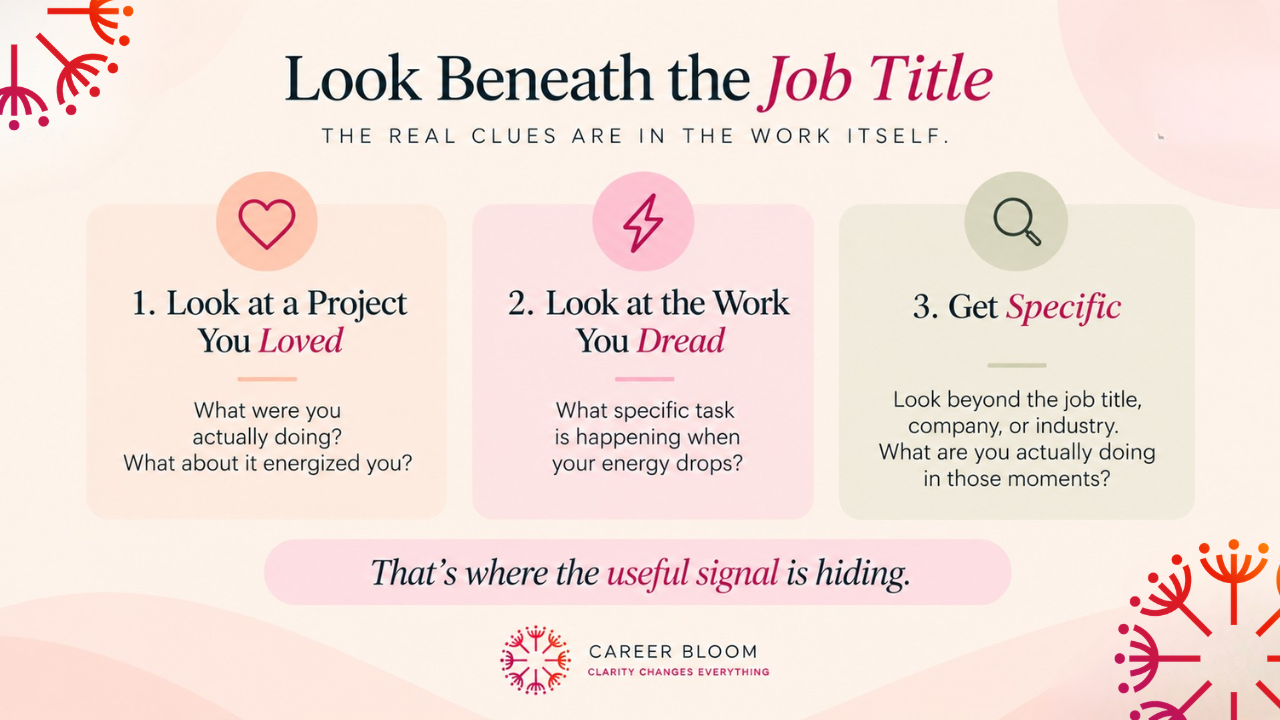
Think about a project you genuinely loved. What were you actually doing?
Now think about the work you dread. What specific task is happening when your energy drops?
Try to get more specific than the job itself, the company, or even the industry. What are you actually doing in those moments?
That is often where the useful signal is hiding.
Your Next Career Doesn't Have to Be Another Version of the Last One
Priya’s problem wasn’t that she lacked discipline.
She wasn’t indecisive.
And she certainly didn’t need to become more grateful for a job that looked good on paper.
She had been trying to solve the wrong variable.
Burned out? Find something calmer.
Bored? Find something more demanding.
Repeat.
Once we decoded what was happening underneath that cycle, the question changed from:
“Should my next job be calmer or more challenging?”
to:
“What kind of work allows me to keep learning, create order from complexity, use the expertise I’ve built, and spend less of my day doing work that drains me?”
That is a career direction question.
And it produces very different possibilities.
If you’ve been thinking, I know I need a change, but I don’t want to make the wrong decision again, this is the work I do inside the Career Clarity Formula.
We decode your work patterns, define your career-fit criteria, identify realistic directions, and translate those directions into a strategic next move, so you’re not simply applying for another version of the career you already know doesn’t fit.
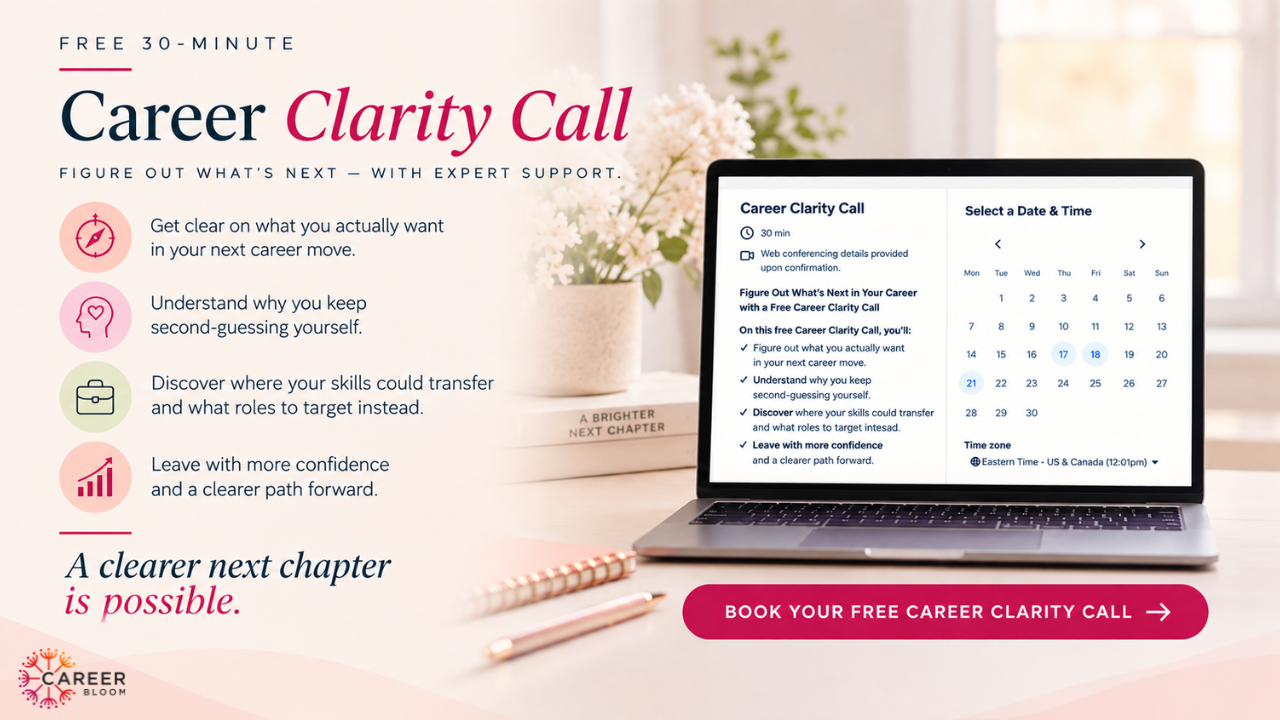
You can also start with a free 30-minute Career Clarity Call. We’ll look at what’s keeping you stuck and what needs to become clearer before you make your next move.
Because after 15, 20, or 25 years of experience, you probably don’t need another list of jobs you could do.
You need to understand which work is actually right for the person you’ve become.
And sometimes the biggest clue is hiding inside the sentence you’ve been saying for years:
“I can do it. I just don’t like it.”
About Career Coach & Author
Theresa White, Career Clarity Expert, 5x Certified Career Coach, and the Founder of Career Bloom, is known for her expertise in guiding people to get unstuck and find the direction they need to move forward in their careers—fast. In a time when so many people are re-evaluating their work, Theresa offers actionable insights that empower clients to identify their true strengths and pursue work that genuinely aligns with their goals.
Theresa’s clients often call her sessions “epiphanies” and “transformational.” She brings immediate clarity to career goals, helping people unlock a deep understanding of what makes work fulfilling for them. Past participants consistently describe her approach as “spot on” and an “answer to questions they’d been asking for weeks.”
Theresa’s approach is empathetic yet practical, and she’s known for empowering clients with a clear direction in as little as 30 days, guaranteeing results.
Connect with Theresa on LinkedIn, listen to the Career Clarity Unlocked Podcast, or schedule your free 30-minute career clarity consultation.

Frequently Asked Questions About Career Fit, Burnout, and Your Next Career Move
How do I know if I need a new job or a career change?
Look beyond how you feel about your company and pay attention to the work itself. If the same tasks keep draining you across different jobs, companies, or environments, another job with a similar set of responsibilities may recreate the same problem. Career clarity comes from identifying which parts of your work energize you, which consistently drain you, and what you need your next role to include for it to be a better fit.
Why am I good at my job but still unhappy and burned out?
Being good at your job does not necessarily mean the work is a good fit for you. You can be highly skilled at managing people, working with clients, presenting, or solving certain problems and still find those activities draining. In fact, being good at work you no longer enjoy can make career misalignment harder to recognize because your success keeps reinforcing the very responsibilities you may want less of in your next career.
How do I choose my next career without starting over?
Start with the experience you already have rather than assuming a career change means throwing it away. Look for patterns in how you think, solve problems, create value, and do your best work. Then define your career-fit criteria and identify roles where those strengths and your existing expertise transfer. The goal is not simply to find something different. It is to identify a realistic career direction that fits you better while building on the experience you have spent years developing.(mention call one more time
If you’re struggling to see those patterns clearly on your own, that’s exactly what we can look at together on a free 30-minute Career Clarity Call. We’ll identify what’s keeping you stuck and what needs to become clearer before you make your next move.
What Other Job Seekers Are Reading
- What to do when you're feeling stuck in career
- 8 progressive companies to work for
- 7 Message Templates to Reach Out to Recruiters
- Free Job Search Tracker
- Get Career Clarity In Just 30 Days!
- Take this 60 second quiz to see if a free career clarity call with my team is your next best step.
Subscribe now to never miss the latest blog!
Every Thursday, we cover an important topic, actionable advice, and inspiring content to help you find work that makes you feel like *pinch me* I'm getting paid to do this???
We hate SPAM. We will never sell your information, for any reason.