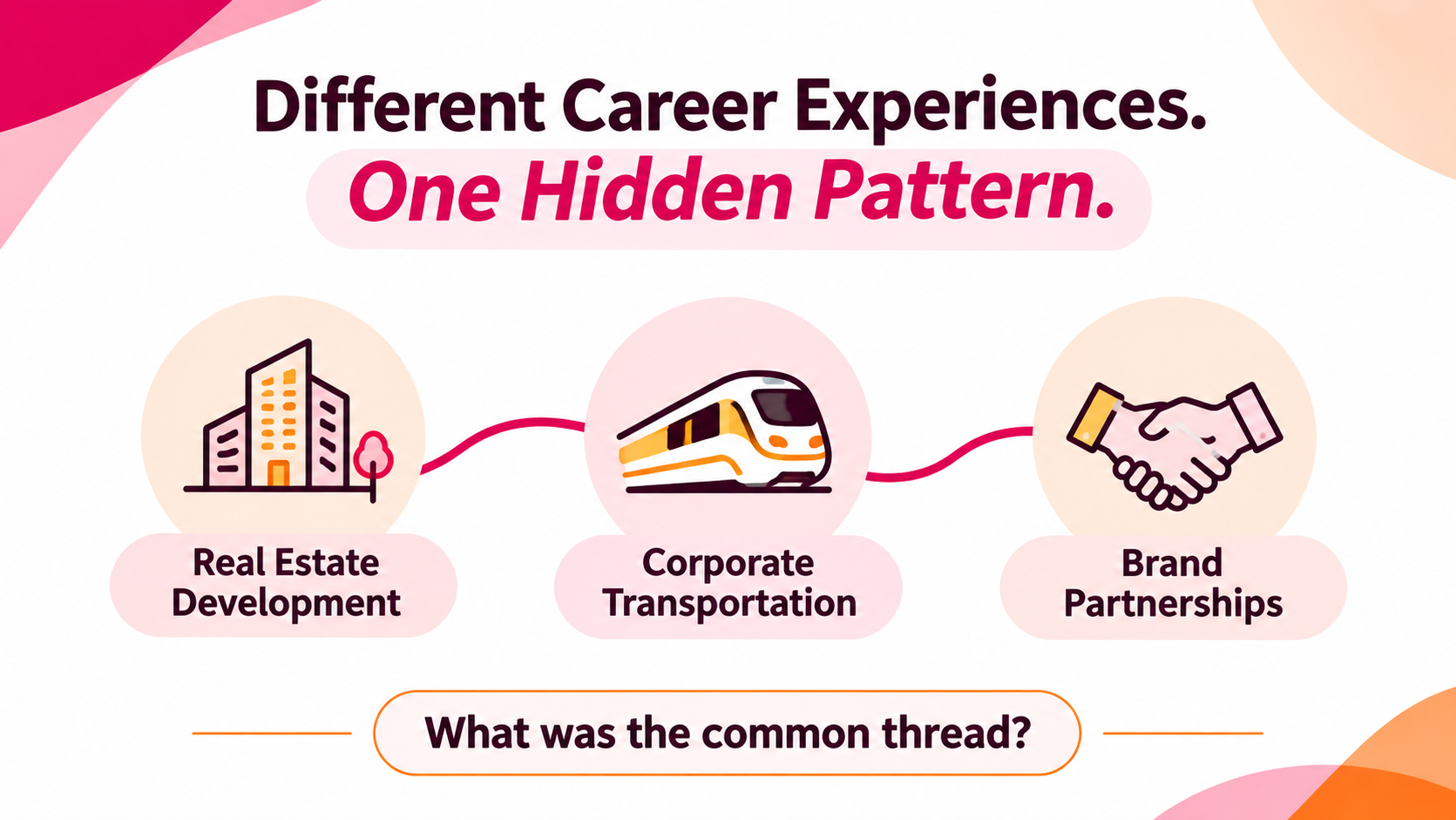
Amanda had worked with BMW and Volkswagen. She'd helped bring major real estate developments to life. She'd built strategic partnerships, landed difficult clients, and helped launch a corporate transportation program.
Her résumé wasn't exactly lacking.
But when she opened LinkedIn to look for her next opportunity?
She wasn't sure what she should even be looking for.
She knew she wanted to take her career to the next level. More responsibility. More growth. Better pay. And work that felt like a better fit.
What she couldn't figure out was how all those years of experience fit together.
She described wanting to stop "throwing spaghetti at a wall" when looking at job postings.
And I understood why.
When you've done a lot of different things successfully, the question isn't always what you're qualified to do.
Sometimes it's which parts of your experience you actually want to build your next career around.
That's what Amanda and I set out to figure out.
🎧 Prefer to listen? Go behind the scenes of my live coaching session with Amanda and hear how I helped her connect the dots between her strengths and her next career move.
The Career Pattern Amanda Couldn't See
I started asking Amanda about her favorite professional experiences.
Not her biggest accomplishments on paper. Not necessarily the ones with the most impressive numbers.
The ones she genuinely loved.
She told me about supporting a team of architects working on a new community in New Delhi.
Then there was Brickell City Centre in Miami.
She'd watched that development go from plans and models on a conference table to an actual place where people could shop, work, and live.
She eventually lived there herself.
Think about how surreal that must have been.
One day you're looking at a model of a building. Years later, you're walking through it on your way home.
Amanda loved seeing something that had once been an idea become real.
She described a similar experience at Brightline.
She'd helped build its corporate program, giving companies new ways to connect employees with transportation and expand their recruiting reach.
Later, she'd ride the train and actually see employees using it.
That was the part she kept coming back to.
Seeing people benefit from something she'd helped create.
Then we talked about her brand campaigns and the clients she'd won over.
Different industries. Different projects. Different job responsibilities.
But as Amanda talked, I started hearing the same things over and over.
She loved creating something that hadn't existed before.
And she loved the relationships that made it possible.
The Deal She Closed Three Hours Before Surgery
Then Amanda told me a story I haven't forgotten.
She was preparing for major spine surgery when a client commitment suddenly needed a sponsor.
She had about a week and a half to make it happen.
She was in excruciating pain, going to doctor's appointments, and trying to get everything sorted before surgery.
But she'd promised her client something.
And she wasn't going to go back and say, "Just kidding."
She found the sponsor.
The agreement was signed, sealed, and delivered three hours before she went into surgery.
Now, there are plenty of things you could take away from that story.
Amanda is determined. Resourceful. Excellent under pressure.
All true.
But I wanted to know something else.
Why was keeping that promise so important to her?
As we talked, she kept coming back to the same answer.
Trust.
She'd built a relationship with that client. She'd made a commitment. She cared about delivering what she'd promised.
And suddenly, the other stories started sounding a little different.
The clients who initially didn't want to work with her but eventually became long-term partners.
The relationships she maintained across industries.
The way she thought about whether her work would actually make a difference for the people involved.
Amanda wasn't simply good at closing deals.
She was exceptionally good at building the trust that made those deals possible.
And she cared about what happened to people after the deal was done.
Why Amanda Didn't Recognize Her Biggest Career Strength
Earlier in our work, Amanda had taken a Sparketype assessment.
Two parts of her results were especially interesting: Maker and Nurturer.
Maker? That made sense.
Amanda loved creating things. Campaigns, partnerships, programs, even physical spaces.
But Nurturer?
That one had confused her.
She'd associated nurturing with nonprofit work or caregiving. She couldn't see how it fit her career in sales and strategic partnerships.
Until we started connecting the dots.
The Nurturer wasn't separate from the Maker.
Her ability to build relationships and earn trust was part of what made her so effective at creating things in the first place.
And the things she most enjoyed creating had something else in common.
They made a difference for people.
The development where people now lived.
The transportation program employees actually used.
The campaigns that helped her clients achieve something meaningful.
It wasn't creativity for creativity's sake.
It was creating something useful, with and for other people.
As we talked through this, Amanda started recognizing the pattern herself.
And then she said something that stopped me:
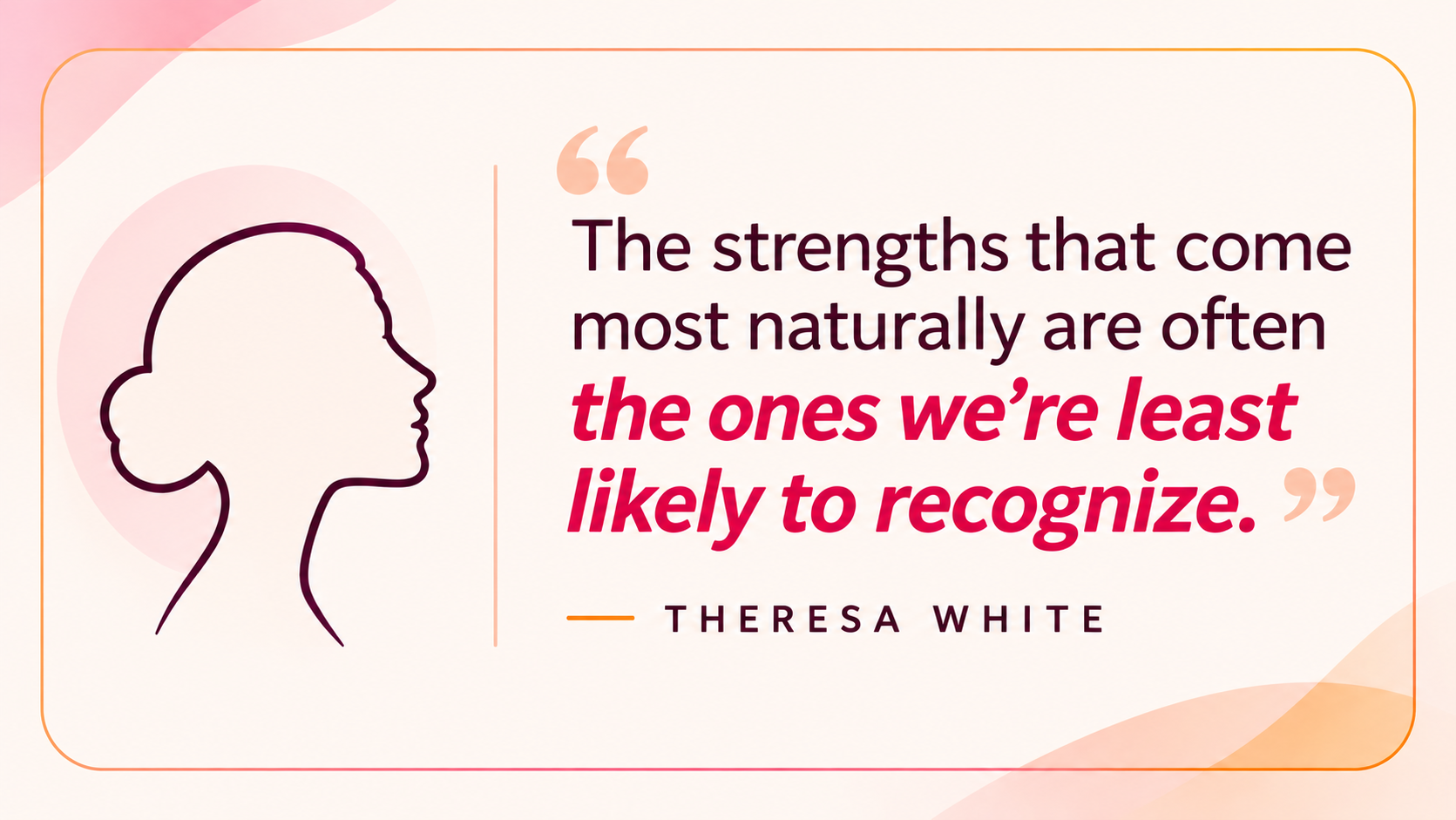
"I didn't see that as a superpower because I guess I'm just so used to me being that way."
There it was.
She'd spent years building relationships, earning trust, and making ambitious things happen.
But because that relationship-building came so naturally, she'd never really considered how much it contributed to her success.
To her, it was just who she was.
Why the Skills That Come Naturally Can Be Easy to Overlook
There's an interesting connection here to the psychology of skill development.
Psychologists Walter Schneider and Richard Shiffrin studied how practice can make certain mental processes more automatic.
When you're first learning something, it takes deliberate effort. With enough consistent practice, parts of that process can begin to feel almost effortless.
Of course, building meaningful relationships is more complex than a practiced routine. And the research doesn't prove that we automatically undervalue everything that comes easily.
But it does highlight something worth thinking about:
How much credit do you give yourself for something you no longer have to think very hard about doing?
Especially when you're comparing it with skills you spent years deliberately trying to master?
In Amanda's case, relationship-building felt so much like second nature that she'd overlooked its role in nearly every major success she described.
And that mattered because she was trying to decide what to do next.
How Recognizing Her Strengths Changed Amanda's Career Direction
Here's where our conversation became especially useful.
Amanda wasn't looking for a nice description of her personality.
She wanted to know which jobs to pursue.
And knowing she was good at sales, partnerships, and campaigns wasn't enough.
Those skills could lead her toward dozens of different roles.
Some would probably be a great fit.
Others might use her experience while leaving out the parts of work she found most fulfilling.
But now we had something more specific to work with.
Amanda wanted opportunities where she could combine creativity with client-facing work.
Where building relationships wasn't just a small part of the job.
Where she could develop partnerships, create something valuable, and see the impact of her work.
That gave her a much better way to evaluate job descriptions.
Instead of asking only, "Could I do this job?"
She could ask, "Would this role let me do more of the work I actually love and do best?"
Near the end of our coaching conversation, Amanda told me that our discussion had given her an aha moment about how everything fit together.
Then she said something even better.
She was already looking at opportunities differently.
She knew which ones she wanted to prioritize.
And which ones she could take off her list.
That's the difference between recognizing a strength and knowing what to do with it.
One helps you understand yourself.
The other helps you make a career decision.
How to Find the Strengths That Could Guide Your Next Career Move
You might not have Amanda's background in brand partnerships or major development projects.
But you may recognize the feeling of having years of experience and still not knowing where to take it next.
If that's you, try looking at your career a little differently.
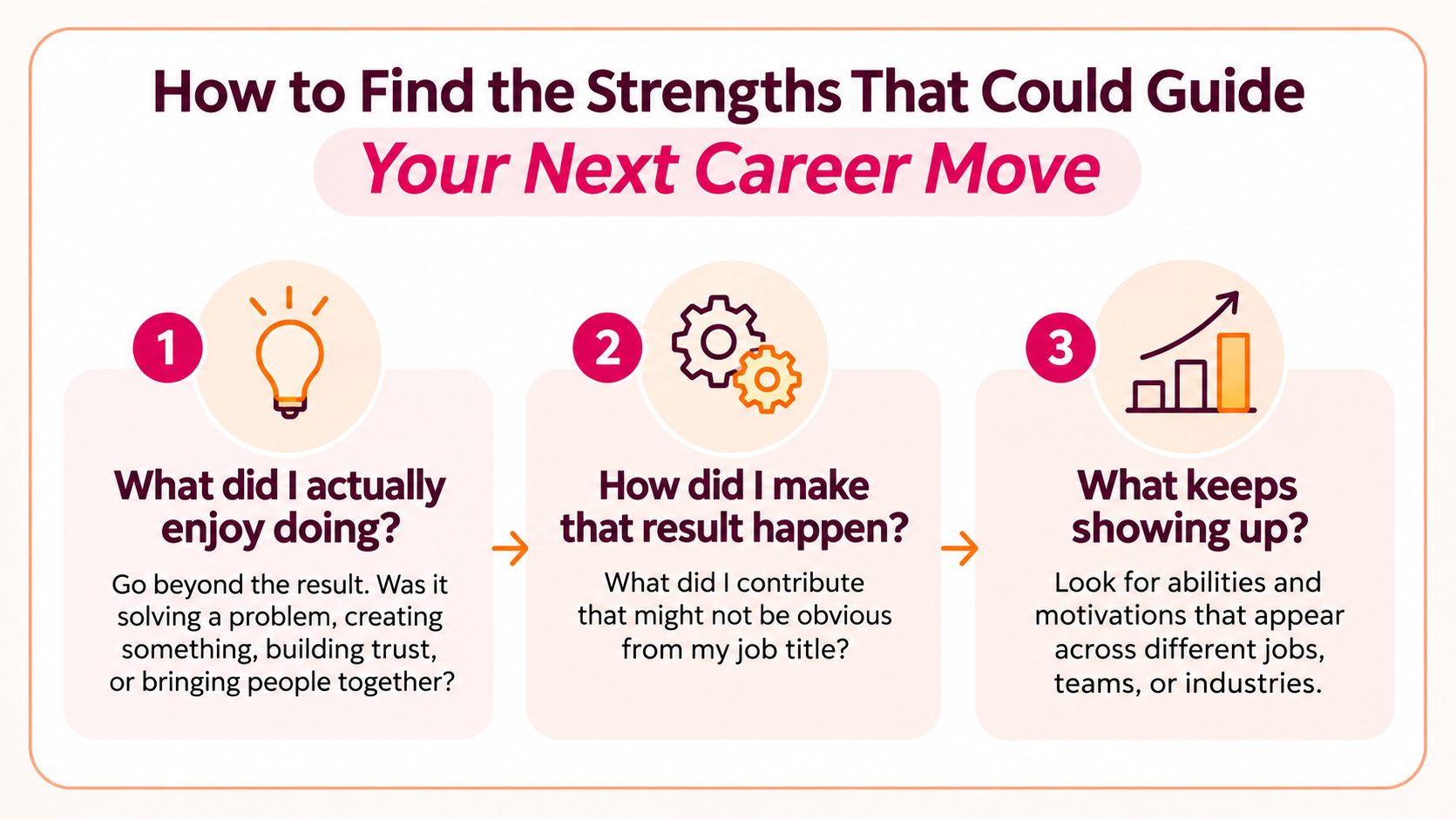
Start with three experiences you genuinely enjoyed. Not necessarily your biggest achievements. Think about projects that made you feel proud, energized, or deeply engaged.
For each one, ask yourself:
- What did I actually enjoy doing? Go beyond the result. Was it solving a problem, creating something, building trust, or bringing people together?
- How did I make that result happen? What did I contribute that might not be obvious from my job title?
- What keeps showing up? Look for abilities and motivations that appear across different jobs, teams, or industries.
Then comes the question that matters most:
Would I want to use these strengths more in my next role?
Because being good at something doesn't automatically mean you want to keep doing it.
The goal isn't to create a longer list of skills.
It's to understand which combination of strengths, interests, and experiences should shape your next career move.
And sometimes, the patterns are easier for someone outside your career to spot.
Your Next Career Move Might Be Hiding in What You've Already Done
What I love about Amanda's story is that she didn't need to reinvent herself.
She didn't need to go back to school or abandon everything she'd spent years building.
She needed to see something about her experience that had been there all along.
Her relationship-building wasn't a separate, nice-to-have personality trait.
It was a major part of how she created results.
And her love of creating things wasn't just about getting a project across the finish line.
She wanted to make something that mattered to people.
Once Amanda could see how those pieces fit together, she had a clearer picture of what to look for next.
That's the kind of clarity I want more successful women to experience.
Not just knowing what you're good at.
Knowing where you want to take it.
Hear Amanda's Career Clarity Breakthrough
In the latest episode of Career Clarity Unlocked, I take you behind the scenes of my real coaching conversation with Amanda.
You'll hear the stories she shared, the patterns we uncovered, and the moment she began seeing her career, and her next opportunities, differently.
🎧 Listen to Amanda's coaching session on Spotify
And if you're struggling to connect the dots in your own career, I'd love to help you explore what's possible.
Book a free 30-minute Career Clarity Call to talk about where you're stuck and what it could take to get clear on your next move.
About Career Coach & Author
Theresa White, Career Clarity Expert, 5x Certified Career Coach, and the Founder of Career Bloom, is known for her expertise in guiding people to get unstuck and find the direction they need to move forward in their careers—fast. In a time when so many people are re-evaluating their work, Theresa offers actionable insights that empower clients to identify their true strengths and pursue work that genuinely aligns with their goals.
Theresa’s clients often call her sessions “epiphanies” and “transformational.” She brings immediate clarity to career goals, helping people unlock a deep understanding of what makes work fulfilling for them. Past participants consistently describe her approach as “spot on” and an “answer to questions they’d been asking for weeks.”
Theresa’s approach is empathetic yet practical, and she’s known for empowering clients with a clear direction in as little as 30 days, guaranteeing results.
Connect with Theresa on LinkedIn, listen to the Career Clarity Unlocked Podcast, or schedule your free 30-minute career clarity consultation.

Frequently Asked Questions About Career Strengths and Finding Your Next Move:
Why is it hard to recognize your own career strengths?
Some strengths feel so natural that you don't think of them as special. Reviewing your accomplishments, looking for patterns, and getting an outside perspective can help you identify abilities you've been overlooking.
How do I identify my transferable skills for a career change?
Look at how you've created results across different roles, not just the tasks listed on your résumé. Skills such as building relationships, solving problems, and managing projects can be valuable across industries.
How can knowing my strengths help me choose my next career?
Your strengths can help you narrow down opportunities, especially when you combine them with the work you enjoy, your values, and your practical priorities. The goal is to identify roles where your experience and interests fit together.
Can I change careers without starting over?
Often, yes. You may be able to use the skills and experience you've already built in a different role or industry. The first step is understanding what you want to carry forward and where it could create value.
What Other Job Seekers Are Reading
- What to do when you're feeling stuck in career
- 8 progressive companies to work for
- 7 Message Templates to Reach Out to Recruiters
- Free Job Search Tracker
- Why Successful Women Focus on Career Clarity Before Career Transition
- How Hoku Made a Successful Career Pivot Using Existing Skills
- Discover Your Hidden Strengths With the Ultimate Transferable Skills Guide
- Get Career Clarity In Just 30 Days!
- Take this 60 second quiz to see if a free career clarity call with my team is your next best step.
Subscribe now to never miss the latest blog!
Every Thursday, we cover an important topic, actionable advice, and inspiring content to help you find work that makes you feel like *pinch me* I'm getting paid to do this???
We hate SPAM. We will never sell your information, for any reason.