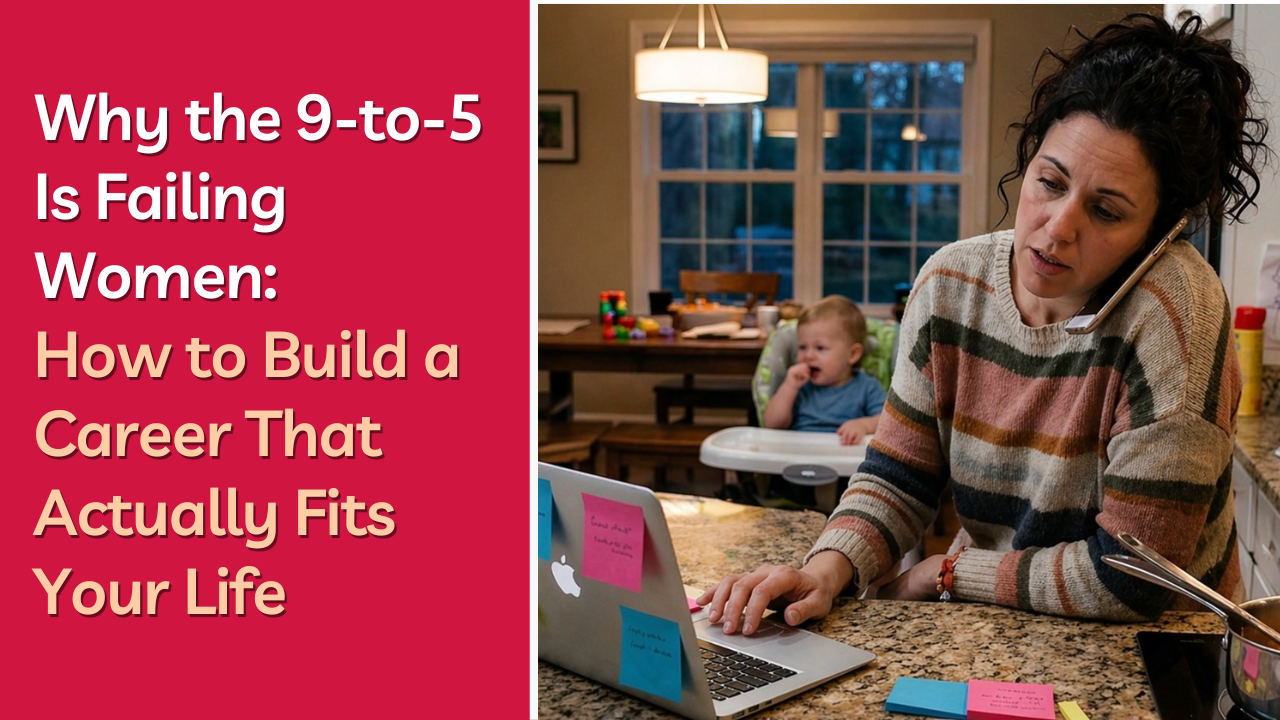
Let me guess what this week has looked like for you.
Your alarm goes off, and before your feet even hit the floor, you're already mentally running through yesterday’s unfinished work. Emails. Meetings. That one thing you didn’t get to.
You rush through the morning, maybe getting your kids out the door, maybe just trying to get yourself out the door… grabbing coffee because there’s no time for an actual breakfast.
You glance at your calendar and it’s already packed. Back-to-back meetings, no breathing room… and it’s not even 8 a.m. yet.
By midday, you’re inhaling your lunch at your desk.
By afternoon, you’re handling what feels like the workload of two people.
By evening, you’re physically home, but mentally still at the office.
And somewhere around 10 or 11 p.m., you’re in bed, scrolling LinkedIn… feeling that familiar mix of overwhelm and guilt, thinking:
“I know I need to make a change. But I don’t even know where to start.”
If you’re reading this like “yeah… that’s exactly it”…
You’re not the problem. The system is.
👉 Prefer to listen? Tune into the full episode here
The Workweek You're Living In Was Built for a Factory Floor
The Monday-through-Friday, 9-to-5, 40-hour workweek is not some timeless, scientifically validated formula for productivity.
It’s a relic from the early 1900s, and it was built for a world that looks nothing like yours.
Go back to the 1800s. People were working 10, 12, even 16 hours a day in factories. Workers fought hard, and risked their lives, for the radical idea of:
8 hours for work
8 hours for rest
8 hours for life
At the time, that was a huge win. It was about basic human dignity, not optimizing performance.
Then came Henry Ford.
In the 1910s and 1920s, he was running massive car factories. Assembly lines, heavy machinery, men doing the same repetitive motion, hour after hour. He realized something simple:
Exhausted workers make more mistakes. They quit more often. They cost money.
So in 1914, he moved to an 8-hour workday. In 1926, he introduced a five-day, 40-hour workweek. Not because he cared about work-life balance, but because it made his business more efficient. He also realized that if workers had weekends off and steady pay, they’d have more time and money to spend.
Your weekend is, quite literally, a 100-year-old marketing strategy.
Now look at the world this system was built for:
- One breadwinner
• One person at home handling everything else
• Work happening in one physical place
• Customers in the same time zone
• No email, no Slack, no Zoom, no AI
In that world, having everyone show up at the same time, in the same place, Monday through Friday made complete sense.

Everything About Work Changed. The Schedule Didn’t.
Here’s what I find almost absurdly funny… if it weren’t so exhausting to live through.
In the century since Ford rolled out the five-day workweek, the world of work has transformed beyond recognition. Telephones and typewriters gave way to computers, then the internet, then smartphones, then the cloud. A global pandemic proved millions of people could do their jobs from home without being watched every minute.
And now AI is here, doing things we once thought only humans could do. Drafting, summarizing, analyzing, creating. And doing it faster than we ever could.
The technology changed. The offices changed. The nature of work changed. The workforce changed. Dramatically. Fundamentally. To include women.
But the little 9-to-5 blocks on the calendar? Barely moved.
You’re doing 2026 work on a 1920s schedule, inside a life that looks nothing like the one this system was built around.
Two-income households. Single parents. Caring for kids and aging parents. Global teams pinging you across time zones. Clients expecting responses at all hours.
And somehow, we’re still operating as if everyone does their best work between Monday and Friday, 9 to 5, in one fixed place.
When you really step back and look at it… the whole thing starts to feel a little ridiculous.

Why the 9-to-5 Causes Burnout for Women
Let’s get specific, because this is where a lot of women have a real lightbulb moment.
This schedule wasn’t just built for a different era. It was built around an assumption that someone like you didn’t exist in the paid workforce. Someone doing a full-time professional job while also running a household, managing caregiving, navigating health changes, showing up for her family, and trying to maintain some sliver of herself in the margins.
The model was built on an unspoken assumption: that there’s someone else at home doing all that invisible labor. The cooking, the school forms, the doctor appointments, the emotional holding of everyone around you.
That didn’t go away. It just got added to everything you’re already doing.
And then there’s the way the model measures value.
You’re judged on how fast you respond to messages, how often you appear in meetings, how “visible” you are. Not on the quiet, deep, strategic work that actually moves things forward.
So you stay late to prove you’re a team player. You answer Slack messages at 9 p.m. so no one thinks you’re slacking. And then you lie awake feeling like you didn’t accomplish anything that actually mattered.
You’re exhausted from performing work rather than being rewarded for the impact you know you’re capable of making.
Why Your Brain Was Never Meant to Work a 9-to-5 Schedule
Here’s the part no one really says out loud.
Your brain and your creativity do not operate on a factory schedule.
Think about the last time you had a genuinely great idea. It probably wasn’t at 10 a.m. on a Tuesday in your third back-to-back meeting. It was in the shower, on a walk, or in that quiet space before you fell asleep.
The system treats you like a machine that just needs to be switched on for eight blocks a day. But your best work isn’t linear. It never was.
So when you catch yourself thinking, “I should be further along by now,” or “Why can’t I just handle this?” pause for a second.
You’re not failing at work.
You’re succeeding inside a system that was designed for a completely different life, a different gender role, and a different economy. Your body and your brain are finally calling that out.
What Work-Life Balance Could Actually Look Like (And How to Design Your Career Around It)
I don't want to just leave you with a diagnosis. Let's talk about what a worklife actually designed for you could look like.
Research is increasingly showing what many of us already sense: fewer, more focused hours can produce equal or better results than the standard 40-hour grind. Iceland’s government trials, the UK’s 2022 pilot with 61 companies and nearly 3,000 workers, Microsoft Japan’s four-day workweek experiment, study after study points in the same direction.
Shorter, better-designed workweeks tend to maintain or even increase productivity, while dramatically reducing burnout and turnover.
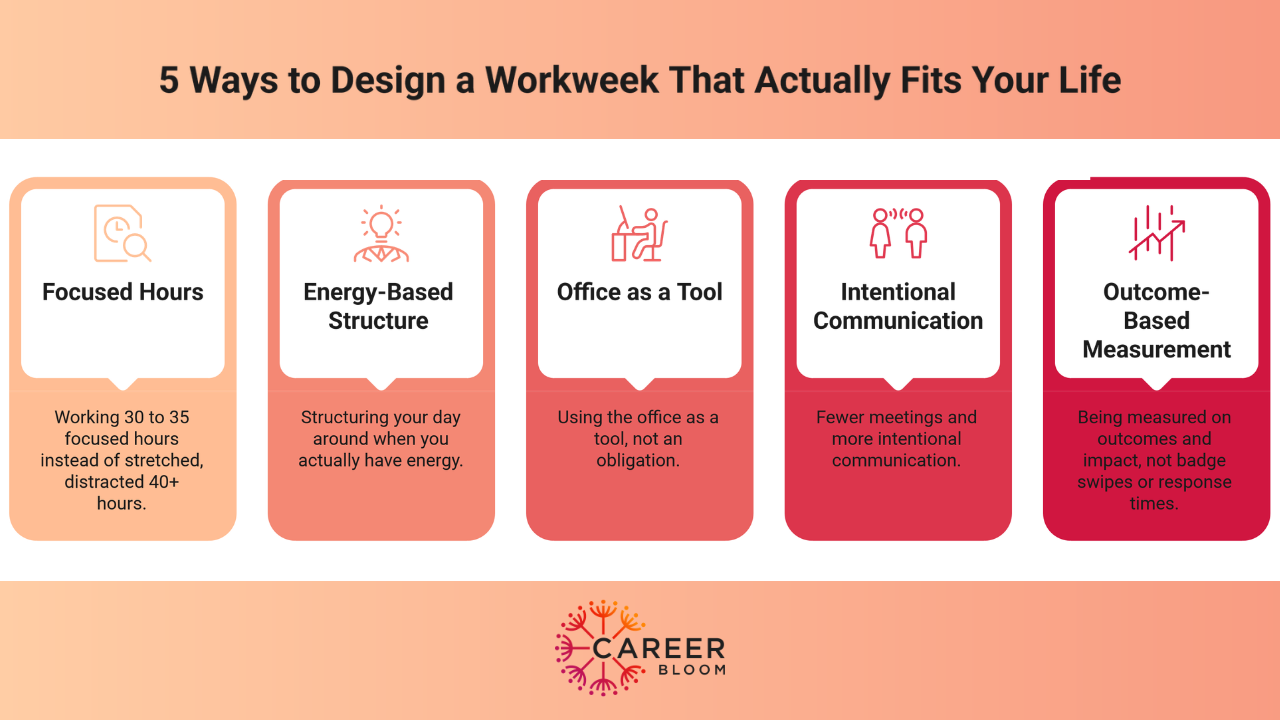
A more realistic way of working looks like this:
- Working 30 to 35 focused hours instead of stretched, distracted 40+
• Structuring your day around when you actually have energy, whether that’s early mornings before the house wakes up, school-day blocks, or evenings when your brain finally comes alive
• Using the office as a tool, not an obligation
• Fewer meetings and more intentional communication
• Being measured on outcomes and impact, not badge swipes or response times
And here's where AI becomes genuinely exciting rather than threatening: in this model, AI is your leverage.
It's the research assistant, the first-draft writer, the meeting summarizer you always wished you had. It handles the low-value busywork so you can spend your limited, precious hours on strategy, creativity, mentorship, and the work only you can do.
How to Plan a Career Change That Actually Fits Your Life
If you're seriously thinking about a career change, and if you've read this far, you probably are, I want to give you a different starting point than most people use.
Don’t start with your résumé. Don’t start with job boards.
Start by designing the week you actually want to live in.
Ask yourself: How many hours a week feels sustainable to me, 30, 32, 35? What time of day am I genuinely at my best? How many days am I willing to commute? How many meetings per day before I’m completely drained?
Write it down.
That becomes your filter. Every opportunity you consider needs to pass that test first.
Then ask: what kinds of roles, paths, or even business models could move me toward that kind of week?
Fully remote roles. Four-day workweek companies. Independent consulting. Portfolio careers.
There are more options than you think, and companies like GitLab, Automattic, Buffer, and Basecamp have already proven that flexible, async-first work isn’t a pipe dream. It’s a competitive advantage.
You don’t need to have the perfect job title figured out yet.
Start with the life and the week you want, and then build the career around that, not the other way around.
Why Your Career No Longer Fits (And What That Actually Means)
Before I wrap up, I want you to really sit with this.
You’re not burned out because you’re weak, ungrateful, or bad at your job.
You’re burned out because you’ve spent years, maybe decades, performing at a high level inside a system that was never designed for your life.
You’ve done everything right. You worked hard. You said yes. You showed up. You were the reliable one. The good teammate. The person who made it work.
And at some point, it stopped working for you.
That restless feeling, the Sunday dread, the quiet “is this it?” in the back of your mind, the sense that you’re capable of more but can’t quite access it where you are… that’s not something to ignore.
It’s a signal.
It’s telling you that the structure you’ve been operating in no longer matches the life you actually want to build.
You haven’t lost direction.
You're just finally noticing that the map you were given no longer matches the life you want.
And that, honestly, is the best possible place to start.
Start Designing Your Ideal Workweek
If you’re reading this and thinking, okay… this is exactly what I’ve been feeling… don’t just close the tab and go back to the same routine.
I put together a tool to help you actually map this out for yourself.
👉 Download the Workweek Designer here:
www.careerbloomcoaching.com/episode90
It walks you through exactly how to map your ideal week, identify the roles that match it, and use AI to cut your busywork in half.
About Career Coach & Author
Theresa White, Career Clarity Expert, 5x Certified Career Coach, and the Founder of Career Bloom, is known for her expertise in guiding people to get unstuck and find the direction they need to move forward in their careers, fast. In a time when so many people are re-evaluating their work, Theresa offers actionable insights that empower clients to identify their true strengths and pursue work that genuinely aligns with their goals.
Theresa’s clients often call her sessions “epiphanies” and “transformational.” She brings immediate clarity to career goals, helping people unlock a deep understanding of what makes work fulfilling for them. Past participants consistently describe her approach as “spot on” and an “answer to questions they’d been asking for weeks.”
Theresa’s approach is empathetic yet practical, and she’s known for empowering clients with a clear direction in as little as 30 days, guaranteeing results.
Connect with Theresa on LinkedIn, listen to the Career Clarity Unlocked Podcast, or schedule your free 30-minute career clarity consultation.

Frequently Asked Questions About Flexible Careers for Women and Working Moms:
What is a flexible work schedule and how is it different from a traditional 9-to-5?
A flexible work schedule allows you to structure your work around when you’re actually productive, not fixed hours, often with fewer meetings, more autonomy, and a greater focus on results instead of being “online” all day.
Are there real companies that support flexible or remote work for women and working parents?
Yes, companies like GitLab, Automattic, Buffer, and Basecamp have built fully remote, async-first environments, proving that flexible work models can increase productivity while better supporting women balancing careers and caregiving.
How can women balance a career and motherhood without burning out in a 9-to-5 job?
The real shift isn’t doing more, it’s working differently. Women who avoid burnout tend to prioritize roles with flexibility, fewer meetings, and clear outcome-based expectations so their time and energy actually align with how their life works. If you'd like help figuring out your next step, check out my free live masterclass, Start Your Career Change in 3 Simple Steps!, where I walk you through how to gain career clarity, create a realistic plan, and confidently move toward work that fits your life.

What Other Job Seekers Are Reading
- What to do when you're feeling stuck in career
- How to Find Your Perfect Career
- 8 progressive companies to work for
- 7 Message Templates to Reach Out to Recruiters
- How to Use AI to Find a Job in 2025: Why Soft Skills Still Matter
- Free Job Search Tracker
- Get Career Clarity In Just 30 Days!
- Take this 60 second quiz to see if a free career clarity call with my team is your next best step.
Subscribe now to never miss the latest blog!
Every Thursday, we cover an important topic, actionable advice, and inspiring content to help you find work that makes you feel like *pinch me* I'm getting paid to do this???
We hate SPAM. We will never sell your information, for any reason.