
You know when you get a project at work that’s actually interesting? There’s a problem to solve, you don’t know the answer yet, and you get completely absorbed in figuring it out.
You research. You ask questions. You try different things. You keep pulling at the thread until finally, you figure it out.
And it works.
That’s the part you love.
What you don’t love is what comes next.
Because now that you’ve solved the problem, you’re the one stuck maintaining the solution. Monitoring it. Following up. Running the same process again and again.
And the work that was genuinely interesting six months ago has somehow become mind-numbingly boring.
If you recognize yourself in that, I’d pay attention to it. Because that shift from figuring it out to keeping it going can tell you a lot about the kind of work you actually need in your next role.
You’ve spent years building expertise. You’ve moved up. People trust you. You can point to real accomplishments.
Yet lately, you’re lacking motivation. The work that once challenged you feels repetitive. You know you’ve outgrown something, but you’re not sure what or what you should do instead.
And that’s when the career questions start spinning.
Do I need a different company? A bigger role? A completely different career? What would I even enjoy besides what I’ve already been doing?
Before you start searching job titles, there’s something much more useful to understand:
What kind of work actually gives you energy, and at what point does that energy disappear?
I recently worked with a senior marketing leader I’ll call Claire, whose career story made this pattern incredibly clear.

Why Do I Get Bored at Work Even When I’m Successful?
Claire had built a successful career. She was strategic, curious, experienced, and the kind of person people trusted when something complicated needed to be figured out.
One project in particular stood out.
Her company had a trade show process that was messy and difficult to measure. There were too many disconnected pieces, too much manual tracking, and no clear way to see what was actually working.
Claire took it on.
And this was the part of the story where she lit up.
She started researching how other companies handled it. She dug into the CRM. She looked at the reporting. She talked to the people involved and started piecing together a better way to connect the activity to actual business results.
She did a deep dive early on, bringing in leaders from Sales and Operations, figuring out where the gaps were, and building a process that could work across different regions.
Then she built it.
She got the right people aligned, worked through resistance, and helped roll out a much clearer system across the company.
It worked.
And more importantly, it solved the problem she had set out to solve.
So I asked Claire which part she had enjoyed most.
Her answer came quickly.
The research. The figuring out. The building.
Then we talked about what happened once the problem was solved.
Now someone needed to monitor the system. Check that people were using it. Follow up. Maintain what had already been created.
In other words, the interesting part was over.
Now she had to babysit the solution.
That was when her energy disappeared.
She told me she wished she could simply hand that part to somebody else.
There was our clue.
The Problem Wasn’t Motivation. It Was the Type of Work.
It would be easy for Claire to look at this pattern and decide:
I need to be more disciplined.
That’s especially common among successful women. You’re used to being the person who follows through, gets things done, and figures out how to make something work.
So when your motivation drops, you assume the problem must be you.
But Claire wasn’t losing motivation randomly.
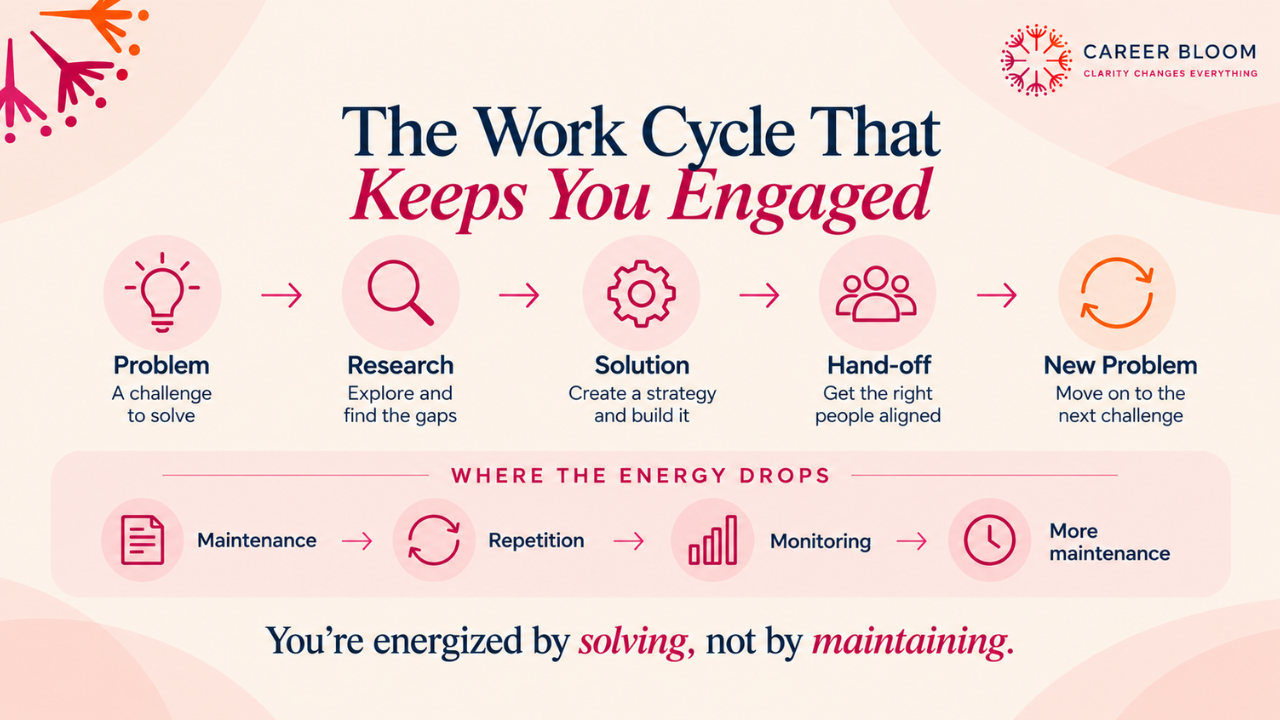
Her energy followed a remarkably consistent cycle:
Problem → Research → Solution → Hand-off → New problem
Give her something complicated that nobody has figured out yet, and she’s engaged.
Let her research it, pull together the puzzle pieces, find the gaps, create a strategy, get people aligned, and build something better, and she comes alive.
But once the question changes from “How do we solve this?” to “How do we keep doing this over and over?”, the work changes for her.
That is the important part.
Claire didn’t necessarily hate marketing.
She didn’t lack discipline.
She wasn’t incapable of follow-through.
She was energized by solving, not by maintaining.
And if your career is increasingly filled with repetitive work after the interesting problems have already been solved, boredom may be telling you something very useful about what your next job needs to look like.
Being Good at Something Doesn’t Mean You Want to Keep Doing It
This is one of the biggest career clarity mistakes I see.
Experienced professionals have accumulated a lot of skills.
You may be excellent at managing people, facilitating meetings, handling crises, building presentations, executing programs, managing stakeholders, or running established processes.
But being good at something doesn’t automatically mean you should build your next career around doing more of it.
That was another important discovery for Claire.
She could be highly visible. She could lead meetings and speak in front of groups.
But having to be continuously “on” drained her.
Interestingly, it wasn’t necessarily the people part.
Put her in a meeting where she could ask questions, understand different perspectives, gather the puzzle pieces, and help the group solve something?
That felt different.
Now she was using her natural curiosity and problem-solving ability.
Same meeting room.
Completely different experience of the work.
This is why career clarity requires going deeper than strengths.
You need to distinguish between:
What you can do well and what you want to keep doing well.
Your resume usually tells you the first.
Your work patterns tell you the second.
Look at the Work Inside the Job Title
Another career idea Claire was considering sounded logical on paper: teaching.
She loves learning. She loves digging deeply into subjects. She enjoys helping people.
So perhaps she could eventually teach at a university.
Maybe.
But instead of deciding based on the title, we unpacked the actual work.
Imagine researching a fascinating subject, becoming deeply knowledgeable about it, and creating a course from scratch.
Claire’s energy goes up.
Now imagine teaching essentially the same material semester after semester.
Different story.
This distinction comes up constantly in career changes.
Someone can love psychology and hate the day-to-day reality of being a therapist.
Someone can become fascinated by Pilates and have absolutely no desire to teach the same class every week.
Someone can genuinely enjoy mentoring colleagues and still not want her calendar filled with people-management responsibilities.
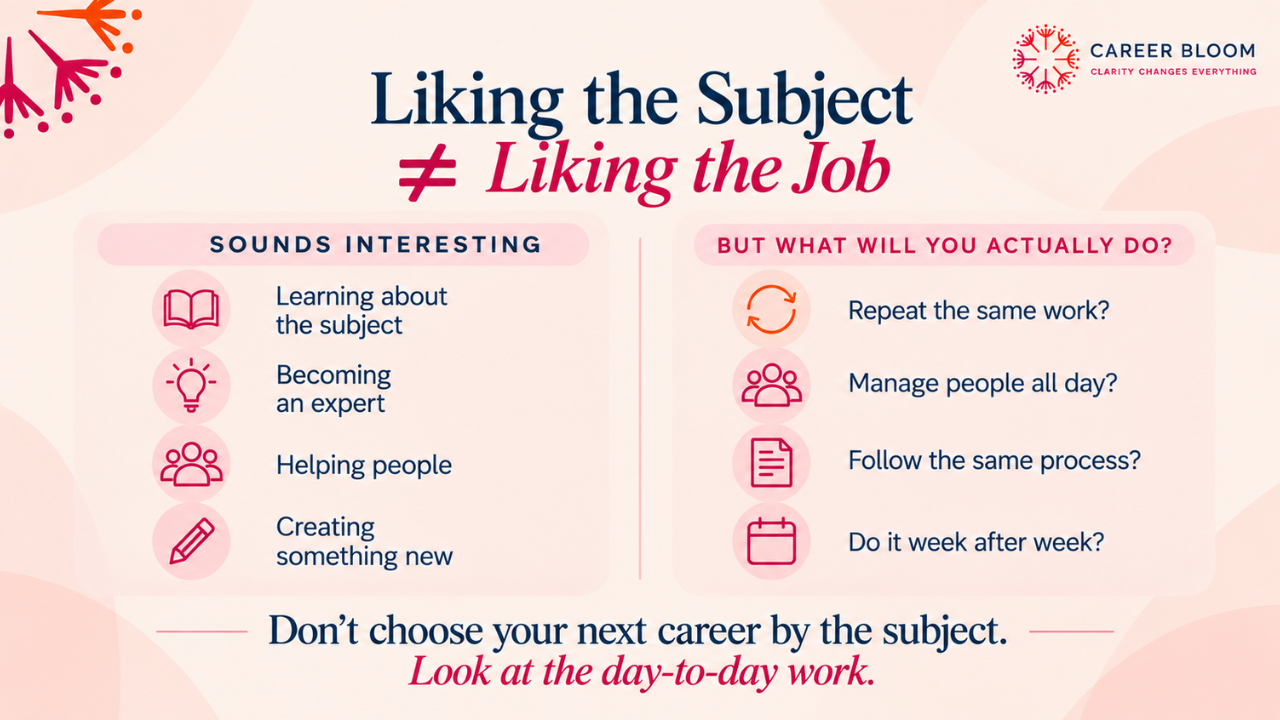
That’s why interest in the subject and enjoyment of the day-to-day activities required by the job are two different things.
Career fit lives in the second one.
Your Boredom at Work Is Data
This is where the conversation with Claire became much more useful.
Instead of asking, What career should I switch to?, we could look at the pattern underneath the jobs she had already done.
I wanted to know:
- What was happening when she was most engaged?
- What was she actually doing?
- What kinds of problems did people trust her to solve?
- What drained her, even when she was good at it?
- At what point did interesting work turn into repetitive work?
A clear pattern emerged.
Claire came alive when she could:
- Identify a problem
- Research it deeply
- Figure out what was really happening
- Connect information other people weren’t connecting
- Build a solution
- Get the right people involved
- Turn the solution into something usable
- Hand it off and move to the next interesting problem
She lost energy when the work shifted toward repetitive execution and long-term maintenance.
Now we had something much more useful than:
“I think I need a new career.”
We had a career-fit criterion.
Her next role needed a high ratio of problem-solving to maintenance.
That is much more useful than saying, “I want something challenging.”
Because now we have something we can actually evaluate.
What Does This Tell You About the Kind of Job You Need?
Imagine Claire is looking at two opportunities.
The first role sounds impressive. Great title. Good salary. Familiar industry.
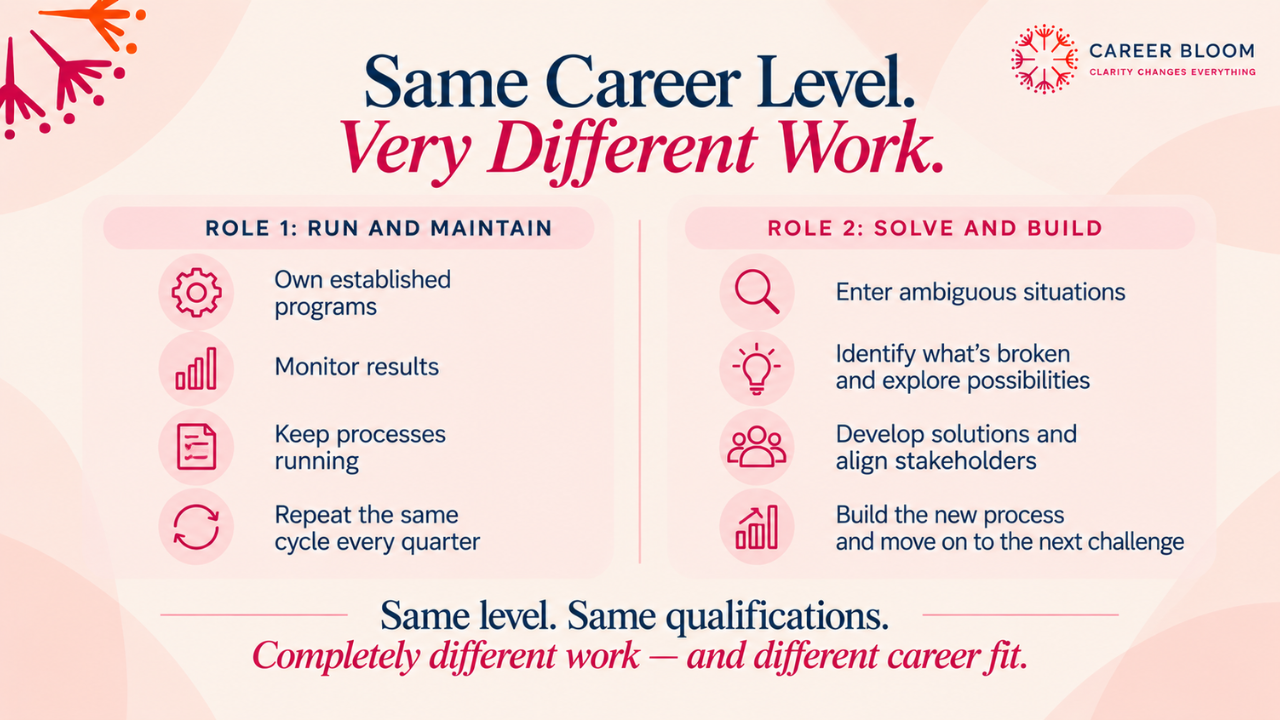
But once she looks closely, most of the job involves owning established programs, monitoring results, keeping processes running, and repeating the same cycle every quarter.
The second role may look less obvious on paper.
But the work involves entering ambiguous situations, identifying what’s broken, researching possibilities, developing solutions, aligning stakeholders, building the new process, and then moving on to the next business problem.
For Claire, those jobs are not remotely the same.
Even if she is technically qualified for both.
This is why I don’t start career clarity work by handing someone a list of job titles.
First, we decode the work patterns.
Then we turn those patterns into career-fit criteria.
Then we identify realistic roles and directions that contain more of the work she wants to keep doing.
Only then do we start asking which titles, industries, or paths make sense.
Your Next Career Move May Be Closer Than You Think
Claire’s pattern didn’t necessarily point toward throwing away her marketing experience and starting over.
It opened up possibilities that used her experience differently.
We could explore work involving marketing operations and transformation, strategic operations, consulting, analytics, process improvement, or project-based strategic work.
The common denominator wasn’t a particular title.
It was the work itself:
Problem → Research → Solution → Hand-off → New problem
That is also a much stronger way for Claire to understand the value she brings.
Instead of simply saying:
“I’ve worked in marketing for years.”
She can see something deeper:
I figure things out and streamline complex processes.
Suddenly, her experience isn’t a box she has to escape.
It’s evidence of the kind of problems she is particularly good at solving.
And that matters when you’re at a career crossroads but don’t want to casually throw away 15 or 20 years of experience.
The goal isn’t to start over.
It’s to understand what you’ve already built well enough to see where else it can take you.
Try This Before You Start Another Job Search
Think about three projects from your career:
- One you absolutely loved
- One you were good at but found draining
- One that started exciting but eventually became boring
Don’t focus on the subject matter or the job title.
Look at what you were actually doing.
Were you:
- Researching?
- Building?
- Fixing?
- Creating?
- Analyzing?
- Leading?
- Executing?
- Maintaining?
- Repeating the same process again and again?
- Keeping something running long after the interesting problem had been solved?
Then notice when your energy changed.
This is the part most people skip.
Don’t just ask, Did I like this job?
Ask:
At what point did I stop liking the work?
Sometimes the answer is surprisingly specific.
You were energized while figuring out the strategy, then bored once your job became executing it every quarter.
You loved building the program, but maintaining it for the next two years felt mind-numbing.
You were completely engaged while solving the messy problem. Then everything started running smoothly, and suddenly you had nothing new to figure out.
The work went from challenging to predictable.
From solving to maintaining.
From creating to babysitting.
That distinction matters.
You may not hate marketing. You may hate maintaining established programs.
You may not hate leadership. You may hate spending your days managing the same recurring issues.
You may not be tired of your industry. You may be tired of executing other people’s strategies when you want to be solving bigger problems.
Those are very different career diagnoses.
And they lead to very different next moves.
If you’re thinking, “I know something needs to change, but I don’t trust myself to choose the right next step,” don’t start by forcing yourself to pick a new career.
Start by understanding your work patterns.
Take the 2-minute Career Bloom Career Clarity Quiz to start uncovering your ideal career change, one that uses your strengths, honors your values, and leaves burnout behind.
The quiz will help you start identifying what energizes you, what drains you, and what those patterns may be telling you about the kind of work that actually fits you now.
Because the goal isn’t simply to find another job you can do.
It’s to get clearer on a career direction that fits your life, lights you up, and actually makes sense.

About Career Coach & Author
Theresa White, Career Clarity Expert, 5x Certified Career Coach, and the Founder of Career Bloom, is known for her expertise in guiding people to get unstuck and find the direction they need to move forward in their careers—fast. In a time when so many people are re-evaluating their work, Theresa offers actionable insights that empower clients to identify their true strengths and pursue work that genuinely aligns with their goals.
Theresa’s clients often call her sessions “epiphanies” and “transformational.” She brings immediate clarity to career goals, helping people unlock a deep understanding of what makes work fulfilling for them. Past participants consistently describe her approach as “spot on” and an “answer to questions they’d been asking for weeks.”
Theresa’s approach is empathetic yet practical, and she’s known for empowering clients with a clear direction in as little as 30 days, guaranteeing results.
Connect with Theresa on LinkedIn, listen to the Career Clarity Unlocked Podcast, or schedule your free 30-minute career clarity consultation.

Career Clarity FAQ
Why am I bored at work even though I’m good at my job?
Being good at your job doesn’t necessarily mean the day-to-day work is a good fit for you. You may be highly capable at repetitive execution or maintaining established systems while feeling much more energized by learning, building, strategy, or solving new problems. Pay attention to the point where your energy drops. If boredom tends to show up once the problem is solved and you’re left maintaining the solution, that pattern can tell you a lot about what your next role needs more of and less of.
What kind of jobs are good for people who love problem-solving?
People who enjoy solving new problems may be drawn to roles involving strategy, consulting, transformation, operations, analytics, process improvement, innovation, or project-based work. But the title alone isn’t enough. Look at the actual responsibilities and ask how much of the role involves solving new problems versus maintaining established processes, repeating routine work, or babysitting the same solution indefinitely.
How do I figure out what career or job is right for me next?
Start by looking for patterns across your best and worst work experiences. Identify what you were doing when you felt most engaged, when your energy dropped, what problems you naturally solve well, and which responsibilities you don’t want to keep carrying forward. Those patterns can become career-fit criteria that help you evaluate realistic next steps without assuming you have to start over.
What Other Job Seekers Are Reading
Subscribe now to never miss the latest blog!
Every Thursday, we cover an important topic, actionable advice, and inspiring content to help you find work that makes you feel like *pinch me* I'm getting paid to do this???
We hate SPAM. We will never sell your information, for any reason.