"Everything switched."
I'll never forget hearing those words.
Amanda sat quietly for a moment after saying them, staring down at the mug in her hands as if the answer might be somewhere at the bottom. When she finally looked up, she smiled, but it was the kind of smile people use when they're trying to make sense of something that still hurts.
She had spent years chasing what she believed was her dream career. She was ambitious, dependable, and willing to outwork almost anyone to get where she wanted to go.
Then she landed in the hospital with a life-threatening illness.
When she was finally discharged, her boss told her she "hadn't been working hard enough."
She paused.
Then she said something I'll never forget.
"I don't want to do this anymore."
Most people hear a story like that and assume burnout ended someone's career.
I hear something different.
I hear the beginning of a much more honest conversation.
Burnout Doesn't Always Mean You're Done
When people come to me feeling burned out, they usually believe something about themselves has broken.
"I used to be so ambitious."
"I don't know what I want anymore."
"I feel like I've lost myself."
If you've ever thought those words, you know how unsettling they are. They don't just make you question your career, they make you question your identity.
For years, you've probably been the capable one. The reliable one. The person who figures things out.
So when work suddenly feels heavy, it's easy to conclude you've changed.
Sometimes you have.
But not in the way you think.
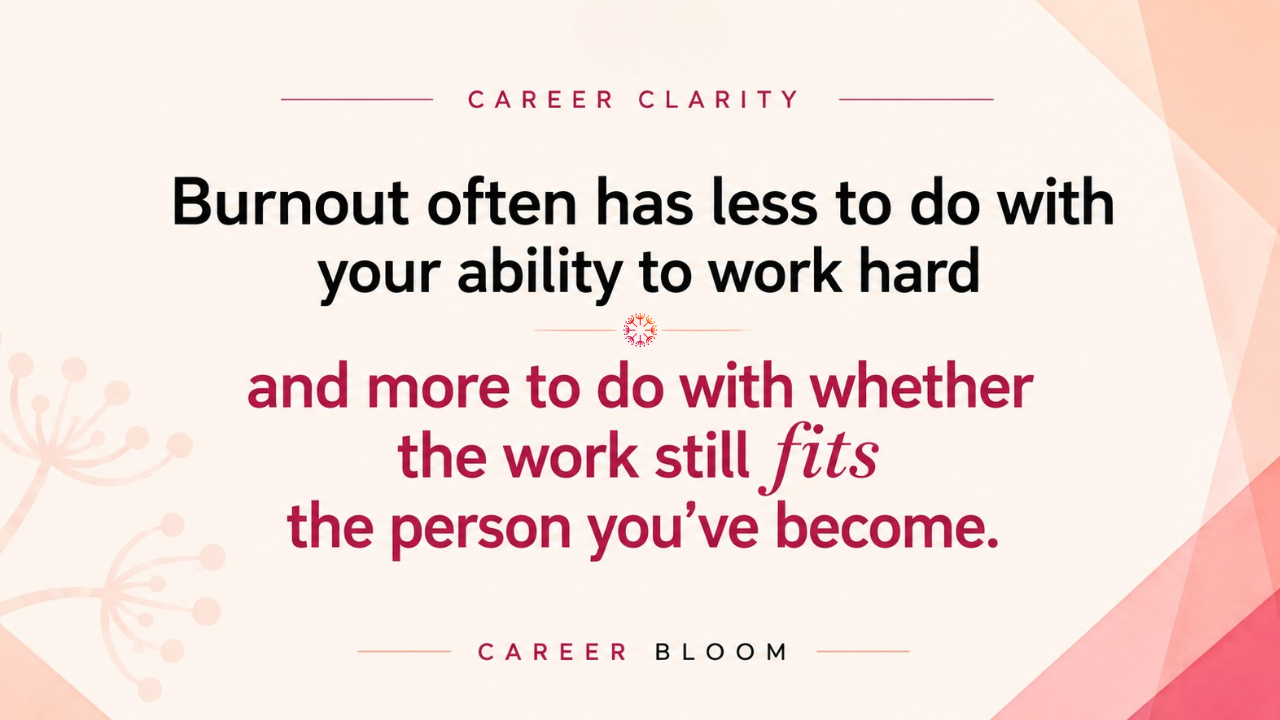
Over the years, I've noticed that burnout often has less to do with your ability to work hard and more to do with whether the work still fits the person you've become.
Amanda was about to discover that for herself.
"Maybe I Just Need a Different Job."
As we talked, Amanda was convinced she knew the problem.
"I think I just need a different company."
"Maybe," I said. "Tell me more."
She described long hours, unhealthy expectations, and a workplace where results seemed to matter more than people. Every story pointed to her environment.
Then I asked a question she wasn't expecting.
“If the company changed, but your daily work stayed the same, would you still feel this way?”
She frowned.
"I...don't know."
That silence told me more than any answer could have.
A few minutes later I asked another question.
"What does a really good day at work look like?"
She laughed.
"I honestly can't remember."
"Take your time."
She leaned back in her chair and looked toward the window.
Then, almost reluctantly, she said, "Actually..."
She began describing a project from years earlier.
As she talked, something changed.
Her posture shifted.
Her voice became animated.
She stopped choosing her words so carefully and simply started telling the story.
I wasn't listening for job titles.
I was listening for energy.
The Version of Amanda I Hadn't Met Yet
She told me about tracking down information no one else could find.
"I became obsessed," she laughed. "Everyone else had given up, but I couldn't let it go."
"What happened?"
"I kept connecting pieces that didn't seem related until suddenly...it all clicked."
Her hands were moving now.
She wasn't talking like someone who was burned out.
She was talking like someone completely absorbed in solving a puzzle.
"Can I tell you something weird?" she asked.
"Of course."
"When someone tells me a problem can't be solved..."
She smiled for the first time that afternoon.
"...that's when I get excited."
There she was.
Not exhausted.
Not unmotivated.
Not lacking ambition.
Just hidden beneath years of work that asked her to use almost none of what energized her.
As we kept talking, I noticed something else.
Every time Amanda described work she loved, she leaned forward.
Every time she described her current job, she leaned back, crossed her arms, and looked at the floor.
She didn't need another personality assessment.
Her body was already telling the story.
The Real Source of Her Burnout
Then I asked a different question.
"What do you spend most of your day doing now?"
Her shoulders dropped.
"Scheduling."
"Coordinating."
"Following up."
"Keeping everyone else's priorities moving."
None of those tasks were difficult for her.
That wasn't the problem.
The problem was that the work asking the least of her mind had become the work consuming most of her days.
She wasn't burned out because she was working too much.
She was burned out because she had stopped using the parts of herself that made work meaningful.
That's an important distinction.
Many high achievers become trapped this way.
They're competent enough to keep getting promoted into work that slowly disconnects them from what naturally energizes them.
From the outside, it looks like success.
From the inside, it feels like disappearing.
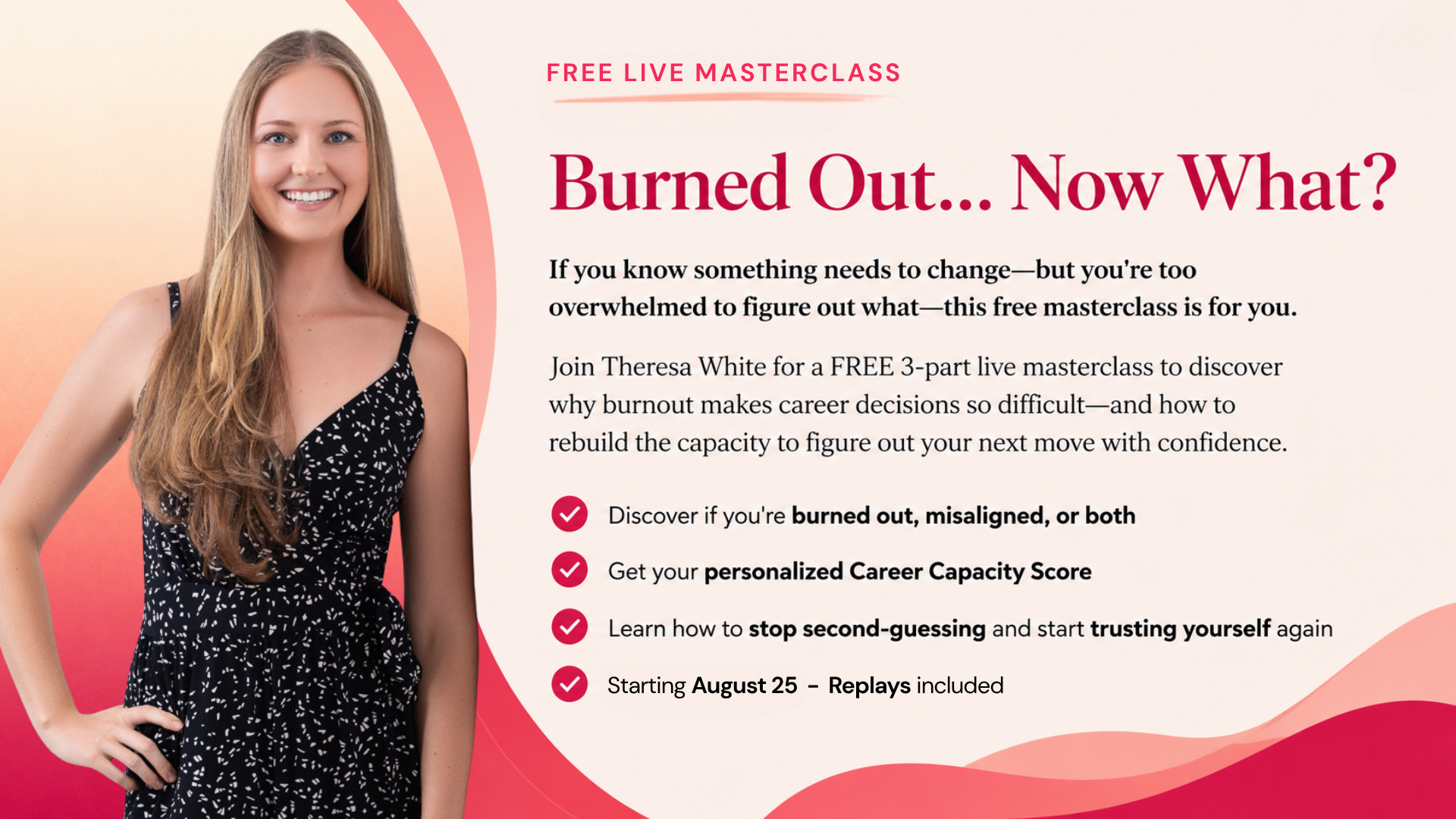
I see this more often than people realize, which is exactly why I created my free Burned Out...Now What? masterclass. So many people assume they're exhausted because they need a new company, a new industry, or more resilience. Before making any of those decisions, you need to understand what kind of work actually gives you energy. That's the conversation Amanda and I were having, and it's the same conversation I guide people through inside the masterclass.

How to Identify the Work That Energizes You
Eventually I asked the question everyone asks.
"So...what do you want instead?"
Amanda stared at the table.
"I don't know."
Then she looked up, almost embarrassed.
"I know exactly what I don't want."
I smiled.
"That's actually where most people start."
We spend so much time trying to identify the perfect job title that we skip the more important question.
What kind of work brings you alive?
Job titles change.
Industries change.
Companies change.
But the kind of work that naturally energizes you tends to leave clues throughout your entire career.
So instead of brainstorming careers, we kept following the clues.
"When have you lost track of time at work?"
"What kinds of problems pull you in?"
"What conversations leave you energized instead of drained?"
One by one, the answers surfaced.
She loved connecting ideas other people couldn't see.
She loved researching until scattered information became a clear recommendation.
She loved influencing decisions, not simply carrying them out.
She loved helping people see possibilities they hadn't considered.
The pattern wasn't hiding.
No one had simply asked her to look for it.
How Career Clarity Begins to Take Shape
There wasn't one dramatic breakthrough.
No lightning bolt.
No perfect career title suddenly appearing.
Instead, clarity arrived quietly.
Amanda stopped asking, "What jobs could I do?"
She started asking, "Does this work let me think the way I'm naturally wired to think?"
That's a completely different question.
By the end of our conversation, she wasn't excited because she'd found one magical answer.
She was excited because she finally understood why she'd felt so disconnected for so long.
Nothing about her ambition had disappeared.
It had simply been pointed in the wrong direction.
Once she understood that, evaluating opportunities became dramatically easier.
Instead of chasing every opening that matched her experience, she could ask a better question:
"Will this work let me solve the kinds of problems that bring out my best?"
That's a much more reliable compass than a job title ever could be.

Why Career Clarity Should Come Before Your Résumé
This is probably where my approach differs most from traditional career coaching.
Most people start by updating their résumé.
Then they network.
Then they apply.
Those are important steps, but they're implementation steps.
Implementation only works when you're moving toward the right destination.
Otherwise, you can conduct a flawless job search that leads you right back into the same burnout you were trying to escape.
I've watched incredibly capable women spend months landing jobs they were perfectly qualified for, only to discover six months later that they felt exactly the same.
Not because they made a bad decision.
Because they never stopped to understand what actually fit.
That's why the Career Capacity Framework begins somewhere different.
First, restore.
Then reclaim.
Only then do you redirect.
If you've been saying, "I've taken every career assessment, but I still don't know what I want," that's exactly what we work through in my free Burned Out...Now What? masterclass.
Before you update your résumé or apply for another role, you need clarity about the work that allows you to do your best thinking. Everything else becomes easier after that.
How Burnout Can Lead to a Better Career Direction
At the beginning of our conversation, Amanda believed burnout had stolen her ambition.
By the end, she realized it had revealed something much more important.
She hadn't stopped caring about meaningful work.
She'd simply spent too long doing work that no longer reflected how she naturally thinks, solves problems, and creates value.
As we wrapped up, she smiled again.
This time it was different.
Lighter.
Hopeful.
"I think I finally understand what happened," she said.
"What?"
She laughed softly.
"Everything switched."
She was right.
Not because her illness changed her.
Not because one difficult boss ruined her career.
But because burnout finally forced her to notice the gap between the work she was doing and the work she was made to do.
If you've reached the point where you're thinking, I know I can't keep doing this, but I don't know what comes next, don't start by updating your résumé.
Start by paying attention to the moments that make you come alive.
Because burnout isn't always the end of your career.
Sometimes it's the moment you finally begin building one that fits.
About the Author: Theresa White, Career Clarity Expert and Coach
Theresa White, Career Clarity Expert, 5x Certified Career Coach, and the Founder of Career Bloom, is known for her expertise in guiding people to get unstuck and find the direction they need to move forward in their careers—fast. In a time when so many people are re-evaluating their work, Theresa offers actionable insights that empower clients to identify their true strengths and pursue work that genuinely aligns with their goals.
Theresa’s clients often call her sessions “epiphanies” and “transformational.” She brings immediate clarity to career goals, helping people unlock a deep understanding of what makes work fulfilling for them. Past participants consistently describe her approach as “spot on” and an “answer to questions they’d been asking for weeks.”
Theresa’s approach is empathetic yet practical, and she’s known for empowering clients with a clear direction in as little as 30 days, guaranteeing results.
Connect with Theresa on LinkedIn, listen to the Career Clarity Unlocked Podcast, or schedule your free 30-minute career clarity consultation.

Career Burnout and Career Clarity: Frequently Asked Questions
How can you tell whether burnout is caused by your job or your career direction?
Start by separating the work environment from the work itself. A difficult manager, unrealistic workload, or unhealthy culture can make an otherwise suitable role feel unbearable. But if the daily work still feels draining, unfulfilling, or underutilizing even in a better environment, the deeper issue may be career misalignment.
Ask yourself: If the company improved but my responsibilities stayed the same, would I want to keep doing this work?
Can you recover from burnout and still decide to change careers?
Yes. Recovering from burnout and gaining career clarity are related, but they are not the same process. Rest can help you think more clearly, but it may not resolve the reasons your work stopped fitting.
Once you have enough capacity to reflect, look for patterns across your career. Notice which projects energized you, which responsibilities drained you, what kinds of problems held your attention, and how you want to use your experience going forward.
What should you do before applying for a new job when you feel burned out?
Before updating your résumé or applying for similar roles, clarify what needs to be different in your next position. Define the work you want to keep doing, the work you no longer want to build your career around, and the conditions you need to perform at your best.
This helps you avoid making a reactive move into the same type of work at a different company. Career clarity gives you criteria for evaluating roles before you begin the job search.
What Other Job Seekers Are Reading
- What to do when you're feeling stuck in career
- How a Bridge Job Gives You Space to Heal from Burnout and Plan Your Next Move
- How to Find Your Perfect Career
- 8 progressive companies to work for
- 7 Message Templates to Reach Out to Recruiters
- Free Job Search Tracker
Get Career Clarity In Just 30 Days! Take this 60 second quiz to see if a free career clarity call with my team is your next best step.
Subscribe now to never miss the latest blog!
Every Thursday, we cover an important topic, actionable advice, and inspiring content to help you find work that makes you feel like *pinch me* I'm getting paid to do this???
We hate SPAM. We will never sell your information, for any reason.