The Job Search Strategy That Doubles Your Chances of Getting Hired (Without Applying More)
Jun 02, 2026
The job market you’re in right now is unlike anything you’ve ever seen before.
Last year, over 1.2 million workers in the US were let go. If your applications feel like they’re disappearing into a black hole, you’re not imagining it.
I recently sat down with Melissa Grabiner, a resume writer and talent acquisition expert who has reviewed thousands of resumes, and we talked about what’s actually happening behind the scenes right now.
Companies are getting hundreds, sometimes thousands, of applications for a single role. Some aren’t even posting jobs anymore because they’re overwhelmed by the volume.
At the same time, more roles are being filled through networking, direct outreach, and recruiter search than through “easy apply” buttons.
So if the traditional job search is producing diminishing returns, what do you do?
You stop putting your entire future in the hands of job boards, and you start creating more ways for companies to say yes to you.
That’s what this post is about.
I’m going to walk you through the exact two-path job search strategy I use with my clients to help them land a great full-time role, consulting work, or both, without applying to more jobs.
You are not starting over.
You are repackaging what you already know how to do into more than one way for companies to say yes to you.
👉 Prefer to listen? Tune into the full episode here
The Dual Career Strategy: A Smarter Job Search Strategy in Today’s Market
The idea is simple, but it changes everything.
You don’t wait to be chosen.
You create more ways for companies to work with you.
You do that by running two paths at the same time:
- Path A: Job Search – You apply for roles and pursue the traditional hiring process.
- Path B: Consulting / Alternative Income – You turn your skills into a focused consulting or project-based offer companies can say yes to right now.
Most candidates only run Path A.
That’s why they stay stuck, especially in a market where the odds of getting hired purely from postings are minimal compared to landing a role through your network.
When you add Path B, you:
- Open multiple entry points into the same companies
- Keep money and momentum flowing (even a few hours a week helps)
- Protect your confidence because you’re not just waiting for a recruiter to pick you
As Melissa Grabiner said when we spoke, “Betting on yourself is really the best thing you can do… Even if someone still wants to get a corporate job… maybe see if you can make some money on the side with the skillset that you have.”
The dual strategy is how you bet on yourself, without abandoning your goal of a great full-time role.
To make this real, I want to introduce you to Jen.
Jen’s Story: From “I Hope Someone Hires Me” To “I Have Something To Offer Right Now”
When Jen came to me, she was clear about one thing:
She wanted a full-time role as a Global Onboarding Program Manager.
She cares deeply about creating onboarding experiences that help new hires ramp faster, stay longer, and actually feel welcomed into their companies.
But she was also facing what you might be facing right now:
- A crowded, competitive job market
- Roles getting hundreds of applications
- A lot of waiting, silence, and “we’ve decided not to move forward”
Instead of telling her to just apply more, we did something different.
We gave companies two ways to say yes to her.
The Shift
Path A: Keep targeting Global Onboarding Program Manager roles.
Path B: Build a focused onboarding consultancy that solves the exact same problems.
This part is important.
Jen was not starting something new.
In both paths, she was doing the same thing:
Helping companies fix broken onboarding so new hires ramp faster, stay longer, and feel supported.
We just made it easier for companies to access that value.
What We Built (And What You Can Model)
- A detailed ideal client avatar so she knew exactly which companies and leaders were the best fit for her work, typically high-growth, mid-sized tech and SaaS companies where onboarding pain is acute.
- A consulting brand (logo, visual identity, brand kit) so she looked credible and “real” as a partner, not just “between jobs.”
- LinkedIn banner images, a carousel, and featured section graphics that told a clear story about who she helps and how.
- A LinkedIn About section that speaks to both:
- Her value as a Global Onboarding Program Manager (Path A)
- Her ability to step in as an onboarding consultant for scaling teams (Path B)
- A 4-week LinkedIn thought leadership content calendar focused on onboarding problems, solutions, and outcomes.
- A simple landing page at brightstartonboarding.com explaining who she helps, what onboarding problems she solves, and a clear way to book a call.
- Calendly setup so decision-makers can grab time with her without email ping-pong.
- A one-page speaker sheet and a lead magnet to attract the right audience and capture interest.
- An automated networking campaign to her first-level LinkedIn connections, sharing the exciting news that she’d launched her onboarding consultancy and inviting conversations.
We didn’t stop her job search.
We made it stronger.
Because now, when she reached out to companies, there were two possible outcomes:
- Yes, to a full-time Global Onboarding Program Manager role
- Or yes, to a consulting engagement, a project, a pilot, or a speaking opportunity
You can build your own version of this.
Let’s walk through how.
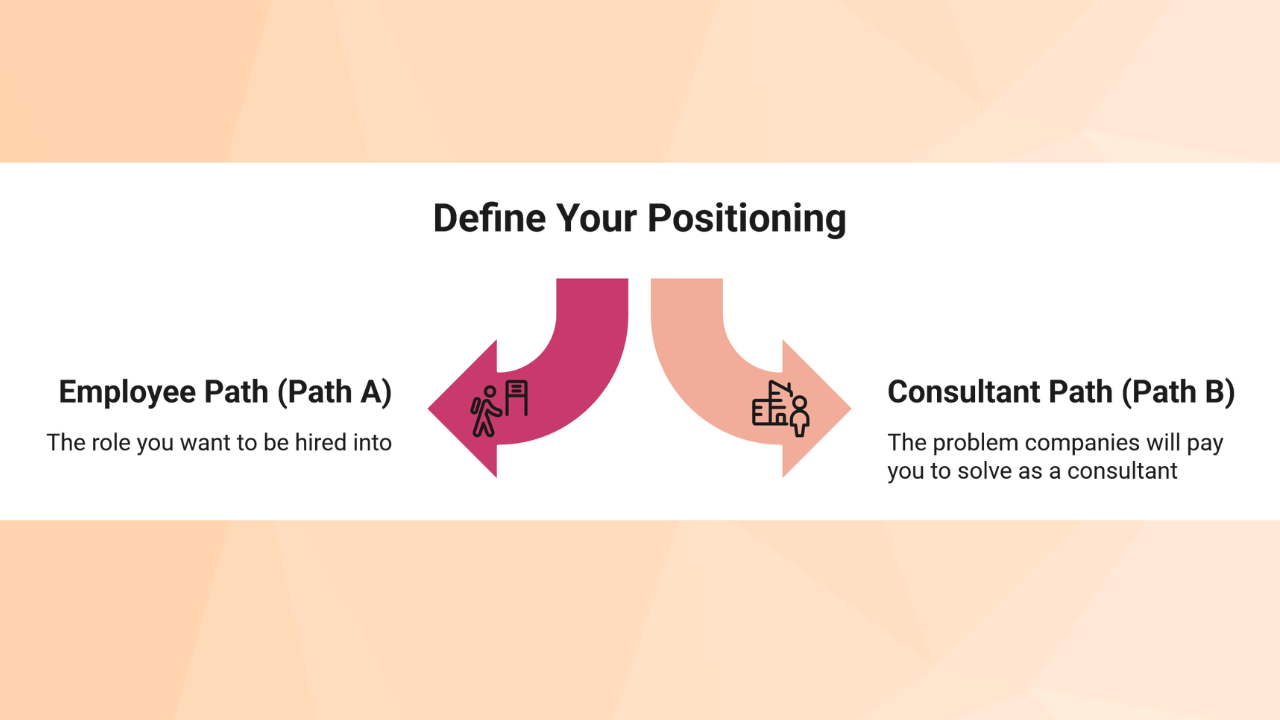
Part 1: Define Your Positioning (Your Foundation)
Before you update anything or announce anything, you need clarity on two things:
- The role you want to be hired into (Path A)
- The problem companies will pay you to solve as a consultant (Path B)
Step 1: Define Your “Hire Me” Role
Answer these questions clearly:
- What exact roles are you targeting?
- What business problems do those roles exist to solve?
Examples:
- “Senior Product Manager in B2B SaaS” → builds and ships products that drive revenue and customer retention.
- “HR Business Partner for scaling companies” → helps leaders navigate growth, performance, and change without burning people out.
Jen’s answer was: Global Onboarding Program Manager for high-growth companies.
Behind that title, she could clearly explain the problems:
- slow ramp times
- inconsistent onboarding
- overwhelmed people teams
- early attrition
Your turn: write down 1–2 titles + 3–5 problems you solve.
This becomes your Path A anchor.
Step 2: Extract Your Consulting Offer
Now ask yourself:
“If a company didn’t hire me full-time… what could they still pay me for?”
You’re not trying to “be a consultant.”
You’re identifying a specific business problem you already know how to solve.
Examples:
- HR: “Improve hiring efficiency and reduce time-to-fill.”
- Marketing: “Increase inbound leads through content strategy.”
- Operations: “Streamline processes to reduce costs and cycle time.”
For Jen, the answer sounded like:
“I design and optimize onboarding programs so new hires ramp faster, stay longer, and feel confident from day one.”
From there, we translated this into concrete outcomes:
- Reduce time-to-productivity
- Improve retention in the first 6–12 months
- Increase manager satisfaction with onboarding
- Improve new-hire survey scores
Ask yourself:
- What outcome do I consistently create?
- How would my best former manager describe the difference I made in their business?
You are not starting over.
You are packaging what you already do in a way companies can buy without needing headcount approval.
Step 3: Create 1–2 Simple Offers
Keep this simple.
You don’t need a complicated business.
Start with:
- One low-barrier audit/assessment
- One project-based engagement
Examples:
- “30-day hiring process audit”
- “6-week LinkedIn content strategy + execution sprint”
- “Onboarding program health check + roadmap”
With Jen, we focused on:
- A concise onboarding audit for growing teams
- A project to design or optimize a global onboarding experience for a specific segment (e.g., new managers, new customer success hires)
Your offers do not need to be perfect or complex.
They need to be:
- Clear
- Specific
- Tied to a business problem someone already feels
Part 2: Build Your Assets (Two Parallel “Sales Systems”)
Once your positioning is clear, you need assets that make both paths work in your favor.
Think of this as building two simple sales systems:
- Path A → helps you get interviews
- Path B → helps you get conversations and projects
Path A: Job Search Assets
Most job seekers know these, but they often under-use them:
- An impact-driven resume with quantifiable achievements where possible (numbers, percentages, ranges).
- A LinkedIn profile optimized for recruiter search (keywords, relevant titles, clear summary).
- A small set of networking message templates so you don’t freeze every time you reach out.
Melissa Grabiner has reviewed thousands of resumes and emphasizes how critical it is to show impact, not just responsibilities, for at least one-third to one-half of your bullets.
In a market where recruiters skim hundreds of applications, those quantitative results are what make you stand out.
Path B: Consulting Assets (The Missing Piece)
This is where most people stop.
And it’s where the biggest opportunity is.
Step 4: Create a Simple Landing Page
This is not about a fancy website.
It’s about clarity.
Your landing page should clearly state:
- Who you help
- What specific problem you solve
- How you help (your 1–2 offers)
- Proof (experience, logos, outcomes, testimonials when you have them)
- A call to action (typically “Book a call”)
For my client Jen, brightstartonboarding.com does exactly this: it tells the story of how she helps growing companies create onboarding that actually works, and gives decision-makers a direct path to talk to her.
Think of this as a “mini website for your expertise.” One page is enough to start.
Step 5: Optimize Your LinkedIn For Both Paths
Your LinkedIn should signal two things at once:
- You are employable for the roles you want
- You are valuable immediately as a partner or consultant
We did this for Jen by:
- Designing LinkedIn banners and carousels that highlight onboarding as her zone of genius.
- Writing an About section that first speaks to her impact in full-time roles, then smoothly transitions into how she helps companies via consulting.
- Using her Featured section to showcase her landing page, lead magnet, and key assets.
A sample headline structure you can adapt:
“Senior HR Leader | Helping companies reduce time-to-hire & new-hire churn | Open to roles & consulting”
The goal is that when a recruiter, hiring manager, or VP of People lands on your profile, they can instantly see:
- “We could hire this person”
- Or: “We could bring them in for a project right now”
Part 3: Your Daily & Weekly Execution System
This is where momentum comes from.
You don’t need 8 hours a day.
You need consistent, focused actions in both paths.
Daily (2–4 Hours Total)
- Networking (Most Important)
Spend meaningful time reaching out real people: - Hiring managers
- Team members in your target functions
- Founders, VPs, and department heads
- Your message is not: “I’m looking for a job; are you hiring?”
Instead, try: “I saw X about your team/company and I’m really interested in how you’re handling Y. I’d love to learn more and hear what’s top-of-mind for you this year.” Melissa’s own career story shows how powerful this can be: she once reached out directly to a CEO on LinkedIn when there was no job posted and ended up with a job offer within two weeks. - Targeted Applications (Not Mass Applying)
Aim for 5–10 high-quality applications per day, max. - Customize your resume and message for roles that genuinely fit
- Always identify at least one person at the company to follow up with on LinkedIn—ideally a decision-maker or future peer
- Remember, the chances of landing a job through your network are far higher than through postings alone.
- Visibility on LinkedIn (Micro-Branding)
Do 1–2 meaningful comments per day: - On target companies’ posts
- On thought leaders in your space
- In relevant groups (these are a hidden gem)
- Melissa notes that much of the “magic” of LinkedIn comes from comments, not posts; her comments often reach tens of thousands of people because they ride on top of others’ audiences. For you, this builds:
- Trust
- Name recognition
- Inbound opportunities from people who discover you through your comments
Weekly
- Publish 1–2 Posts
Topics ideas: - Insights from your field
- Problems you solve and how you think about them
- Lessons learned from past projects or roles
- This supports both:
- Recruiters and hiring managers seeing your expertise in action
- Potential clients discovering you and realizing, “We could use help with exactly this”
- Direct Outreach With a Consulting Twist When you reach out to people at target companies, layer in your consulting angle. Instead of: “I’d love to apply to X role…” Try: “I’ve been thinking about how companies like yours are handling X (e.g., new-hire onboarding in hybrid teams). I specialize in solving this problem. If helpful, I’d be happy to share a few ideas or walk you through how I’d approach it, whether that’s via a full-time role or a project.” This kind of outreach is what opens doors to:
- Conversations
- Projects
- Interviews
- “We’re not ready to hire full-time, but we could use your help as a consultant”
For Jen, we amplified this by launching an automated networking campaign to all of her first-level LinkedIn connections, announcing her new onboarding consultancy and inviting people to reconnect, refer, or explore working together.
She didn’t stop applying. She just stopped relying on applying.
Part 4: Turning Conversations Into Opportunities
This is where the dual strategy really starts to work.
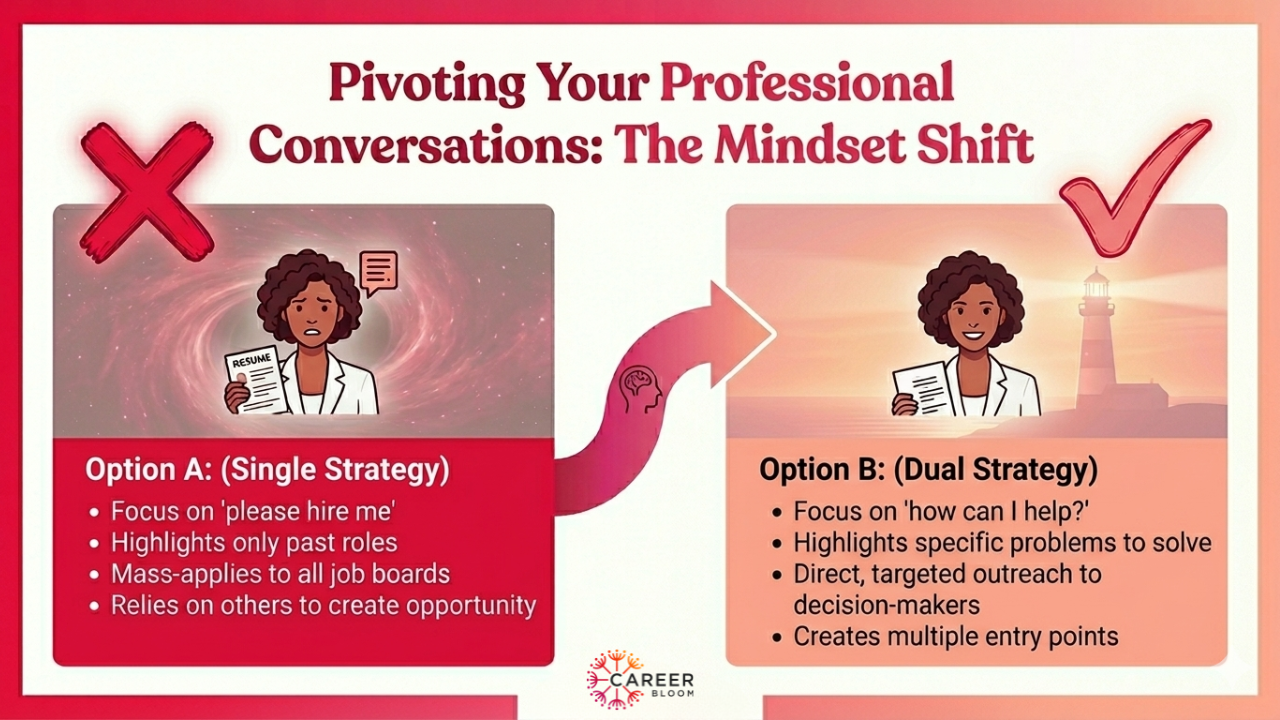
When you shift from “please hire me” to “how can I help?”, every conversation becomes an opportunity.
Imagine you’re speaking with a VP of People or a Director of Marketing at a company you’re interested in. There are three likely scenarios.
Scenario 1: They Are Hiring
Amazing.
Because you’ve been visible, proactive, and clear about your value, you’re already ahead of most applicants.
- You’ve built relationship and trust
- They’ve seen your content or landing page
- You can move directly into a formal process or even a tailored role
Scenario 2: They’re Not Hiring
This is where most people shut down.
Instead, you pivot.
“Totally understand. If helpful, I could support you on a short-term or project basis, especially around X problem. That way you can start seeing progress now without needing full headcount approval.”
This happens more than you think.
One of my clients was in a final interview when the company realized they didn’t actually need a full-time hire. Because she had a consulting offer, they brought her on as a consultant instead.
No full-time role. Still a yes.
Scenario 3: They’re Unsure
This is gold.
You can suggest:
“We could start with a small project or audit to tackle X and see how it goes. If it’s a fit, we can continue as a consultant, or if a full-time role opens up, we already know we work well together.”
Many long-term consulting relationships and contract-to-hire arrangements grow from this “let’s start small” approach.
Part 5: Why This Strategy Works (And Why You’re Not “Doing Too Much”)
If you’re a mid-career or senior professional, you might worry that this is “too much” or that you should just focus on one path.
Let’s reframe that.
- You Create More Entry Points
- Job postings become just one door, not the only door
- Your network, content, consulting offers, and landing page become additional doors
As Melissa shared, many companies now rely heavily on recruiter search, referrals, and direct outreach instead of managing floods of applications.
- You Reduce Dependency
You are no longer entirely dependent on:
- Recruiters opening your application
- Automated systems scanning your resume
- Companies posting roles at the exact moment you’re looking
You stop handing 100% of your power to processes you don’t control.
- You Build Momentum
Momentum is everything in a tough market:
- Conversations → Opportunities
- Small projects → Experience, testimonials, and income
- Income → Confidence and breathing room
Even a few hours of paid work a week can keep your skills fresh, expand your network, and give you proof points that make you more compelling as a full-time candidate.
- You Stand Out Instantly
Most candidates show up with, “Please hire me for this role.”
You show up with, “Here’s the specific way I help companies like yours, and here are two ways we could work together.”
That is completely different positioning.
You’re not asking them to rescue you.
You’re offering to help them solve something painful.
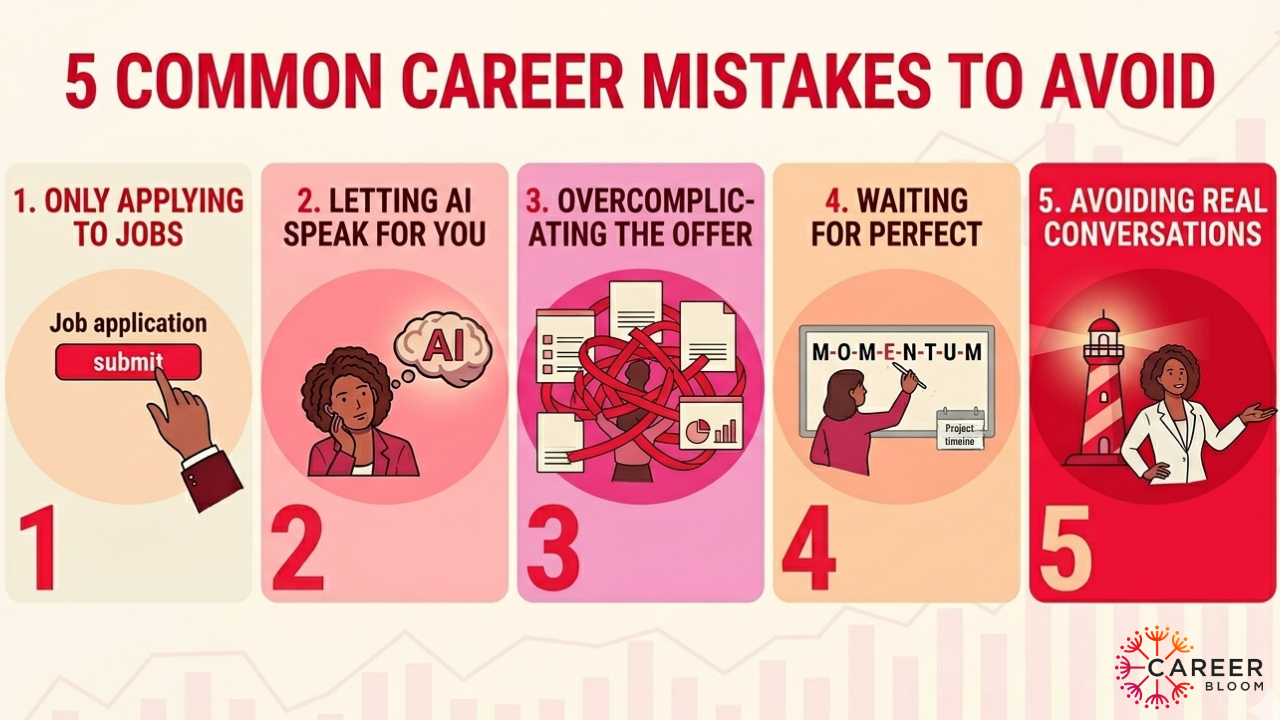
Common Mistakes To Avoid
- Overcomplicating your consulting offer
You do not need a full business. Start with one or two simple, specific ways to help. - Waiting for everything to be “perfect”
A perfect website or perfectly clear messaging is not what gets results. Momentum comes from action. - Only applying to jobs
If your entire strategy is submitting applications, you are relying on the most competitive path. - Letting AI speak for you
Use it to think, not to replace your voice. People connect with people. - Avoiding real conversations
This is the biggest one. You can have everything else right, but if you are not talking to people, nothing moves. Conversations are what create opportunities.
What Success Can Look Like (In 2–8 Weeks)
Every person and situation is different, but inside a dual strategy, these are realistic signs of progress.
Within 2–4 weeks, you could see:
- More conversations with hiring managers, peers, and decision-makers
- Warmer responses from your outreach (because your message is about value, not desperation)
- Increased visibility on LinkedIn as you comment and post consistently
- Early interest in your consulting offer, even if it’s just “This is interesting—let’s stay in touch”
Within 4–8 weeks, you may see:
- First interviews for roles that actually fit
- Short-term projects, audits, or pilots as a consultant
- Or both running in parallel
For example, one of Melissa’s clients, an executive who had been laid off from Microsoft, landed two clients within about a week of shifting into a consulting approach, while still continuing his job search.
This is what happens when you stop waiting to be chosen and start showing companies how you can help them right now.
Final Coaching Advice (From Me To You)
If we were on a coaching call and you asked me, “What’s the one sentence you want me to remember from this blog?” it would be this:
Stop waiting for someone to give you a job. Start showing companies how you can help them right now.
You are not starting over.
You are building a second path on top of everything you’ve already done.
Your experience is still valid.
Your skills are still valuable.
The market is harder, but you are also more resourceful, more seasoned, and more capable than you might feel today.
You can absolutely run a dual career strategy:
- Define your “hire me” role
- Extract a focused consulting offer
- Build simple assets for both paths
- Show up consistently in conversations and on LinkedIn
- Turn every interaction into a chance for either a role or a project
That is the job search strategy that doubles your chances of getting hired without applying to more jobs.
And yes, you can do that, too.
About Career Coach & Author
Theresa White, Career Clarity Expert, 5x Certified Career Coach, and the Founder of Career Bloom, is known for her expertise in guiding people to get unstuck and find the direction they need to move forward in their careers—fast. In a time when so many people are re-evaluating their work, Theresa offers actionable insights that empower clients to identify their true strengths and pursue work that genuinely aligns with their goals.
Theresa’s clients often call her sessions “epiphanies” and “transformational.” She brings immediate clarity to career goals, helping people unlock a deep understanding of what makes work fulfilling for them. Past participants consistently describe her approach as “spot on” and an “answer to questions they’d been asking for weeks.”
Theresa’s approach is empathetic yet practical, and she’s known for empowering clients with a clear direction in as little as 30 days, guaranteeing results.
Connect with Theresa on LinkedIn, listen to the Career Clarity Unlocked Podcast, or schedule your free 30-minute career clarity consultation.

Frequently Asked Questions About Job Search Strategy and Getting Hired in Today’s Market
Is a dual career strategy confusing to recruiters or hiring managers?
Not if your positioning is consistent. When Path A (job) and Path B (consulting) solve the exact same business problem, you aren't seen as "unfocused," you’re seen as a subject matter expert with multiple ways to deliver value.
How do I talk about my consulting work during a full-time job interview?
Position it as "active professional development" that keeps your skills sharp and your industry knowledge current. Most 2026 hiring managers value the entrepreneurial drive and the fact that you haven't let your expertise go stagnant during a transition.
How do I figure out what career move makes sense for me next?
If you’re unsure what direction to take, that’s exactly what I help with. You can book a free career clarity call with me and we’ll map out your next step together.
What Other Job Seekers Are Reading
- What to do when you're feeling stuck in career
- How to Find Your Perfect Career
- 8 progressive companies to work for
- 7 Message Templates to Reach Out to Recruiters
- How to Use AI to Find a Job in 2025: Why Soft Skills Still Matter
- Free Job Search Tracker
- Get Career Clarity In Just 30 Days!
- Take this 60 second quiz to see if a free career clarity call with my team is your next best step.
Subscribe now to never miss the latest blog!
Every Thursday, we cover an important topic, actionable advice, and inspiring content to help you find work that makes you feel like *pinch me* I'm getting paid to do this???
We hate SPAM. We will never sell your information, for any reason.